Manure Pad and Slurry Tank: Sizes, Rules and Grants
The manure pad and the slurry tank keep pens clean and keep manure out of places it should not go. Size them to your herd and storage time, set slopes so liquid drains away, and plan spreading around Poland's nitrate program. Below we cover what to ask for in a design and where to check the rules and funding terms.
verifiedFrom the team that has organised work on poultry farms for years.
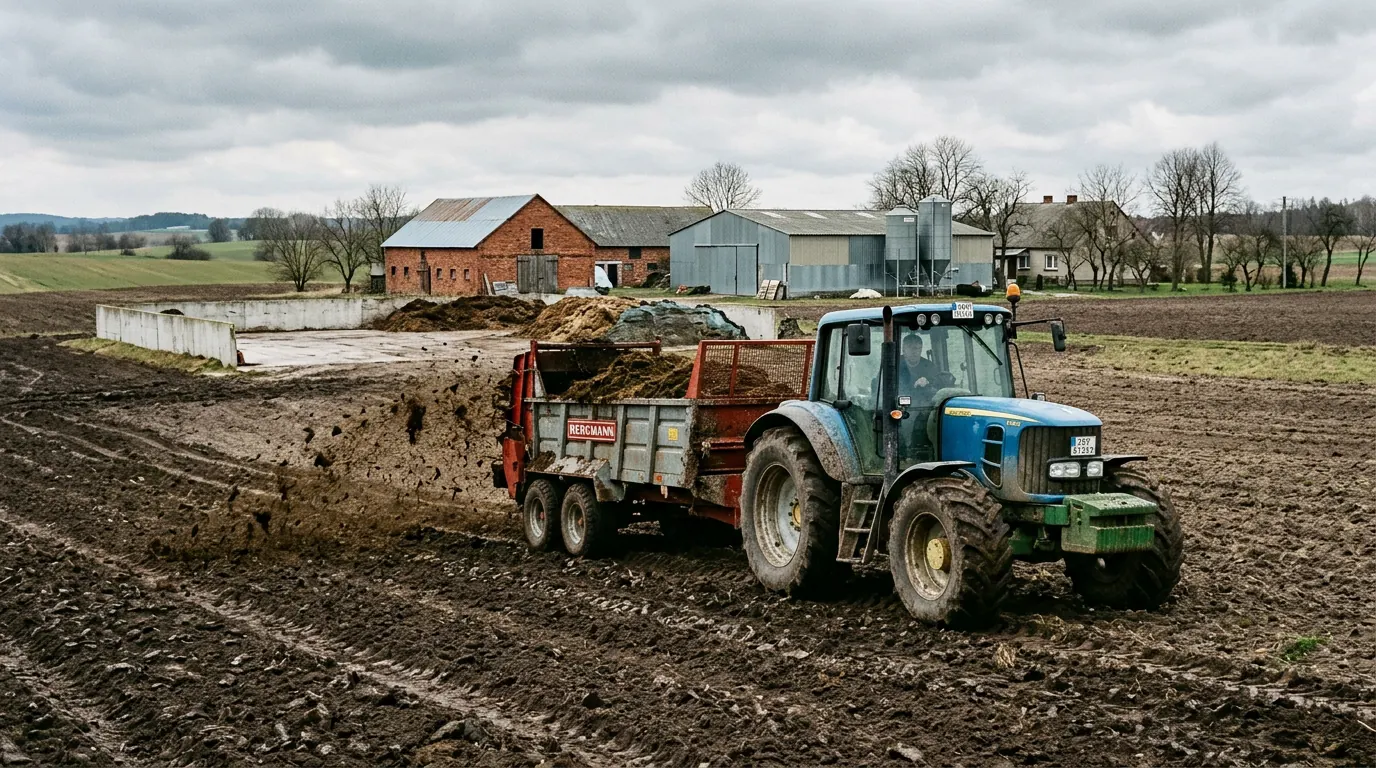
A manure pad is a hard, sloped surface where solid manure and bedding from pens or the barn collect. A slurry tank is a sealed store for liquid waste. It receives runoff from the floor and flow from the channels. Together they form one system: the pad holds solid manure in one place, and the tank collects what drains from it and from the floor. You work out the sizes from the number of animals, the bedding method and how long you must store manure, because spreading dates depend on the fertilizing rules. Review the design with an adviser from an ODR (Poland's agricultural advisory center) or with a designer before you pour concrete. To collect herd data, a farm management program helps.
Where to start planning
First decide how many animals will be in each group and how long they stay on the same bedding. That sets the volume of manure and slurry you must hold between spreading dates. Second, think about access: the pad must be reachable from the farm track, and the tank should sit so a pump or slurry tanker can reach it without maneuvering through a working pen. Third, check the distance to wells, watercourses and homes in the local zoning plan and with the inspector at the county office. Only after these three points do you move on to exact sizes.
Manure pad and tank sizes
A pad that fits your herd
Pad area depends on animal numbers, bedding per head and storage time. For a larger herd, it is easier to estimate the weekly manure mass and multiply it by the number of weeks the manure will sit on the pad. Use your own records: group sizes and last season's straw use. Leave a margin for days when spreading is delayed by weather. Solid manure with straw takes far more room than the droppings alone, so do not size the pad from the manure mass only. Write the results in your herd records so you have a reference point when you expand.
Slurry tank and its capacity
Size the slurry tank from the expected inflow of liquid from the floor, the channels and any wash water. It must hold everything between the dates when spreading on fields is allowed. The longer the period without spreading, the bigger the tank. Leave freeboard so it does not overflow in heavy rain, and do not let rainwater from the hard yard run into it. The tank needs a cleaning access point and space for a pump. Check the level by hand or with a sensor, following the maker's instructions.
Slopes and drainage
Floor slope
The KPODR Minikowo guide to rearing beef calves (KPODR is a regional agricultural advisory center in Poland) recommends a 1:20 slope on concrete floors toward the manure channel. The same principle applies when you design the pad and pens for beef cattle: water and liquid should run one way, not stand on the floor. According to the same source, the channel should lie at least 300 mm inside the feed barrier so animals do not stand in the drains. Check slopes with a spirit level before the concrete is poured, because fixing them later is costly.
Channels and flow to the tank
The same guide says channels should fall at 1:60 and liquid should go to an external storage tank. Channels must not get in the way of mechanical manure removal, so their bottoms and edges should be smooth. Another option is shallow channels in pens, 25–30 mm deep and 100–150 mm wide, which are easy to clean. Before you choose a layout for your barn, discuss it with an adviser, because advice for calves is no substitute for a design for adult cattle.
Tank, spreading and nitrogen limit
Nitrogen limit per hectare
Poland's nitrate program limits the nitrogen applied from natural fertilizers per hectare of farmland. In Teagasc tables (Teagasc is Ireland's agricultural advisory body; this is its beef manual), finishing systems show an organic nitrogen load of 151 to 214 kg N/ha, depending on animal category and system. These figures show the scale of the issue, but they are not a Polish limit. Check the Polish values in the text of the nitrate program rules in ISAP (Poland's online legal database) and with an advisory center. Before you plan the tank, calculate how much nitrogen your herd will produce on your fields, because that limits how much you can spread.
Pasture and natural fertilizers
A pasture fertilized with manure and slurry yields more feed than a neglected one. According to IZ PIB (Poland's Institute of Zootechnics), with good management in suitable weather, about 80% of the herbage can be grazed from the whole yield, against only about 30% on a neglected pasture. So every load of slurry you spread should go where it is needed and within the dates the rules allow. Knowing other fertilizers also helps planning, for example chicken manure, which has a different nutrient content than cattle manure. Spreading dates and paperwork are covered in our guide to manure and slurry documents.
Cleaning, disinfection and location
How often to clean
The KPODR guide for calves recommends fresh bedding in the lying areas every day and cleaning the pens every week. That is for calf rearing, but the principle carries over to other groups: the less often you remove manure, the higher the risk of infection and bad smell. The manure pad should not be a standing place for sick animals or a walkway between groups. Before a new group arrives, clean the pens thoroughly and disinfect with a broad-spectrum product, following the maker's instructions and your vet's advice.
Pad, quarantine and new animals
Teagasc recommends that animals bought in or returning from shows go to a separate isolation facility, generally for a minimum of 28 days, and that it be separate from the rest of the herd even under a shared roof. Do not build the pad or tank so that runoff flows toward that facility. Also plan quarantine dates and any treatment in your records, for example in a treatment and withdrawal period log. Your vet always chooses the medicine and dose.
Rules and support for the investment
Rules on housing conditions
The basic requirements for keeping farm animals are in the Ministry of Agriculture regulation on minimum conditions for keeping farm animal species, consolidated text, Dz.U. 2019 poz. 1966 (Poland's Journal of Laws), with the legal state as of 22.11.2026. The act sets general housing conditions. Check the detailed requirements for pads and tanks in its text in ISAP and with the county veterinary inspectorate (Inspekcja Weterynaryjna). Do not assume the inspector will accept a design just because it looks like your neighbor's.
ARiMR grants
The terms for funding farm infrastructure are set by ARiMR (Poland's Agency for Restructuring and Modernisation of Agriculture) in its announced calls. Amounts and requirements change between calls, so we do not rely on last year's rules. Before you apply, check on gov.pl/web/arimr whether a pad and tank qualify in the current call, and keep the design documents. Herd data and records make the application easier, so keep them from the start, not just when you file.
Frequently asked questions
What size should a manure pad be for cattle?add
There is no single size that fits every barn. It depends on animal numbers, bedding amount and how long manure is stored between spreadings. Work out the manure mass per week, multiply by the storage period and add a margin for weather delays.
What slope should a floor have toward the manure channel?add
The KPODR Minikowo guide for beef calves recommends a 1:20 slope on concrete toward the channel, with channels falling at 1:60 to carry liquid to a tank. The principle is similar for adult cattle, but agree the actual design with an adviser or designer.
Does a slurry tank have to be watertight?add
Yes. The tank must hold liquid without seepage into the soil and water. Check tightness at handover and during use, and report any leaks at once. Check the detailed rules in the regulations and with the inspector.
How often should I clean pens and the manure pad?add
The KPODR guide for calves recommends daily bedding of the lying areas and weekly pen cleaning. Before a new group arrives, the building needs thorough cleaning and disinfection. Adjust the frequency in your barn to animal numbers and bedding condition.
Can I get a grant for a manure pad?add
Funding depends on the current ARiMR call and on meeting its conditions. Do not assume amounts from earlier years. Check announcements at gov.pl/web/arimr before you start, because costs incurred before you apply may not be accepted.
Where can I check the rules on fertilizing and slurry spreading?add
You can find the text of the nitrate program rules in ISAP, Poland's online legal database, at isap.sejm.gov.pl. Check dates and limits in the current version of the act, and ask your county office or agricultural advisory center for practical explanations.
Sources & resources
- linkKPODR Minikowo — Rearing beef calves (guide, SGGW authors)
- linkTeagasc — Teagasc Beef Manual — Section 6: Nutrition
- linkTeagasc (Ireland) — Teagasc Beef Manual — Section 3: Beef Systems
- linkIZ PIB — WZ — Feeding beef cattle in organic farming (K. Bilik et al.)
- linkMinistry of Agriculture / Journal of Laws — Regulation on minimum conditions for keeping farm animal species — consolidated text (Dz.U. 2019 poz. 1966)
- linkInternetowy System Aktów Prawnych (Poland's online legal database) — isap.sejm.gov.pl
Prepared by: DlaFerm Team based on data from the sources listed · Publisher: INSTA-TECH sp. z o.o.
Want herd numbers and manure volumes in one place?
The DlaFerm farm management program helps you keep herd records and the data you need to plan a pad and tank. Create a free farm account and see how it works in practice, or get in touch and we will show you a setup for your barn.
Phone
+48 796 258 151