Dead-in-shell eggs and chick sex: hatch results linked to the breeder flock, camera in research
An egg with a dead embryo takes up space in the incubator until the end of incubation, and the hatch result rarely goes back to the breeder flock. We offer one system for breeder flocks and hatch results, and we research and implement camera-based assessment of embryos and chick sex. We build on studies that identified dead embryos from an ordinary photo and chick sex from the look of the head.
verifiedFrom the team that has organised work on poultry farms for years.
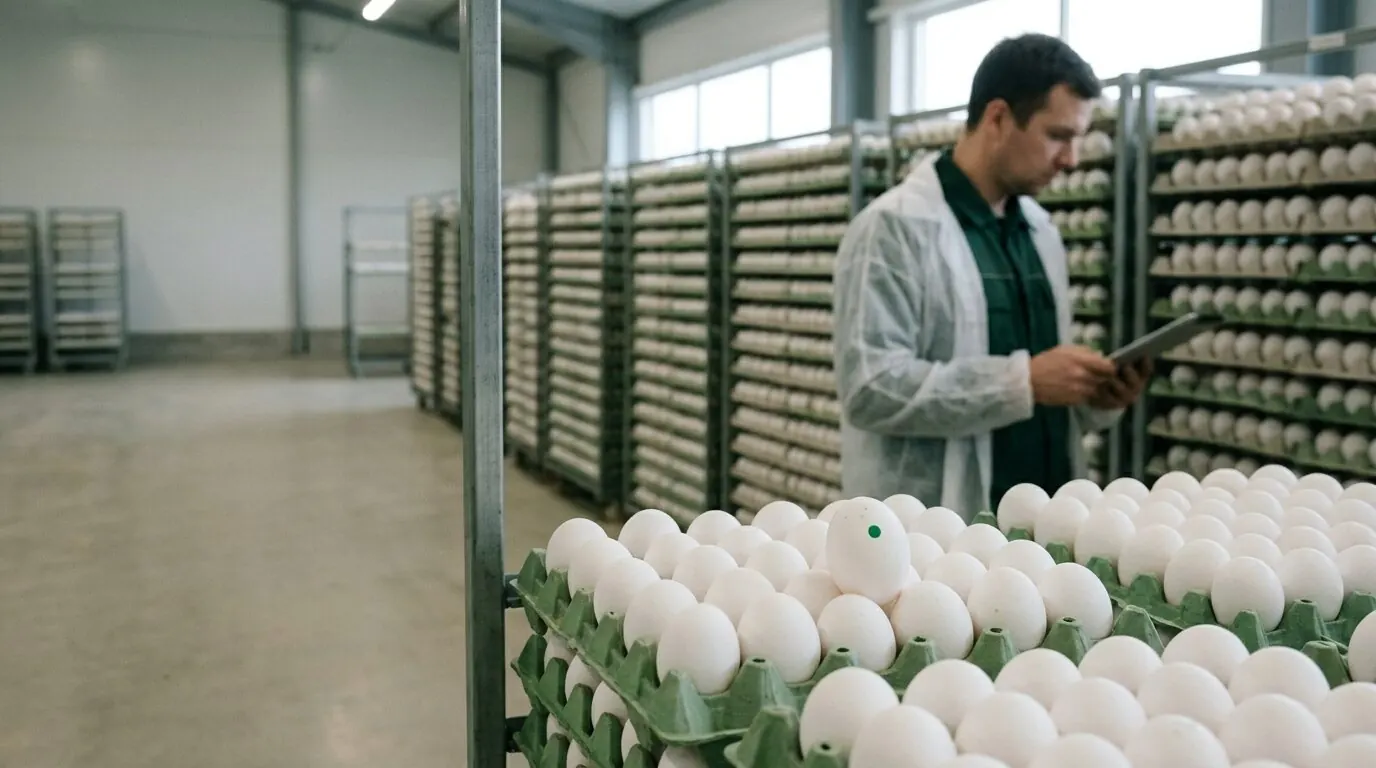
A dead embryo takes up space to the end
Every egg with a dead embryo that stays in the incubator until the end of incubation takes up space, uses energy and can become a source of contamination for the whole batch. The sooner you remove it, the better. Manual candling is labor-intensive, and hyperspectral cameras, which work well for egg assessment, are expensive and hard to operate.
The hatch result gets lost on the way
The share of infertile and dead-in-shell eggs only means something when you know which breeder flock and which delivery the eggs came from. When results sit in a separate spreadsheet, it is hard to connect a poor hatch with drugs or disease in the flock. Chick sex is similar: vent sexing needs trained people and extra handling of every chick. We cover sexing before hatching in our article on determining sex in the egg.
How we solve it
1. Breeder flock in the flock record
You keep breeder flocks in the same digital flock record as commercial farms, with entries, medicines, withdrawal periods and samples. This works today.
2. Hatch results recorded in the system
You can record hatch results in DlaFerm today. You enter the results of a manual breakout analysis in the system, and our guide to hatch breakout analysis explains how to do it.
3. Hatchery module: batches, calendar, orders
We are researching the handling of set batches, the hatch calendar, hatchability and chick orders from farms, and we are implementing it together with the first hatcheries. The hatchery module is described on the hatchery software page.
4. Embryo and sex assessment from a camera
We research assessing embryos and chick sex from images, and we implement linking such results to the egg batch, the breeder flock and the receiving farm. The hatchery decides whether to discard eggs and how to sex chicks.
What the research says
An ordinary camera almost matches a hyperspectral one
Ahmed and colleagues (2024), in a paper in Smart Agricultural Technology, photographed eggs in early incubation with an ordinary color camera, then reconstructed a hyperspectral image from those photos, that is, they predicted how the egg would look in many light bands. From the reconstructed spectra, the model told dead-embryo eggs apart on day 3 of incubation with an accuracy of about 81%, against 83–85% from a real hyperspectral camera. The gap is small. So the expensive camera may be needed only to collect training data, and in daily work an ordinary camera over the candling table is enough.
With rare cases, what matters is how many dead embryos the model finds
The dataset in that paper had 102 eggs, only 9 of them with a dead embryo. A model that called every egg alive would formally score over 90% accuracy and find no dead embryo at all. So when we judge such a system, we look not only at overall accuracy but also at the share of dead embryos found and the number of live eggs rejected by mistake. That needs hatch results recorded per batch, which is where we start.
Chick sex can be judged from the look of the head
Veganzones Rodriguez and colleagues (2024) took an idea known from sex recognition in human face photos and applied it to chicks. The analysis covered 353 day-old chicks of known sex from a commercial hatchery (184 females and 169 males). Each was filmed with three cameras in a darkened box, giving 5727 frames. The best model reached 81.98% accuracy and an AUC of 0.895. The split into training and test sets was made by chick, not by frame. The authors suggest a camera in the vaccination machine for day-old chicks, which holds the chick by the head anyway.
Selling single-sex flocks takes more
An accuracy of about 82% means roughly one chick in five would get the wrong sex. For a hatchery selling single-sex flocks, that is too much. According to the same paper, traditional methods give high accuracy, but feather sexing works only in selected breeds, and vent sexing needs experts. So we treat sex from images as a research direction, not a feature for today.
What the hatchery and the farm gain
A poor hatch linked to the flock
A hatch result recorded against the batch and the breeder flock lets you compare it with medicines, diseases and samples in that flock. The cause is easier to find when everything is in one place.
Breeder flock records without a binder
Entries, medicines, withdrawal periods and samples for the breeder flock are in the flock record. For an inspection or a talk with the chick buyer, the data is ready.
Data ready for a camera
Hatch results from many batches are the material on which you can test any automatic method before you start to trust it.
Let's talk about your hatchery
Do you run a hatchery or a breeder flock? Book a demo through the contact form at the bottom of the page. We describe embryo development day by day in our article on embryo development in the egg.
Frequently asked questions
What hatchery functions work in DlaFerm today?add
You keep breeder flocks in the flock record, with entries, medicines, withdrawal periods and samples, and you record hatch results in the system. We are researching the full hatchery module, with set batches, a hatch calendar and chick orders, and implementing it with the first hatcheries.
What equipment do I need?add
A phone or computer is enough to record flocks and hatches. Camera-based embryo assessment would need a camera over the candling table or over the belt, and it is the subject of our research.
How much work does setup take?add
A wizard guides you through the farm description and the first flock. You can enter a flock from a photo of a document, a PDF or a spreadsheet. We describe the steps on the page about how we implement.
What if there is no signal in the building?add
The farmer app works offline. Entries send themselves when the phone gets a signal.
Can an ordinary camera detect a dead embryo?add
In a laboratory study, color camera photos converted into a reconstructed hyperspectral image told dead-embryo eggs apart on day 3 of incubation with an accuracy of about 81%. The dataset had only 102 eggs, though, 9 of them with a dead embryo.
Can chick sex be recognized from the look of the head?add
A study on 353 day-old chicks gave 81.98% accuracy. That is too low for practical use in a hatchery, and the method was tested on recordings in a darkened box, without line speed.
How do you know a camera can support candling?add
In the embryo paper, the result from an ordinary camera after spectrum reconstruction (about 81%) was close to the result from a real hyperspectral camera (83–85%). The best image reconstruction method reached an RMSE of 0.0159. That is evidence that cheaper equipment may be enough, but before rollout each hatchery would have to compare the camera with manual candling on its own batches.
Sources & resources
- linkAhmed M.T., Ahmed M.W., Monjur O., Emmert J.L., Chowdhary G., Kamruzzaman M. (2024). Hyperspectral Image Reconstruction for Predicting Chick Embryo Mortality Towards Advancing Egg and Hatchery Industry. arXiv:2405.13843 (also Smart Agricultural Technology 9, 2024)
- linkVeganzones Rodriguez M., Phan T., Fernandes A.F.A., Breen V., Arango J., Kidd M.T., Le N. (2024). Facial Chick Sexing: An Automated Chick Sexing System From Chick Facial Image. arXiv:2410.09155
Prepared by: DlaFerm Team based on data from the sources listed · Publisher: INSTA-TECH sp. z o.o.
Let's talk about your breeder flock and hatch results
Want to link hatch results to the breeder flock and the egg batch? Get in touch, and we will show you the breeder flock record and hatch records in DlaFerm. You can also create a free farm account and try the <a href="/program-do-zarzadzania-ferma-drobiu">farm management program</a>.
Phone
+48 796 258 151