Abnormal droppings in the poultry house: from photo to vet sample
Staff see changes in droppings on every walk-through, but judging by eye depends on experience, and the lab result arrives later. We record mortality, tasks and treatment for each flock, and we are researching and rolling out a hint based on a photo of the droppings. It builds on studies that showed what a model can recognize from a photo.
verifiedFrom the team that has organised work on poultry farms for years.
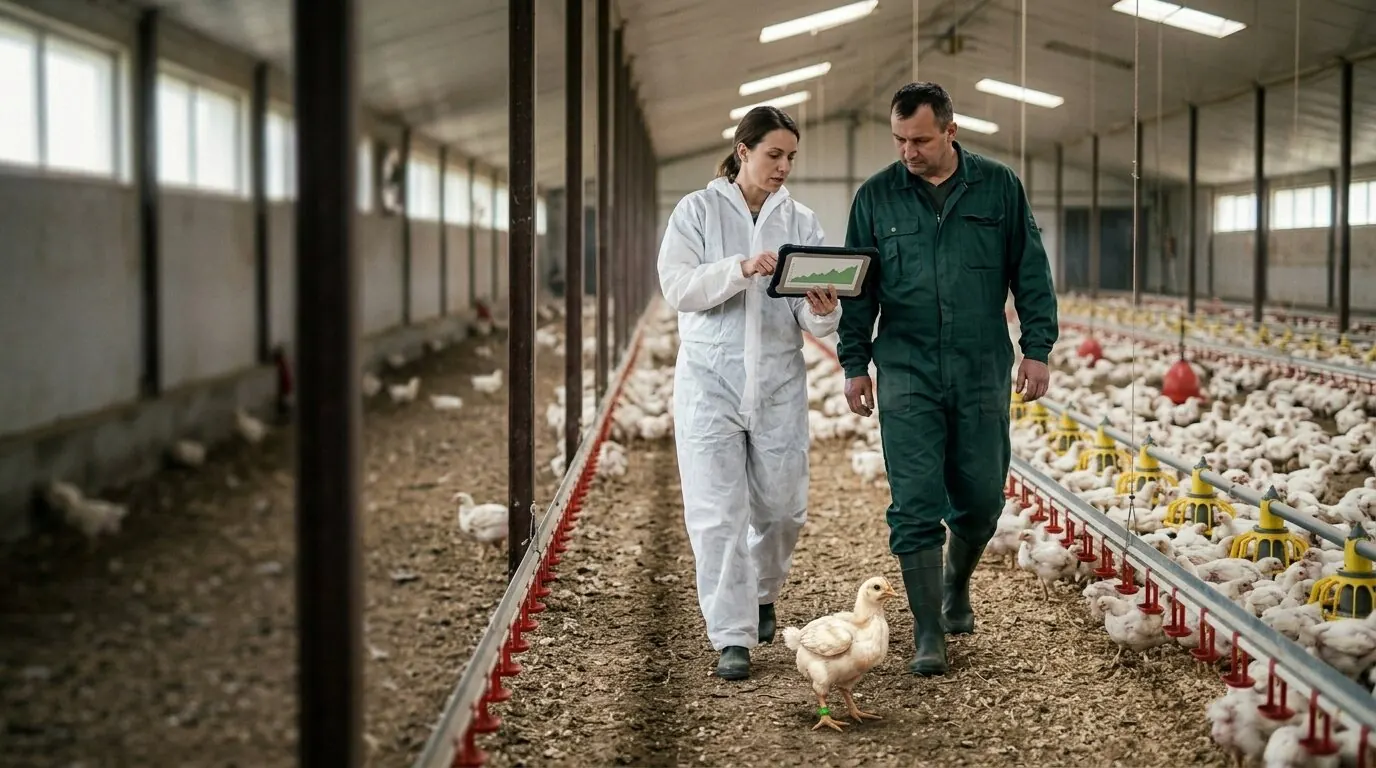
You see droppings every day, the result comes days later
A change in droppings is one of the first signs of gut problems: bloody with coccidiosis, watery, greenish. Staff see them on every walk-through, but judging by eye depends on experience. One person notices, another walks past. And what they notice often stays in their head instead of going into the flock record.
Every day of delay means more sick birds
Lab confirmation comes later, and the pressure to cut antibiotic use calls for a fast, accurate diagnosis. The later someone takes a sample, the later the vet can choose treatment. For a general description of signs, see the table of poultry disease symptoms.
How we solve it
1. Walk-through and mortality recorded per flock (works now)
Staff record mortality for the flock, and you assign them tasks in the app. Entries also work without signal in the house and are sent once the phone gets a network.
2. Droppings photo and hint (we are researching and rolling out)
We are researching a hint based on a photo of the droppings and rolling it out on farms. A worker takes the photo with a phone during the walk-through. We plan for the photo never to leave the farm, with the model learning across many farms at once.
3. Signal: take a sample and call the vet
The photo result is a signal, not a diagnosis. Coccidiosis, salmonellosis and Newcastle disease need different handling, and Newcastle disease is a notifiable disease that the authorities control. We describe the signs in our articles on coccidiosis in broilers and Salmonella on a poultry farm.
4. Flock history at hand for your vet (works now)
You keep treatments and withdrawal periods in the records, so when disease is suspected your vet sees mortality, earlier treatments and the course of the flock. More in the article on treatment records and withdrawal periods.
What the research says
A droppings photo can tell diseases apart
Islam's team (2025) used 8067 droppings photos in four classes: coccidiosis, salmonellosis, Newcastle disease and healthy. A simple model based on color and texture features recognized them with 95.85% accuracy, almost as well as the large Xception network (96.45%), and trained in 638 seconds without a graphics card. Newcastle disease was recognized worst, with a recall of 0.85, which confirms that the result must go to a vet.
One shared model for many farms, without sending photos
Chi (2026) cleaned public droppings image sets of duplicates, which made up 46.89%. On 8770 unique images he tested federated learning: each farm trains the model on its own photos and sends only the model changes. A model from a single farm reached 64.86%, and the shared federated model 90.31%, close to 95.10% when data is pooled in one place.
Droppings say more than the look of the bird
Sabbella's team (2025) trained a YOLOv8 detector to recognize disease from photos of the birds themselves. Overall precision was 0.693, and for Newcastle disease recall was only 0.598. That is why we start with droppings photos.
An AI camera works in a production house
Tong's team (2024) mounted four small cameras with an AI processor in the sensor on a feed cart in a caged house and photographed over 2700 hens for five months. Healthy and sick hens were told apart with an mAP of 95.1%, and the camera sent only a few bytes of result instead of an image. Chen's team (2024) showed on cattle data that choosing devices in federated learning cuts energy use by 10%. We cover robots in the house in robots in the poultry house: what they can do now.
What the farm gains
Faster sample, faster treatment
The photo hint is meant to shorten the path from the walk-through to the phone call to your vet.
Less dependence on one person's experience
Any worker can take a photo and record an observation, and you see it with the flock.
Complete treatment documentation
Mortality, treatment and withdrawal periods are in the records. For inspections and at pickup, you have entries for the whole cycle.
We will show it on your flock
We are glad to show our research results on data from your flock. Just write to us through the form at the bottom of the page.
Frequently asked questions
How does droppings photo analysis work?add
Staff record mortality and observations in the app, and you keep treatment in the records. We are researching and rolling out a hint from a droppings photo: a photo taken with a phone during the walk-through signals whether a sample is worth taking.
What equipment do I need?add
A phone with a camera and the app. You need no cameras or computer in the house.
How much work is setup?add
You can go through the account and farm wizard in one afternoon. A droppings photo takes a few seconds during a walk-through you do anyway.
What if there is no signal in the poultry house?add
You make entries offline, and the app sends them when the phone gets a signal.
Will a photo replace the vet or the lab?add
No. The photo is a signal to take a sample. A vet makes the diagnosis based on testing. Newcastle disease is notifiable and controlled by the authorities, so every hour counts if you suspect it.
Will my photos go to other farms?add
We plan federated learning: the photo stays on your farm, and only model changes go to the shared model.
What data do you collect?add
Mortality, observations, tasks, treatment records with withdrawal periods and, for the hint, droppings photos.
How do you know a droppings photo tells you anything?add
On 8067 photos a simple model told coccidiosis, salmonellosis, Newcastle disease and healthy droppings apart with 95.85% accuracy (Islam's team, 2025). A shared model across many farms reached 90.31% against 64.86% for a single-farm model (Chi, 2026). In a production house an AI camera told healthy and sick hens apart with an mAP of 95.1% (Tong's team, 2024).
Sources & resources
- linkChi T.-Y. (2026). FecalFed: Privacy-Preserving Poultry Disease Detection via Federated Learning. arXiv:2604.00559
- linkIslam A.K.M.S., Hassan M.R., Uddin M., Rahman M.S. (2025). Lightweight Model for Poultry Disease Detection from Fecal Images Using Multi-Color Space Feature Optimization and Machine Learning. arXiv:2507.10056
- linkSabbella A.S.R., Prachothan Ch.L., Panta E.K. (2025). YOLOv8-Based Deep Learning Model for Automated Poultry Disease Detection and Health Monitoring. arXiv:2508.04658
- linkTong Q., Wang J., Yang W. et al. (2024). Edge AI-Enabled Chicken Health Detection Based on Enhanced FCOS-Lite and Knowledge Distillation. arXiv:2407.09562
- linkChen D., Yang P., Chen I.-R., Ha D.S., Cho J.-H. (2024). SusFL: Energy-Aware Federated Learning-based Monitoring for Sustainable Smart Farms. arXiv:2402.10280
Prepared by: DlaFerm Team based on data from the sources listed · Publisher: INSTA-TECH sp. z o.o.
From walk-through to vet decision, faster
We will show you how mortality, tasks and treatment records work in the <a href="/program-do-zarzadzania-ferma-drobiu">farm management app</a>, and how we are rolling out the droppings photo hint. Create a free farm account or get in touch.
Phone
+48 796 258 151