Will cattle prices rise? Beef cattle price outlook
Beef cattle prices depend on the number of cows in the country, imports, feed prices and herd health. When you pick a selling date, look at quotes from several weeks, not from a single day. Below we describe the price drivers and where to check the data. We update this page every month.
verifiedFrom the team that has organised work on poultry farms for years.
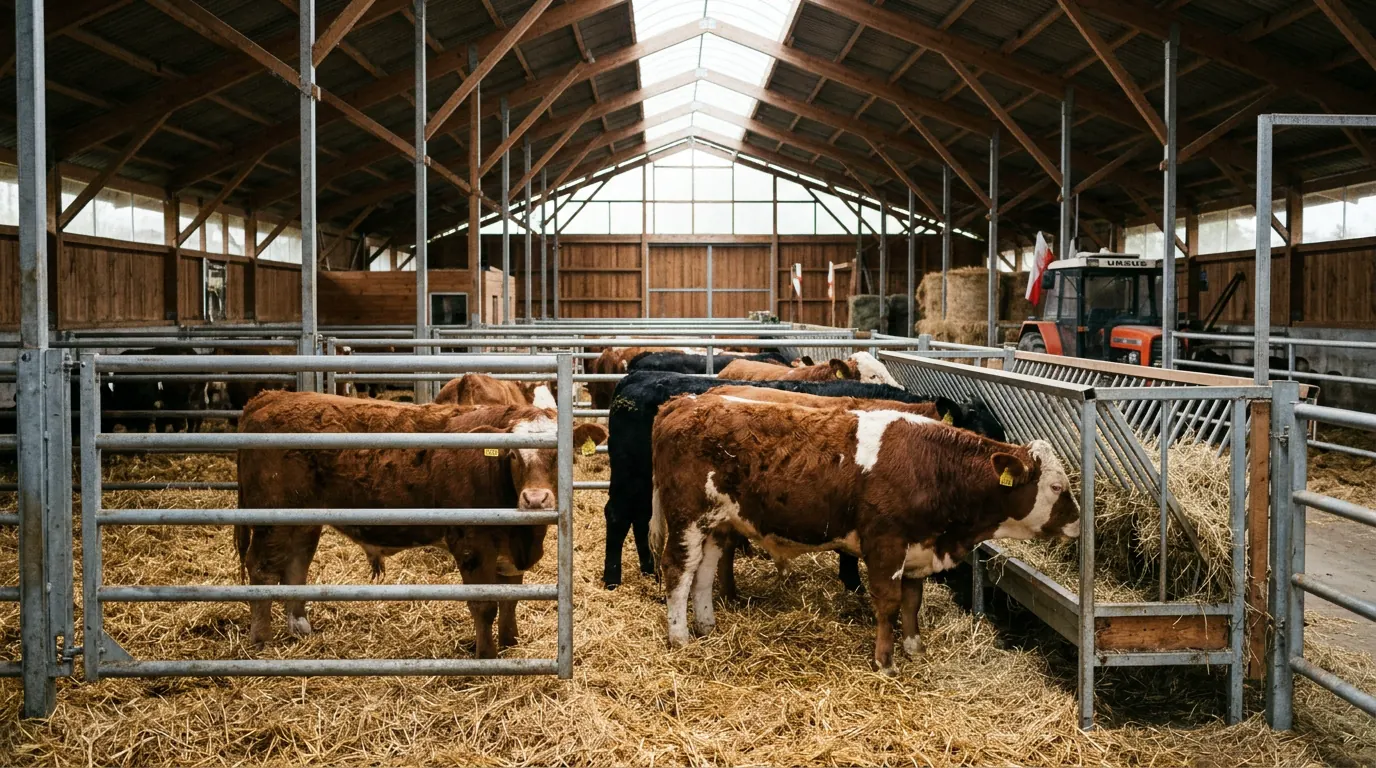
Will cattle prices rise? It depends on whether the supply of beef cattle in Poland falls faster than demand from slaughterhouses and exporters. Prices react to changes in herd size with a delay, because a calf needs many months before it goes to slaughter. So an outlook only makes sense when it combines data on herds, the market and costs. We give no amounts here, because quotes change every week. You will find the current value in the official report.
Why an outlook starts with the herds
In Poland, beef cows are a small part of the herd. According to IZ PIB (the Institute of Animal Production, National Research Institute), beef cows make up about 1% of all cows. So national beef supply rests largely on rearing calves from other production types. A change in the number of beef cows affects the market after several years, but the signals show earlier: in the prices of breeding stock and in decisions to keep heifers. You can work out whether your own rearing pays in the cost per 1 kg of live weight calculator.
How to read cattle price quotes
What the Ministry excludes from calculations
The methodology for recording beef and veal market data (from Poland's Ministry of Agriculture and Rural Development, MRiRW, and its ZSRIR market reporting system) says which carcasses are left out when purchase prices are calculated. These include carcasses from cattle bought in lots and paid at a fixed rate, carcasses from cattle under 300 kg live weight (under 150 kg warm carcass weight), carcasses from sanitary slaughter, and carcasses with a vet's condemnation where the cost was charged to the supplier. Software that calculates prices should skip these carcasses automatically. So compare your price with the quote for a similar weight category.
Live weight and carcass weight
The duty to report prices covers cattle paid by carcass weight and cattle paid by live weight. How the slaughterhouse and the supplier settle up does not change this duty. When you sell, check whether the contract pays by live weight or carcass weight, and what dressing percentage it assumes. A difference in dressing percentage can change your result more than a small move in the quote.
Where to check the data
The Ministry of Agriculture and Rural Development publishes the official information, and you can find the legislation in ISAP, Poland's online legal acts system. The Institute of Animal Production (IZ PIB) prepares analyses of production and profitability, and agricultural advisory centers publish practical calculations. To compare your own sales, you need weight and dressing records for each lot. Without them it is hard to tell whether a quote applies to your cattle.
What can push beef cattle prices up or down
Supply and the herd cycle
Live cattle prices depend a lot on how many animals go to slaughter. According to IZ PIB (Grodzki et al., 2015), total beef production in Poland reached 1,428,000 t in 1990. When farmers cut herds, supply falls with a delay and prices may rise. When herds grow, the surplus usually presses on quotes. This cycle repeats, so we base our analysis on several years of data.
Exports and demand
According to IZ PIB, Poland ranks seventh in the European Union for beef production. So the decisions of slaughterhouses that export meat, and the situation on foreign markets, affect the price. The authors of a 2018 review note rising profitability of beef production, visible in the prices of breeding stock and slaughter cattle. Check whether slaughterhouses in your region are taking more animals or fewer.
Feed costs
Feed is the largest cost of rearing. When feed prices rise, the farmer expects a higher cattle price, but the market does not always pay the difference. Different finishing intensities give different results. ODR Lubań (a regional agricultural advisory center) published a sample income calculation for beef production at several intensity levels. Record feed prices with the date so you can compare changes over time.
Herd health
Infectious diseases can quickly cut supply and change trading decisions. One example is lumpy skin disease (LSD), described in a leaflet from PODR Szepietowo (another regional advisory center). Quarantine and restrictions are ordered by the county veterinarian, and their effect on prices can be hard to predict. A vet always chooses the treatment. Record the medicines given and their withdrawal periods, because without them you cannot sell animals in line with the rules. Keep these records in the treatment and withdrawal module.
What to do before you sell cattle
Work out the cost of further rearing
Before you decide whether to sell now or rear longer, compare the cost of each extra day with the possible gain in price. Longer rearing means feed, labor and disease risk. When daily gains fall, longer rearing stops paying, even if quotes are rising. Record weight, date and feed use, then compare the result with your calculation.
Plan your sales lots
It pays to arrange sales in lots that fit your rearing plan and the slaughterhouse's intake dates. Stocking and cycle planning helps you set the dates, and a farm management program keeps lot data in one place.
Rely on records, not memory
An outlook is useful when you compare it with your own numbers: weight, dressing percentage, feed cost and the result of each lot. Good records also let you quickly show what was given to the animals and when, if a buyer or an inspector asks.
Cattle prices in November 2026
What we know as of 22 Nov 2026
This page reflects the situation as of 22 Nov 2026. We give no amounts, because live cattle quotes change every week and any number goes out of date fast. We describe the directions: supply, export demand, feed costs and herd health. In each monthly update we check the same factors, so the results can be compared.
How to use the outlook
Before you decide, take the latest official quote, adjust it to your weight category and compare it with the cost of further rearing. If the difference does not cover feed and labor, selling now may be the better choice. When gains are good and the market is rising, longer rearing may pay. The decision depends on your numbers.
Breeds, rearing and transport and the value of animals
Choosing a breed
Breed choice affects gains and dressing percentage. The Teagasc Beef Manual covers beef production systems (Section 3) and feeding of suckler cows (Section 6). Before you change breed, compare results from your own lots, not from catalog descriptions.
Welfare during transport
The rules on minimum standards for protecting calves come from Council Directive 2008/119/EC. Poor conditions during transport lower the value of animals and raise the risk of losses. Follow the requirements in force in Poland and check the current legal status in ISAP, because rules can change.
Frequently asked questions
Will cattle prices rise in 2026?add
The answer depends on supply, export demand and feed costs. The outlook rests on directions, not on a guaranteed price. We update it every month and give no specific amounts.
Where can I check cattle prices in November 2026?add
The Ministry of Agriculture and Rural Development publishes the official quotes. You can find the methodology for recording market data in the ministry's documents. Quotes change every week, so always check the latest report.
What determines beef cattle prices?add
The most important factors are the number of cattle going to slaughter, slaughterhouse and export demand, feed prices and herd health. In the short term, trade restrictions ordered by the Veterinary Inspection (Inspekcja Weterynaryjna) also matter.
Is the price quote an average of all deals?add
No. The methodology excludes carcasses from light cattle under 300 kg live weight, carcasses from sanitary slaughter and some carcasses with condemnations. Compare your price with the quote for a similar weight category.
Does lumpy skin disease (LSD) affect cattle prices?add
Lumpy skin disease can limit trade and animal movements, which affects supply. How big the effect is depends on the inspection's decisions. Your vet and the Chief Veterinary Inspectorate (Główny Inspektorat Weterynarii) give information on protecting your herd.
Should I sell cattle now or later?add
Compare the cost of further rearing with the possible rise in price. Take into account gains, feed use and disease risk. Without records of weight and costs you cannot work this out reliably.
Sources & resources
- linkMRiRW (ZSRIR) — Methodology for recording market data on beef and veal
- linkIZ PIB — WZ — Current state and prospects of beef cattle rearing and breeding in Poland (H. Grodzki et al.), WZ LIII(2015)2:77–87
- linkIZ PIB — WZ — New methods of assessing the performance and breeding value of beef breeds (Z. Choroszy et al.), WZ LVI(2018)3:17–23
- linkODR Lubań (PODR publication) — Sample farm income calculation for beef production (different intensity levels)
- linkPODR Szepietowo — Lumpy skin disease (LSD) — leaflet (Z. Marciniak)
- linkTeagasc (Ireland) — Teagasc Beef Manual — Section 3: Beef Systems
Prepared by: DlaFerm Team based on data from the sources listed · Publisher: INSTA-TECH sp. z o.o.
Working out whether your beef herd pays?
The DlaFerm.pl farm management program keeps lot, feed and result data in one place. Create a free farm account in DlaFerm.pl or get in touch, and we will show you how to set it up.
Phone
+48 796 258 151