Egg prices: what sets the price of eggs at the packing station and in the shop
Egg prices change every week, so we give no Polish amounts in this guide. We show what drives the price at the packing station and in the shop, how to read European Commission quotes, and how to turn a price per mendel into a price per egg.
verifiedFrom the team that has organised work on poultry farms for years.
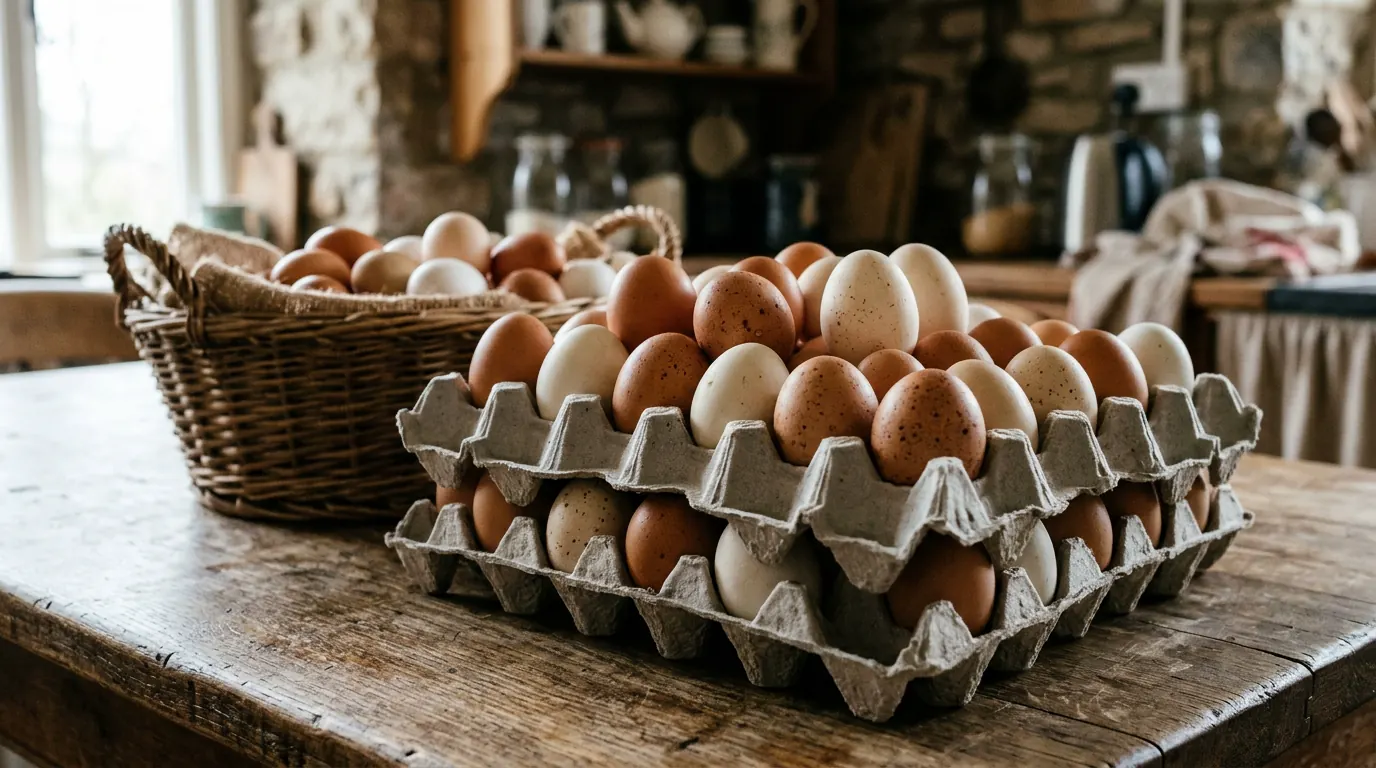
The price of eggs is not fixed, and there is no single figure for the whole country. Eggs are priced one way at the packing station (the buyer that sorts and packs them), another way in the shop, and another way when you sell from the farm. The price depends on quality class, egg weight, rearing method, season and the overall state of the European Union market. Exact zloty amounts move so fast that they would be out of date within a week, so check them in current quotes.
What one egg costs and what a mendel costs
Keepers ask two things most often: what one egg costs and what a mendel costs. The mendel (15 eggs) is the traditional Polish measure for selling eggs. You get the price of one egg by dividing the price of the mendel by the number of eggs in it. Below we explain where the price comes from, what the rearing method does to it, and where to find current data. If you are planning your own flock, start with Laying hens: where to start, what they cost, which breed is best.
Egg quotes in the European Union
Class A egg prices at packing stations
EU member states send weekly egg prices to the European Commission, and its Directorate-General for Agriculture (DG AGRI) collects them in an egg market dashboard. According to the dashboard, updated on 20.11.2026, the average EU price of class A eggs at packing stations was 242.36 € per 100 kg. The price fell 1.4% against the previous week, 2.3% against the previous month and 16.2% year on year. Note the unit: the price is given per 100 kg of eggs, not per egg.
How the price compares with other countries
The same dashboard compares the EU price with Chicago (USA), Brazil and India. The values in €/100 kg are: EU 242.36, USA 128.26, Brazil 113.53, India 101.4. These gaps show why egg imports from non-EU countries are limited. According to the European Commission, eggs from outside the Union are subject to customs duties and import quotas, and table eggs must also meet EU marketing standards.
What sets the price of eggs
Quality class and egg weight
EU marketing standards set how eggs are sorted by quality and weight. That is why quotes cover class A eggs, and the price per kilogram rises or falls with the kind of eggs in the batch. Eggs are worth more commercially when they have been sorted and marked correctly. We describe the marking rules in Marking of hen eggs. For sorting equipment, see our page on egg sorters.
Rearing method: cage, barn, free range, organic
The European Commission publishes separate price charts for class A eggs from four systems: cage, barn, free-range and organic. The prices differ because the cost of producing an egg depends on the system. For you, the choice of method comes before buying hens and equipping the house. For an overview of equipment, see Laying farm equipment: nests, perches, egg collection.
Costs you carry yourself
The egg price has to cover feed, chicks or hens, treatment, litter, labor and energy. Add vaccination, described in our guide to poultry vaccines (types and price), plus egg collection and storage. Whenever feed prices change or egg prices drop, work out what one egg costs you to produce. Without that figure you cannot tell whether selling at the current price pays.
Poland compared with the EU: hen numbers and rearing systems
How many laying hens Poland has
According to a European Commission summary (2025 data, maximum production capacity), Poland has 53,646,618 laying hens. That is 13.7% of all laying hens in the Union, and Poland ranks second, behind Germany (57,824,667 hens). France (51,081,700) and Spain (47,223,460) follow. The whole Union has over 350 million laying hens, which produce close to 6.7 million tonnes of eggs a year.
How hens are kept in Poland
Notification data for 2025 show that in Poland 62.2% of laying hens are kept in cages (enriched cages), 28.8% in barn systems, 7.6% free range and 1.4% organic. For comparison, across the Union cages account for 34.5%, barn 42.3%, free range 16.6% and organic 6.5%. In the EU 256.4 million hens, or 65.5%, are kept outside cages. Since cages dominate in Poland, the prices of eggs from other systems depend on smaller supply and on what customers expect.
Packing station, shop and farm sales
Selling to packing stations
At a packing station, eggs are sorted by quality and weight, packed and marked. The station price follows wholesale quotes and is usually the lowest in the chain. Ask the buyer which class and weight they pay for, how often they change the price list, and how collection works. With larger flocks, mechanization saves labor: mechanical egg collection and egg conveyors and belts cut working time.
Shop price and the price of table eggs
In the shop, packaging, transport and the retailer's margin are added to the wholesale price. That is why table eggs cost more on the shelf than at the packing station. The type of packaging and the rearing method shown on the egg also affect the price. Eggs from barn, free-range or organic systems usually have higher retail prices than eggs from cages.
Farm sales and village eggs
Direct sales have their own prices, because the customer pays for freshness and knowing the producer. We describe the rules, marking and registration in Selling eggs from the farm: rules, marking, RHD (direct retail from farms). We cover the level of village egg prices on the page Village egg prices. Well-stored eggs keep their quality, as we explain in our guide to egg storage.
How to check current egg prices and work out the price per egg
Where to look for current prices
For EU quotes, go to the European Commission (DG AGRI) website, open the eggs section and download the egg market dashboard with the date of the last update. For Polish prices, ask packing stations and buyers in your area. General market information is available from Poland's Ministry of Agriculture and Rural Development (MRiRW) and the National Research Institute of Animal Production (Instytut Zootechniki PIB). Write down each price with its date, because next month it will be different.
Price per mendel and per egg
When a buyer quotes a price per mendel, divide it by the number of eggs in the mendel to get the price of one egg. When they quote a price per kilogram, multiply it by the weight of one egg in kilograms. Always compare prices in the same unit and for the same class and rearing method. Prices for larger and smaller eggs differ even within one packing station.
When profitability rises and when it falls
Profitability depends on the gap between the egg price and the cost of producing it. Keep data on egg collection, feed and mortality in one place so you know your cost per egg. Poultry house records in DlaFerm help with this. For a wider view of running a poultry farm, see Poultry farm management software.
Frequently asked questions
How much does an egg cost?add
The price of an egg depends on class, weight, rearing method and sales channel. We give no amount because it changes every week. Check the current price at the packing station, in the shop or with the producer.
How much does a mendel of eggs cost?add
The seller sets the price of a mendel according to egg size and rearing method. To compare offers, divide the price of the mendel by the number of eggs in it and compare prices per egg.
What are egg prices at packing stations?add
The station price depends on wholesale quotes, egg class and weight, and your contract with the packing station. According to the European Commission, the average EU price of class A eggs at packing stations was 242.36 € per 100 kg (update of 20.11.2026).
Where can I check current egg prices?add
The European Commission (DG AGRI) publishes EU quotes in its egg market dashboard. Check Polish prices with buyers and packing stations, and find market information from Poland's Ministry of Agriculture and the Instytut Zootechniki PIB.
Why are organic eggs more expensive?add
The European Commission reports egg prices separately for cage, barn, free-range and organic systems, because production costs differ between them. In Poland organic hens make up 1.4% of laying hens, so supply is small.
Is the shop price of table eggs the same as the packing station price?add
No. In the shop, packaging, transport and the retailer's margin are added to the wholesale price, so the shelf price is higher than the packing station price.
Sources & resources
- linkEuropean Commission (DG AGRI) — Eggs — market situation — dashboard (23.07.2025)
- linkEuropean Commission (DG AGRI) — Eggs — market, marketing standards and trade
- linkPoland's Ministry of Agriculture and Rural Development — gov.pl/web/rolnictwo
- linkNational Research Institute of Animal Production (Instytut Zootechniki PIB) — izoo.krakow.pl
Prepared by: DlaFerm Team based on data from the sources listed · Publisher: INSTA-TECH sp. z o.o.
Work out your cost per egg in DlaFerm poultry farm management
Our poultry farm management software keeps flock, feed and egg collection data in one place, so you can compare your selling price with your production cost. Create a free farm account in DlaFerm or get in touch.
Phone
+48 796 258 151