Laying hen farm equipment: nest boxes, perches, egg collection
Laying hens need three things in the house: a perch to sleep on at height, a dark nest box to lay in, and an easy way to collect eggs. We explain how to choose and place them so eggs end up in the nests, not on the litter.
verifiedFrom the team that has organised work on poultry farms for years.
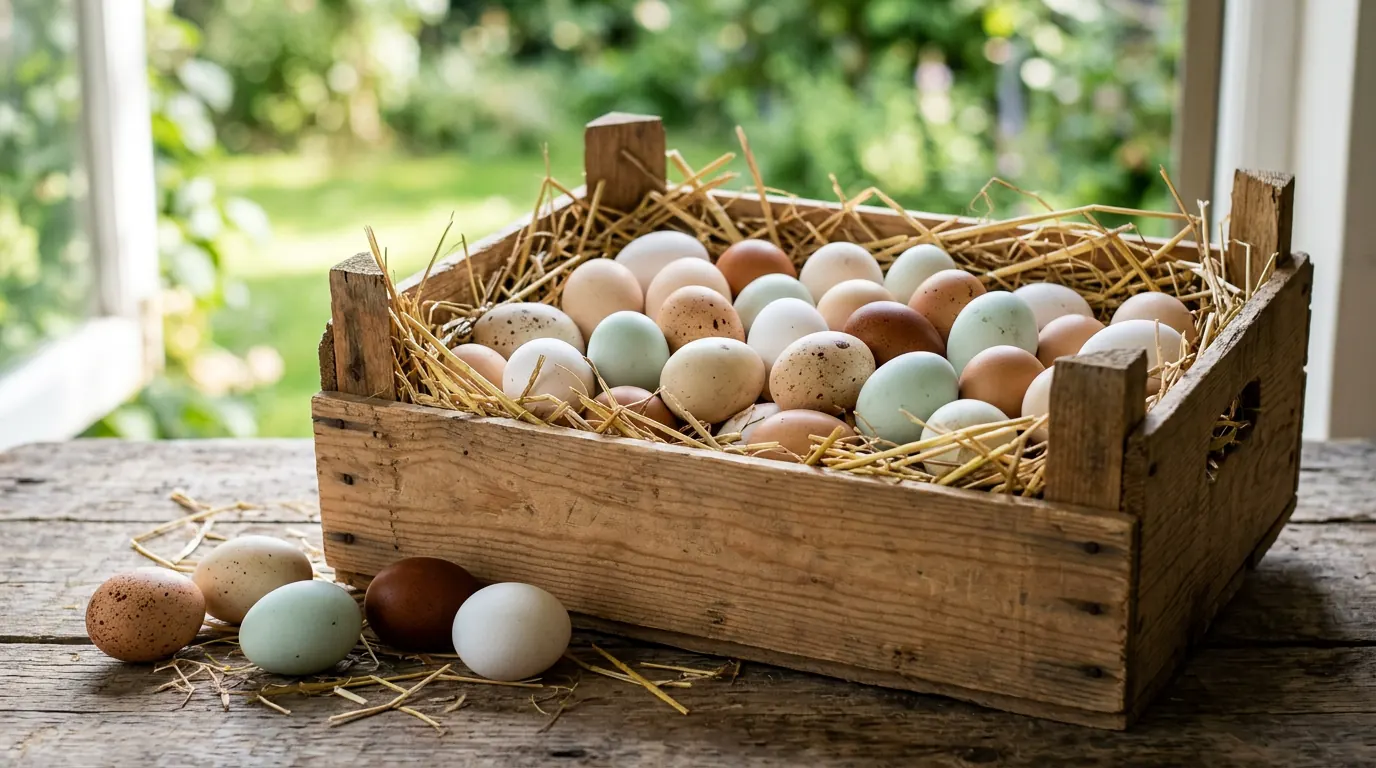
The basic equipment of a laying hen farm is perches, nest boxes, drinkers, feeders and litter. On top of that comes gear for collecting and sorting eggs. Each item affects how many eggs are laid outside the nest, how clean the shells are, and the condition of the hens' legs and feet. Well-chosen equipment also cuts the daily work with the flock.
Where to start planning
Start with the number of hens and the usable floor area of the house. From these you work out perch length, the number of nest boxes and the number of drinking points. General building requirements are in our article on laying hen house requirements. For dimensions and stocking densities in commercial farming, check the current rules in ISAP (Poland's online legal database, Internetowy System Aktów Prawnych) and with the Veterinary Inspection (Inspekcja Weterynaryjna). Here we give only the principles and values used in practice.
Perches for hens: how many, how high, what material
Perch length per hen
All hens should fit on the perch at once, because they roost together at night. Small flocks usually get 20–25 cm per hen, while in commercial farming the rules and guidelines give smaller values. Check the breed too: heavy hens need more room. If some birds sleep on the floor or in the nest boxes, the perches are too short or in the wrong place. Exact dimensions are in a separate article: hen perch dimensions.
Height, spacing and shape
Mount the perch higher than the nest boxes so hens do not sleep in the nests. If you build several levels, keep a horizontal gap between the bars so birds above do not foul those below. A good perch has rounded edges and a width that lets a hen wrap her toes around it and cover her feet with feathers. Wood is warmer than metal, but harder to disinfect and mites settle in it more readily. Fix perches so you can remove or lift them for washing.
Litter under the perches
Most droppings collect under the perches at night. Fit a tray or cover there that you can clear separately, without disturbing all the litter. This helps keep the house dry and cuts ammonia. If you are fighting mites, also look at diatomaceous earth for hens, which people use in perch cracks and in the dust bath.
Nest boxes for laying hens: number and placement
How many nest boxes per flock
Small flocks usually get one nest box per 4–5 hens. Hens happily share the same boxes, so there is no point in counting one box per hen. Large flocks use group nests, and their size and stocking come from the rules and the equipment maker's instructions. If hens fight over one box while others stand empty, check the lighting and access. For construction details, see nest boxes for hens: how to build them.
Location and lighting
Place nest boxes in dim light, away from direct light and drafts. The floor should slope slightly so eggs roll to the collection table, if your system has one. Put a low step or landing rail in front of the boxes. Hens that have not laid in nests before usually lay their first eggs in dark corners. So when you place the birds, cover dark nooks and mark the nest boxes before the hens start laying.
Nest lining
The lining should be dry, clean and soft: straw, shavings or ready-made mats. Replace it when it is soiled, because a dirty nest means dirty eggs. Lining that is too loose pushes eggs out of the middle and raises shell cracking. Steady access to calcium matters for shell quality, as we explain in lime, shell and grit for hens.
Egg collection: easier work, better quality
Collection frequency and floor eggs
Collect eggs several times a day, especially at peak laying hours. The less time an egg sits in the nest, the fewer cracks and less dirt, and the less temptation for hens to peck it. Treat eggs found on the litter separately and do not mix them with nest eggs. In commercial flocks they are marked as floor eggs and kept out of further sale under the packing plant's rules. Many such eggs signal that the nests are unattractive or badly placed.
Weighing eggs as a flock signal
The Ross Parent Stock Management Handbook 2023 recommends weighing eggs from the second collection, so you do not count eggs from the previous day. It also recommends recording the average egg weight daily and comparing it with the target. If egg weight falls for several days, the handbook advises raising the feed allowance quickly. This comes from breeder flock management, but it works for commercial layers too: a drop in egg weight or laying rate is the first sign of a feeding or watering error. We cover feeding rules in feeding laying hens.
Drinkers, feeders and litter
Drinkers and feeders
Choose the feeding space, its length and the number of drinking points to match flock size and the equipment maker's instructions. Every hen needs constant access to water and quick access to feed, without weaker birds being pushed aside. Set drinkers at the hens' back height, and feeders so the birds do not kick litter into them. We describe feed composition and amounts in feed for laying hens and grains for laying hens.
Litter and dust bath
Litter should be dry and loose. Clear wet spots under drinkers as they appear, because damp encourages mold and worsens foot condition. A sand or dust bath helps hens keep their feathers in good shape and limits external parasites. For larger flocks, plan space for a dust bath in the house or on the range. For a full overview of the house, see chicken coop design and equipment.
The most common equipment mistakes with laying hens
Perches that are too short and nest boxes in a bright spot are the most common reasons some hens sleep and lay on the floor. The second mistake is no trays under the perches, so the litter turns wet and smells of ammonia. The third is collecting eggs too rarely, especially on hot days. The fourth is nest boxes by a door or window, where hens get little peace. Before you buy new gear, walk the house at dawn and in the evening and note where the hens sleep, where they lay and where fights start.
Frequently asked questions
How many nest boxes do laying hens need?add
Small flocks usually get one nest box per 4–5 hens. On commercial farms the number and size of nests come from the rules and the equipment maker's instructions. If hens queue or lay outside the nests, add boxes or improve their placement.
How much perch space does a hen need?add
Small flocks usually get 20–25 cm per hen. Heavy breeds need more room. In commercial farming the values set by the rules apply, which you can check in ISAP or with the Veterinary Inspection.
How high should I mount perches in a chicken coop?add
Mount perches higher than the nest boxes so hens do not sleep in the nests. Choose the exact height to suit the breed and the house, so hens can jump up and come down safely. We give details in our article on perch dimensions.
What should I do when hens lay eggs outside the nest boxes?add
Check that the nests are in dim light, that there are enough of them and that the lining is dry. Cover the dark corners where hens lay on the floor. Collect eggs more often and remove dirty lining.
How often should I collect eggs?add
Several times a day, and more often at peak laying hours. A short time in the nest limits cracks and dirt on the shell. Collect floor eggs separately.
How can I tell there is a feeding error in the flock?add
The Ross Parent Stock Management Handbook 2023 points to a day-to-day fall in average egg weight as a sign that the feed allowance is too small. Record egg weight daily and compare it with the target for your line.
Sources & resources
- linkRoss Parent Stock Management Handbook 2023 (Interactive)
- linkRoss Broiler Management Handbook 2025
- linkInstytut Zootechniki PIB (National Research Institute of Animal Production) — izoo.krakow.pl
- linkGłówny Inspektorat Weterynarii (Chief Veterinary Inspectorate) — gov.pl/web/wetgiw
- linkInternetowy System Aktów Prawnych (online legal database) — isap.sejm.gov.pl
Prepared by: DlaFerm Team based on data from the sources listed · Publisher: INSTA-TECH sp. z o.o.
Keep your hen house records in DlaFerm
The <a href="/program-do-ewidencji-kurnika">Hen house records</a> module lets you log egg collection, losses and feed use for each house in one place. Create a free farm account or get in touch.
Phone
+48 796 258 151