Grains for laying hens: wheat, barley, corn and ratios
Grains give laying hens mostly energy, but grain alone does not balance a ration. Wheat, barley and corn go into a mix in different shares, depending on price, availability and the feed's composition. We explain how to choose grains and how to recalculate the rest of the ration when you change something.
verifiedFrom the team that has organised work on poultry farms for years.
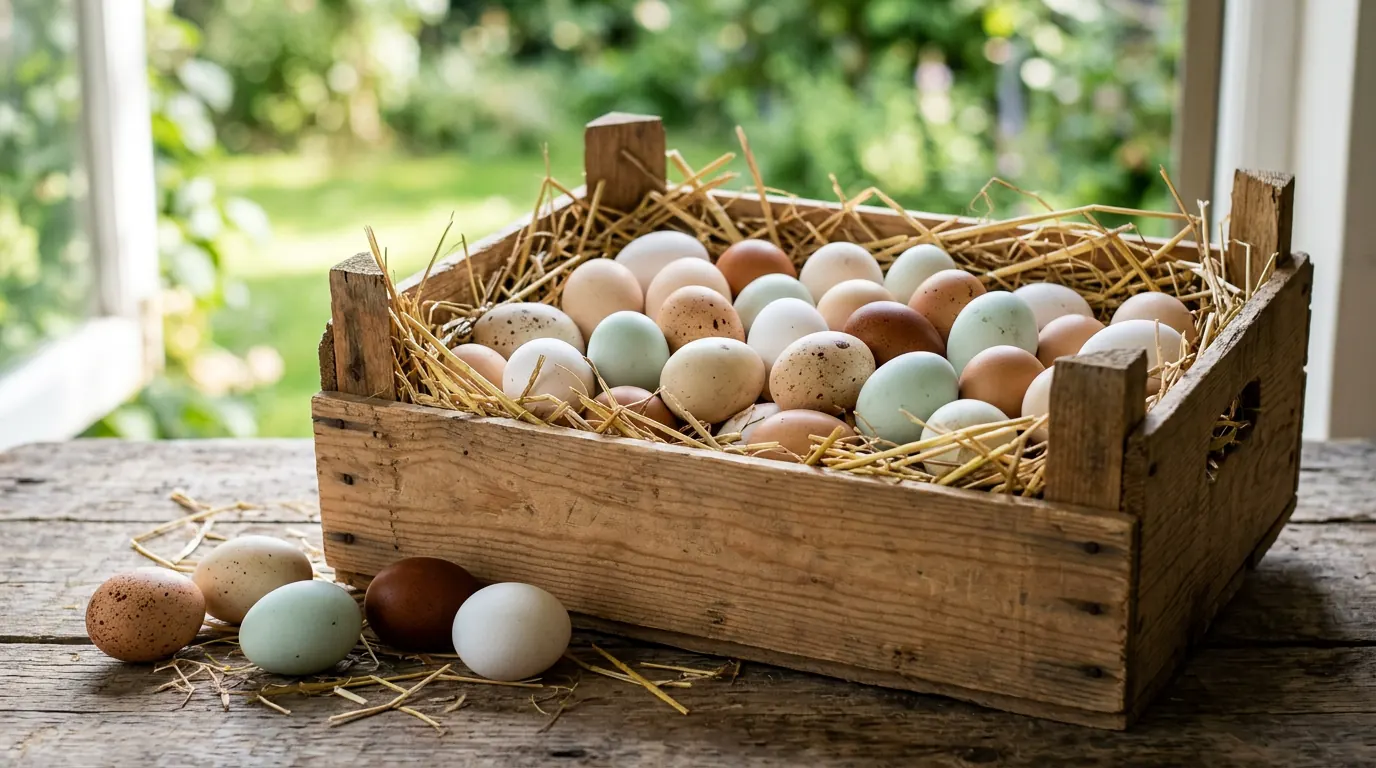
Laying hens get grain as their main source of energy, but grain alone does not balance a ration. Wheat, barley and corn go into a mix in different shares, depending on price, availability and the composition of the finished feed. If you feed a complete feed, the grains are already mixed in and the feed maker sets the ratios. If you mix feed on the farm, grains supply energy, and you add protein, calcium and vitamins as separate ingredients. We describe finished compositions and amounts on the page about feed for laying hens.
Why grain alone is not enough
Grain is high in energy and starch, but low in calcium and short on some amino acids. A hen needs calcium for eggshells, so wheat or corn alone will not do. You offer lime and shells in a separate container, and the bird regulates its own intake. We describe how in lime, shells and grit for hens.
The role of grains in the ration
Grains as an energy source
In a laying hen ration, grains mainly supply energy, which the bird uses for maintenance and egg laying. The 2021 Ross 308 Parent Stock nutrition specifications base their nutrient norms on a shared energy level of 2800 kcal/kg. That applies to parent stock breeds, but the principle is the same: change the energy of the feed and you change the rest of the calculations. Protein, amino acids and calcium must then be adjusted in proportion. Adding grain without recalculating the whole ration is not safe for egg production.
How to read the composition of a finished feed
On a complete feed label, grains are listed in the composition, usually from the highest share down. Do not assume the wheat in a mix is the same as wheat from your own mill. Variety, moisture and protein content change the value of the grain. If you mix feed yourself, check a laboratory analysis of the batch. If you have no analysis, treat table values as a rough guide and watch laying rate and egg weight in the flock.
Wheat, barley and corn in practice
Wheat
Wheat is usually richer in protein than corn, so it often takes a major place in a laying hen mix. It is easy to get in the region and grinds well. Its share is reduced when grain prices in feed rise or when you need to lower the energy of the ration. Wheat bran is a different matter. It is a diluent, not an energy source, as we explain below.
Corn
Corn is among the most energy-rich grains in poultry feed, but it is low in protein and some amino acids. Its value depends on how it was dried and stored. Damp grain can carry mold, so check the batch before it goes into feed. You can read more about corn for birds in corn for hens.
Barley
Barley has less energy than wheat and corn. Its cell walls contain polysaccharides that make gut contents more viscous. So introduce barley gradually and watch droppings and litter. A ration with a high share of barley can be less efficient, so when you change grains, recalculate the ration with a nutrition adviser or a vet.
How to set grain ratios
The ration depends on weight and laying rate
The Ross Parent Stock Management Handbook 2023 says the amount of feed should follow body weight, muscle scoring and egg production, and be corrected when the flock departs from the recommendations. That matters more than a fixed ratio of wheat to corn. A heavier bird with a high laying rate needs a different ration than a lighter one. Weigh birds regularly, not only at a flock check.
Flock uniformity
Body weight uniformity decides how evenly the feed is used. The Ross Broiler Management Handbook 2025 notes that profitability depends on how many birds hit the target parameters, which needs predictable, even growth and accurate measuring. Weight spread is described by the CV%: standard deviation divided by the mean and multiplied by 100. In the Ross PS 2023 handbook example, a deviation of 0.056 kg at a mean of 0.459 kg gives a CV% of 12.3.
When you change grains, you change energy
Proportional adjustment
Aviagen specifications say nutrient values must be adjusted proportionally when the energy level of the feed changes. This applies especially to digestible lysine. If you replace part of the corn with a lower-energy ingredient, it is not enough to just add it to the mix. Recalculate protein, amino acids and calcium. Record the results of your calculations so that after a few weeks you can see what changed laying rate.
What to check after a change
Watch laying rate, egg weight, feed intake and droppings for several weeks after changing the recipe. Compare results with earlier batches, not only with the table norm. FCR and EPEF indicators help you judge whether the grain change pays off. Collect the data in the FCR and EPEF online module so you do not calculate them by hand every week.
Diluting feed and eating time
Diluting ingredients
The 2021 Ross 308 Parent Stock specifications list wheat bran or wheat middlings, rice bran, oat or soy hulls and inorganic clays, such as aluminosilicates, as ingredients that lower energy density. They add bulk to the feed rather than energy. Use them in moderation and always with a recalculation of the other ingredients. Mineral clays do not replace calcium or other feed components.
Time to eat the feed
Bulky feed takes longer to eat. Aviagen notes that you should monitor how long it takes all birds to finish the feed, so that every bird gets its share. If part of the flock cannot keep up, split feeding into more portions or improve access to feeders. We describe feeding principles in the article on feeding laying hens.
How to introduce a new ration to the flock
Change gradually
Introduce the new ratio in several steps over a few days, not in one day. Birds react to the taste and structure of feed, and a sudden change can cut intake. Write down the date of each change, the composition and your observations. If signs of disease or a drop in laying appear during the change, talk to a vet rather than looking for the cause only in the grain.
Records
Keep feed compositions, grain batch numbers and change dates in a logbook. The Ross Broiler Management Handbook 2025 is about broilers, but its measuring principle fits laying hens too: without accurate records you cannot tell which change worked. If you give medicines in feed or water, keep treatment and withdrawal period records. The dose and withdrawal period are set by a vet.
Frequently asked questions
What are the best grains for laying hens?add
There is no single best grain. Wheat, barley and corn differ in energy, protein content and price. The choice depends on what is available in your region and on the composition of the finished feed you use on the farm.
Can laying hens eat only grain?add
No. Grains give mainly energy, while a hen also needs protein, amino acids, calcium and vitamins. Without them, laying rate and shell quality fall. Grains must be part of a balanced ration.
What is the ratio of wheat to corn in laying hen feed?add
We give no fixed ratio, because it depends on the feed composition, bird weight and laying rate. With complete feed, the maker sets the ratios. If you mix your own, work out the ratios with a nutrition adviser and watch the flock.
Can you feed barley to laying hens?add
Yes, but introduce it gradually and watch droppings and litter. Barley has less energy than wheat and corn, so you need to recalculate the ration. A grain change should be backed by observing laying rate and egg weight.
How much grain should you give hens a day?add
The amount of feed should follow body weight and laying rate, not a fixed portion set in advance. Aviagen specifications recommend adjusting the ration when the flock departs from the recommendations. Set the amount with a nutrition adviser or a vet.
What should I do when I change the grains in the feed?add
Change the ratios gradually and recalculate energy, protein and calcium. Watch laying rate, egg weight and feed eating time for several weeks. Record every change so you know what worked.
Sources & resources
- linkRoss 308 Parent Stock Nutrition Specifications 2021
- linkRoss Parent Stock Management Handbook 2023 (Interactive)
- linkRoss Broiler Management Handbook 2025
- linkChief Veterinary Inspectorate (Główny Inspektorat Weterynarii) — gov.pl/web/wetgiw
- linkNational Research Institute of Animal Production (Instytut Zootechniki PIB) — izoo.krakow.pl
- linkInternet System of Legal Acts (Internetowy System Aktów Prawnych) — isap.sejm.gov.pl
Prepared by: DlaFerm Team based on data from the sources listed · Publisher: INSTA-TECH sp. z o.o.
Do you run a laying hen flock on your own recipes?
In the <a href="/program-do-zarzadzania-ferma-drobiu">farm management program</a> you run your laying flock in one place and keep data on feed changes at hand. Create a free farm account in DlaFerm.pl or get in touch, and we will show you how it works in practice.
Phone
+48 796 258 151