Layer feed: composition, daily amount and how long a 25 kg bag lasts
Layer feed is a mix that gives hens energy, protein, amino acids, calcium for the eggshell, plus vitamins and minerals. How much you need depends on the number of birds, their body weight and their laying rate, not on the bag. Below we show the composition, how to work out the daily amount and how to turn a 25 kg bag into days.
verifiedFrom the team that has organised work on poultry farms for years.
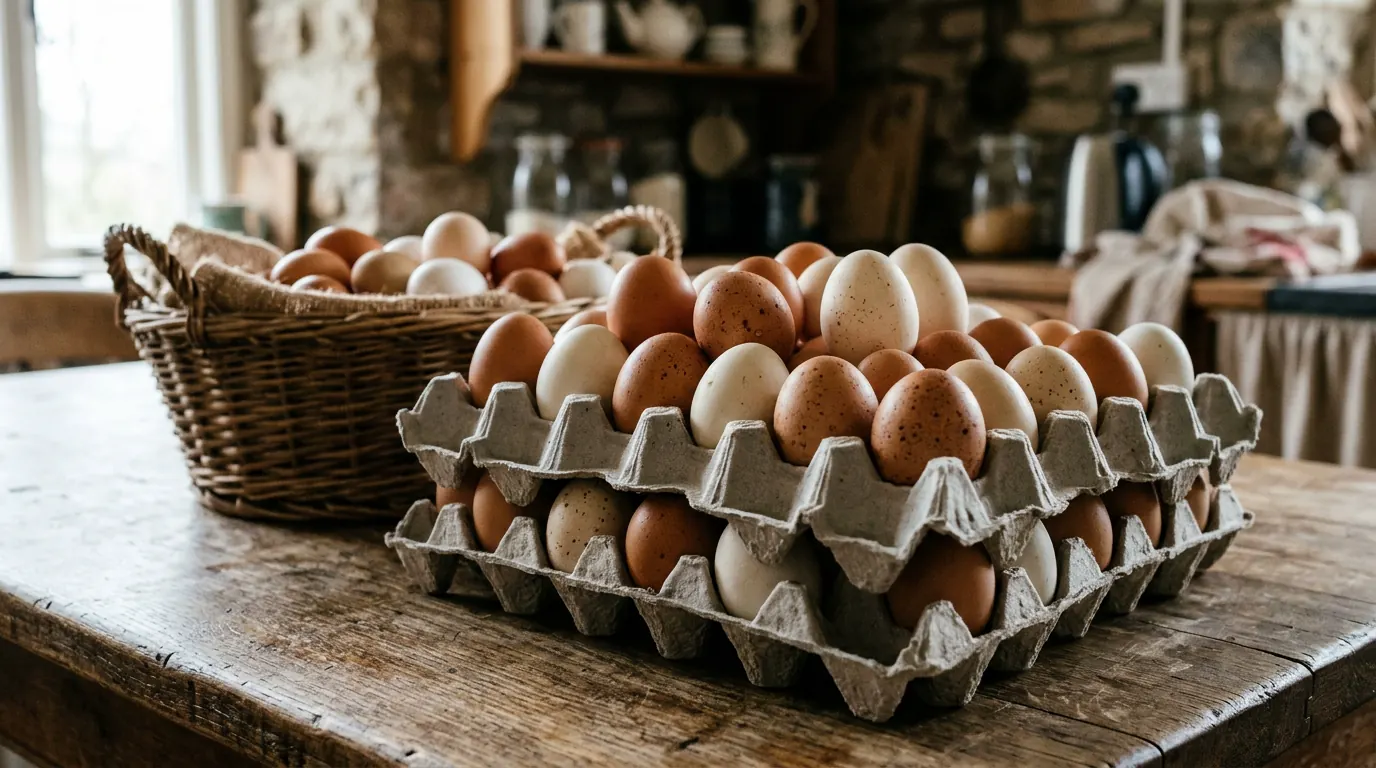
Layer feed is a complete mix that covers a hen's needs for energy, protein, amino acids, vitamins and minerals. A laying hen eats it every day, and the amount depends on her body weight and how hard she is laying. To find how many days a 25 kg bag lasts, divide the weight of the feed by the daily use of the whole flock. The formula works in any house, whether the birds are in cages, on litter or in an aviary system.
Complete feed or concentrate
Complete feed contains everything the bird needs and you give it with no additions. A concentrate is a supplementary mix with a high density of nutrients. You blend it with grain or ground meals from your own farm. The choice depends on what you already have on the farm and how much time you want to spend preparing feed. With a concentrate the proportions must be exact, because a mixing error causes a calcium or protein shortage across the whole flock. Before you pick a product, ask the supplier for the composition and the nutrient declaration on the label.
What layer feed is made of
Energy and protein
Energy comes mainly from grain, and protein from protein crops such as soybean meal or rapeseed meal. Layer feed needs protein in an amount and amino acid profile matched to the age and laying rate of the birds. A lack of lysine or methionine lowers egg production and egg weight, even when the total protein on the label looks fine. So when you change supplier, compare amino acid values as well as crude protein. You will find a reference point for that comparison in the nutrition standards for laying hens.
Calcium and phosphorus for the shell
Calcium is the nutrient a laying hen uses up fastest, because the eggshell is made from it. Layer feed usually has clearly more calcium than feed for growing chicks. Part of the calcium is given separately as coarse limestone grit, which the bird eats as it needs. Too little calcium shows as thin, soft shells and a drop in laying. Available phosphorus is the other key nutrient, but too much does not improve the shell. Choose vitamins and minerals by the label, and if in doubt ask a vet or a nutrition adviser. We write more about vitamins in our guide to vitamins for hens.
How much feed a laying hen eats per day
Typical feed use
In practice a laying hen eats about 110–120 g of feed per day, depending on breed, body weight, house temperature and laying rate. This is a starting point, not a standard to copy. In heat birds eat less and drink more, and in winter use usually goes up. Instead of relying on a table, weigh the feed for a week: put a set weight into the feeder, weigh what is left after a few days and work out the difference per bird. That measurement shows the use of your flock, not an average from a guide. Write the results in your records, so that after a feed or weather change you have something to compare with.
Amount and house conditions
Feed use also depends on water. When water is short, hens eat less and lay less, so checking drinkers matters as much as checking feeders. A house with the right temperature and ventilation lets you keep a steady amount all year. If use suddenly drops by a few percent, check the water, the temperature and the condition of the birds before you change the feed. We describe building requirements in requirements for a laying hen house and drinker choice in automatic drinkers for hens.
How many days a 25 kg bag lasts
The formula
The number of days is the weight of the bag divided by the flock's daily use. The flock's daily use is the number of hens times the use of one hen in kilograms. Example: at 115 g per hen per day, within the 110–120 g range, a flock of 100 hens eats 11.5 kg a day. A 25 kg bag then lasts about 2 days (25 ÷ 11.5 ≈ 2.2). This is pure arithmetic. It does not allow for losses, spills or weather changes, so when planning purchases keep a reserve of a few days.
Why there is no single answer
The same bag lasts a different number of days depending on how many birds you have. With the same assumption, a flock of 20 hens uses a bag in about ten days, and a flock of 500 hens in just a few hours. A ready-made number of days from the internet means nothing without knowing the number of birds. Work it out for your own flock and enter the result in your records. The price of a bag varies with supplier, composition and season, so check current prices directly with the seller, not in a guide.
Concentrate or ready-made layer feed
When a concentrate makes sense
A concentrate pays off when you have your own grain and want to cut feed cost, but then you are responsible for the recipe. The mix has to bring the grain up to full nutritional value, and you give the proportions exactly as on the label. A new batch of grain changes the composition, so check the recipe every time the batch changes. If you have less experience, ready-made complete feed that needs no mixing is often safer. Cost depends on raw material and delivery prices, so compare offers from the same day.
Farm-ground meal or a ready additive
Rapeseed and soybean meal are protein ingredients you can add to feed made on the farm. Their share has to come from an analysis of the composition, not from habit. Too much of one ingredient changes the amino acid profile and can make the feed less palatable. Before you change a recipe, talk it over with a nutrition adviser. You can read more about the ingredient itself in our guide to rapeseed meal for hens.
How to track feed use on your farm
Record deliveries and use
The simplest control is to record every delivery and every use. Enter the date, the number of bags, the number of hens in the flock and the use in that week. After a month you see the real use per bird and know whether a drop in laying is linked to the feed amount or to something else. Without records, every decision about profitability turns into guessing. You can keep such records easily in poultry farm management software. A sudden rise in use can signal disease or a water problem, and treatment decisions belong to a vet.
Silo and store
With bulk feed in a silo, you need to measure the stock, not judge it by eye. Silo level monitoring lets you plan deliveries ahead, before the feed runs out. With bags, record each time you open a batch and count how many bags are left. Compare the stock with the day count from the 25 kg bag section. A gap larger than normal loss when pouring feed points to spills, theft or a counting error, and is worth clearing up right away. You can follow the levels in the feed silo monitoring module.
Frequently asked questions
How much feed does a laying hen eat per day?add
Roughly 110–120 g per bird per day, but use depends on breed, weight, temperature and laying rate. The surest way is to weigh the feed for a week and work out the difference for the whole flock.
How long does a 25 kg bag of feed last for hens?add
Divide the weight of the bag by the flock's daily use. A flock of 100 hens at about 115 g per bird per day eats about 11.5 kg a day, so a bag lasts about two days. With a bigger flock it is shorter.
What is layer feed made of?add
The base is grain for energy, plus protein crops and amino acids. Calcium and phosphorus for the shell and a vitamin and mineral premix are added. The label of a given feed gives the exact composition.
Is a layer concentrate enough without grain?add
No. A concentrate is a supplementary mix, so you usually blend it with grain. You give the proportions as on the label and check them every time the grain batch changes.
Does layer feed need extra calcium?add
Often yes. A laying hen uses a lot of calcium on the shell, so part of it is given separately as coarse grit. Whether and how much to add, agree with a nutrition adviser or a vet, because it depends on the feed composition and laying results.
How can I tell if my hens are getting too little feed?add
Check whether the feeder is empty before the next feeding and compare use with the previous week. A drop in laying, thin shells and leaner birds are a signal to investigate, not just to change the feed.
Do feed rules change?add
Yes, so check rules on feed and its composition in Poland's ISAP (Internetowy System Aktów Prawnych, the online legal database). The legal state we rely on is 22.11.2026. Before you change a recipe, confirm it meets current requirements with your adviser or with the Chief Veterinary Inspectorate (Główny Inspektorat Weterynarii).
Sources & resources
- linkInstytut Zootechniki PIB (National Research Institute of Animal Production) — izoo.krakow.pl
- linkEFSA — efsa.europa.eu
- linkChief Veterinary Inspectorate (Główny Inspektorat Weterynarii) — gov.pl/web/wetgiw
- linkInternetowy System Aktów Prawnych (Poland's online legal database) — isap.sejm.gov.pl
Prepared by: DlaFerm Team based on data from the sources listed · Publisher: INSTA-TECH sp. z o.o.
Counting feed in the silo and in bags?
The feed silo monitoring module helps you keep track of stock on your farm. Create a free farm account in DlaFerm.pl and see how it works for your flock.
Phone
+48 796 258 151