Farm modernization in 2026: pig barn, cattle barn, poultry house
Start your upgrade with a list of buildings and animal groups, not with buying equipment. In a pig barn, ventilation, temperature and pen stocking usually decide the result. Below we show the order of work and where to check current rules and support, as of 22.11.2026.
verifiedFrom the team that has organised work on poultry farms for years.
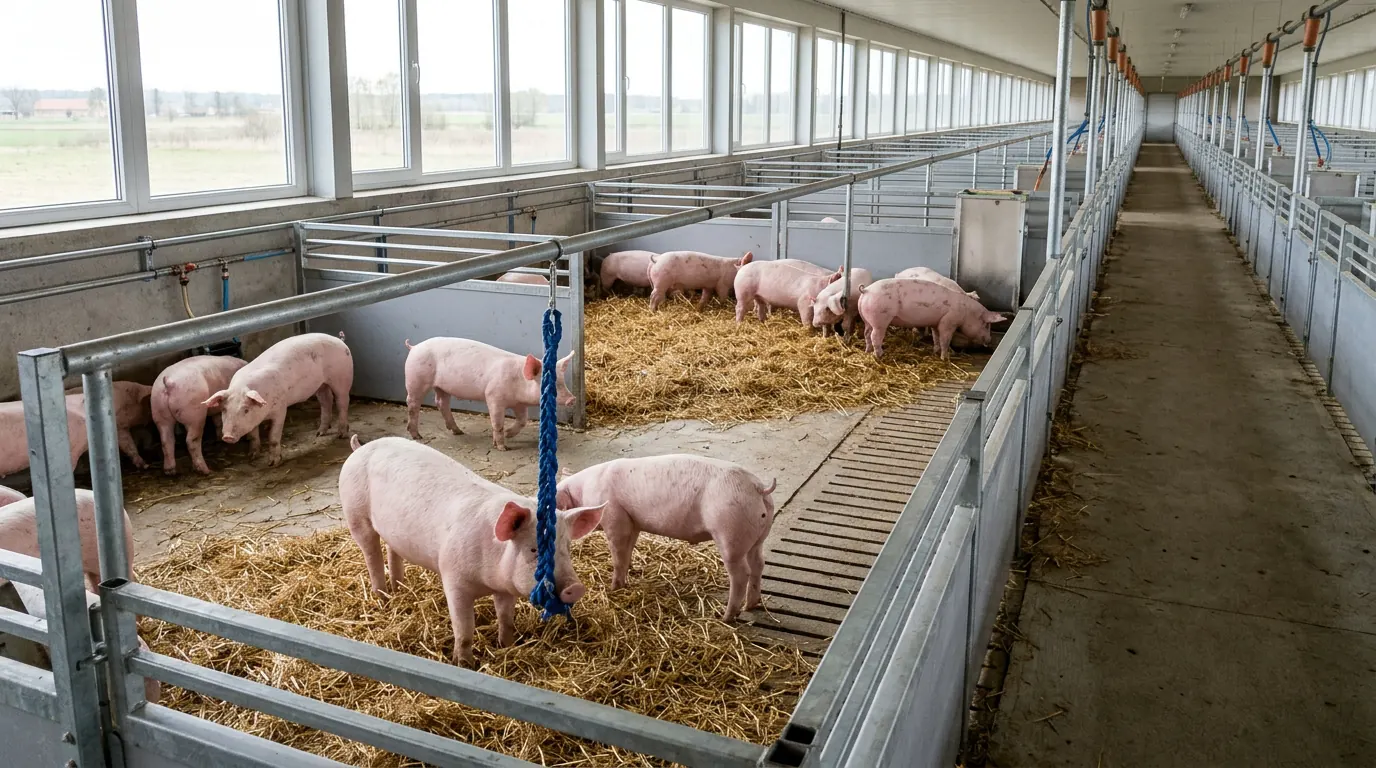
A farm upgrade in 2026 starts with a decision: which buildings and which animal groups to improve first. In a pig barn that is usually ventilation, temperature and pen stocking. In a cattle barn it is stalls and hygiene. In a poultry house it is ventilation and litter removal. Before you spend money, write down the condition of each building, the number of places and the running costs. Record the results in the app for pig farmers so that after a year you can compare them with the results from before the investment.
Order of work
First fix what affects animal health and welfare: ventilation, temperature and stocking density. Feeding equipment and automation come after that. Build the plan around your placement calendar, because construction is easier between cycles than during fattening. You can plan placements and breaks in production in the placement and cycle planning module.
Ventilation and temperature in the pig barn
Temperature depends on piglet weight
The PIC Wean to Finish manual gives recommended room temperatures for piglets. Piglets weighing about 5.4 kg on the first day after weaning, in a building without a brooder and mats, need a set temperature of about 29.4 °C. Piglets weighing about 8.2 kg after 14 days need about 27.2 °C without a brooder, and about 21.1 °C with a brooder and mats. As the animals grow, the set temperature goes down. Check the controller settings with a thermometer in the lying area, not next to the fan, because the reading there can be too low or too high.
Heat from growing finishers
According to the PIC manual, every 27–36 kg of weight gain raises an animal's heat output by about 200 BTU/h (about 59 W). In a full building, ventilation must therefore rise with the weight of the herd, not only in hot weather. An upgrade should include fans with adjustable output and sensors at several points in the room. Log climate readings through the sensor integration so you see the trend over a whole week, not just a single reading.
Stocking density and pen layout
Lying space and group split
The Topigs Norsvin TN70 manual describes group housing systems for sows. It recommends a lying area large enough for all animals to lie down at the same time. It also notes that aggression in a herd usually comes from competition for feed, water and lying space. In practice the same logic applies to finishers. Keep animals of similar weight and size in one group, because bigger and stronger animals quickly take over the feeder and drinker.
Individual feeding stalls
For group systems the same manual recommends individual feeding stalls, so that all animals can eat at the same time and none blocks the others from feed. When you upgrade, check whether the number of feeder places lets the whole group eat at once. Record feed use in the FCR and EPEF indicators, because after you change the pen layout the result shows fastest whether the improvement works.
Cattle barn and poultry house in one plan
Cattle barn: stalls and hygiene
In a cattle barn the priorities are clean stalls, good slurry drainage and safe working conditions for the animals. Before you rebuild, check how the new layout will affect the flow of people and equipment between buildings. We give no stall dimensions here because they depend on breed and technology; choose them with an adviser or a vet. Keep hygiene and treatment records in one place, so that during an inspection you do not search for papers in different drawers.
Poultry house: ventilation and litter
Poultry houses are most often upgraded around ventilation and litter removal. Match the way you remove and dry litter to your heating and ventilation system, and keep up-to-date records of ventilation checks and litter removal. Describe the rules for outside visitors and biosecurity in the biosecurity plan generator, so that new buildings follow consistent rules from the start.
Rules to check before you rebuild
Protection against ASF
The regulation of Poland's Ministry of Agriculture and Rural Development (MRiRW) of 12.03.2026 on measures to combat African swine fever was published as Dz.U. 2026 poz. 344 (Poland's Journal of Laws). Before you change the layout of the pig barn, check whether your farm lies in a restricted area and what rules apply to moving animals, feed and equipment. The rules change from time to time, so always verify the current text in ISAP (Poland's online database of legal acts) and agree the interpretation with the county veterinary officer (powiatowy lekarz weterynarii).
Minimum standards for pigs
Council Directive 2008/120/EC sets minimum standards for the protection of pigs and is the basis for housing requirements. In practice, inspectors assess housing against the national rules that implement this directive. Before you rebuild, ask an adviser to review the design for floors, access to water and pen area, rather than relying on general advice from forums.
Support for modernization in 2026
KPO and ARiMR calls
The IZ PIB guide on pig keeping (the National Research Institute of Animal Production) lists Poland's National Recovery and Resilience Plan (KPO) as a source of support, for example for investment in processing and for building and upgrading storage and distribution centers. The scope for pig barns and the application conditions depend on the specific call. Check current announcements with ARiMR (Agency for Restructuring and Modernisation of Agriculture) and on the Ministry of Agriculture and Rural Development websites, not on amounts from earlier years.
Do the math before you decide
Before you apply, work out the cost of the investment and the possible return from better results: daily gain, feed use per kilogram of gain and mortality. These data come from your own records, so start keeping them now, before the work begins. Track feed cost, usually the biggest item in the calculation, in the feed silo monitoring module, because day-by-day use shows deviations faster than an annual summary.
Frequently asked questions
Where do I start with a pig barn upgrade in 2026?add
Start by writing down the condition of each building: ventilation, temperature, pen stocking and the number of feeder places. Then decide which changes will improve herd results fastest. Only after that check support and legal requirements.
What temperature do weaned piglets need?add
The PIC manual gives values that depend on piglet weight and on whether you use a brooder and mats, for example about 27.2 °C for piglets weighing about 8.2 kg after 14 days without a brooder. Your vet or adviser sets the exact values, and you should check the controller with a thermometer in the lying area.
Can I get a grant for a pig barn upgrade?add
Yes, but the scope of support depends on the call. The IZ PIB guide lists KPO as a source of support, and ARiMR publishes calls and conditions. Check the current announcement before you prepare documents.
Do I need to check ASF rules before rebuilding?add
Yes. The MRiRW regulation of 12.03.2026 (Dz.U. 2026 poz. 344) sets out the measures to combat ASF, and you can check the current legal status in ISAP. If you change the facility, discuss your biosecurity plan with your vet beforehand.
How much space do pigs need in a pen?add
We give no area standards because they depend on the weight category, the housing system and national rules. The principle is constant: all animals in a group must be able to lie down at the same time, and eat at the feeder at the same time. Choose the dimensions with an adviser.
Sources & resources
- linkPIC — PIC Wean to Finish Guidelines
- linkTopigs Norsvin — Feeding Manual TN70 (open access, GNFRS)
- linkIZ PIB — Guide to organic pig keeping (ed. E.R. Grela)
- linkMRiRW / Dziennik Ustaw — Regulation of the Minister of Agriculture of 12.03.2026 on measures to combat African swine fever (Dz.U. 2026 poz. 344)
- linkInternetowy System Aktów Prawnych — isap.sejm.gov.pl
- linkARiMR — gov.pl/web/arimr
Prepared by: DlaFerm Team based on data from the sources listed · Publisher: INSTA-TECH sp. z o.o.
Upgrading a pig barn or cattle barn in 2026?
The pig farmer app in DlaFerm.pl helps you record the condition of your buildings, herd results and costs before and after an investment. Create a free farm account and compare your results from before the upgrade with those you reach after it.
Phone
+48 796 258 151