Can You Keep Pigs for Your Own Use in Poland? Rules for 2026
You can keep pigs for your own use, but slaughter depends on where you live. In areas under African swine fever (ASF) restrictions, a Polish Ministry of Agriculture regulation of 12.03.2026 bans slaughtering pigs to produce meat for your own use. Outside those areas, agree the rules with your vet. Below we explain what to check before your first pig.
verifiedFrom the team that has organised work on poultry farms for years.
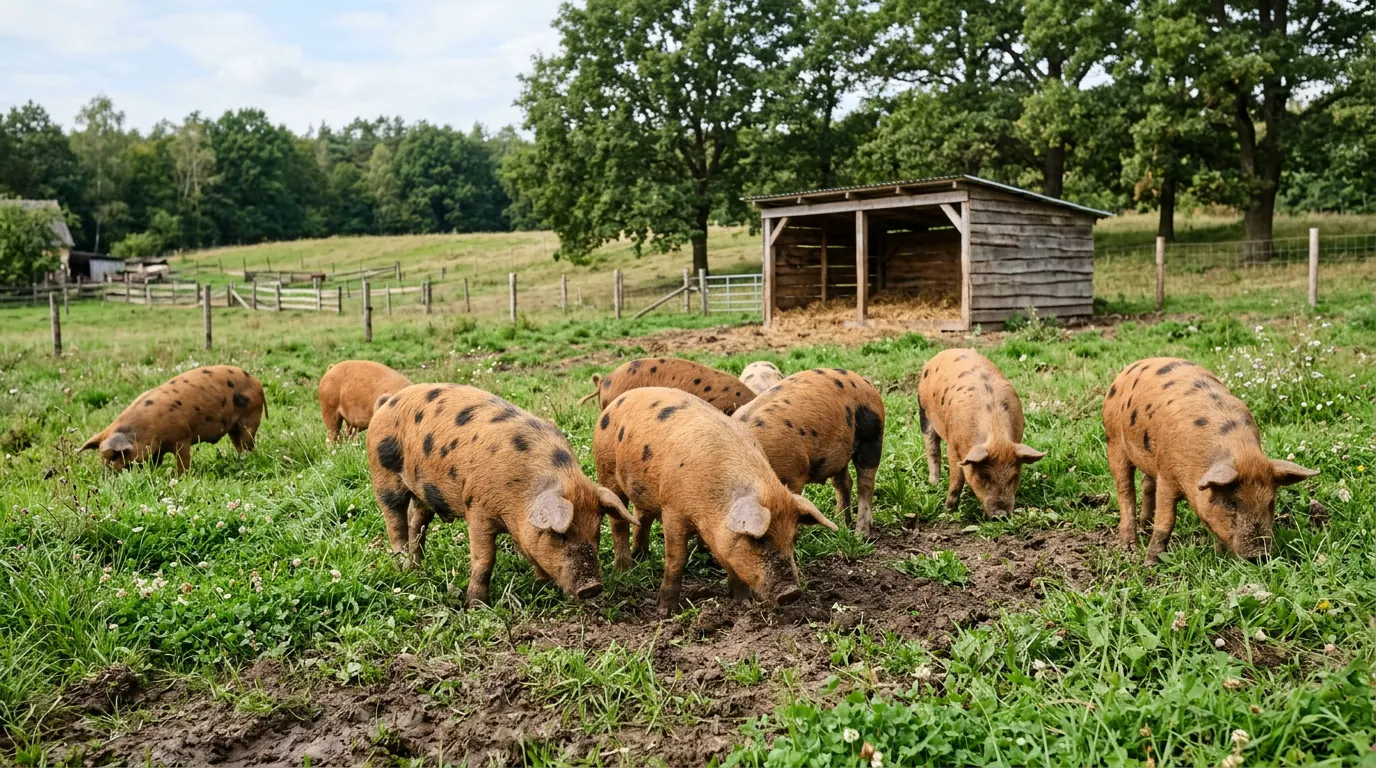
You can keep pigs for your own use, but you cannot slaughter them everywhere. In restriction areas I, II and III set up because of African swine fever (ASF), the regulation bans slaughtering pigs to produce meat for your own use. We describe the legal state as of 22.11.2026. Before you plan slaughter, check whether your land lies in a zone, and ask the county veterinarian (powiatowy lekarz weterynarii) how the rules apply to you.
Who this guide is for
This text is for keepers with a few pigs in a yard or on a small plot who want to know what is allowed and what is not. It does not replace an official decision or advice from a vet. We describe the slaughter process separately in our guide to slaughtering farm animals for your own use.
The slaughter ban in ASF zones
What the rule bans
The regulation of Poland's Ministry of Agriculture (MRiRW) of 12.03.2026 on measures to combat African swine fever (Dz.U. 2026 poz. 344, Poland's Journal of Laws), § 3 section 1, bans slaughtering pigs to produce meat for your own use in establishments located in restriction areas I, II and III. So the ban concerns the place where slaughter would happen. The county your farm is in is not enough to judge it. What counts is whether your plot lies inside the designated area. Check the text of the act in the Internet System of Legal Acts before any larger project.
Zones change
Restriction areas are set as part of ASF control and can change, so a check from a year ago is not enough. Find current information on the website of the Chief Veterinary Inspectorate (Główny Inspektorat Weterynarii, gov.pl/web/wetgiw) or ask the county veterinarian. Write down the date you checked your area's status and keep a printout or a note from the conversation. It helps clear things up if anyone asks about slaughter.
Slaughter for your own use outside restriction areas
What to settle before slaughter
Outside ASF restriction areas this particular ban does not apply, but that does not mean anything goes. Before slaughter, ask the county veterinarian what requirements apply to your case, where and by whom slaughter may be done, what to do with the carcass and slaughter waste, and whether you must notify anyone of your plans. We give no detailed conditions here because they do not come from our sources. Write down what you agree so you do not rely on memory.
Weight and age at slaughter
According to EFSA, the fattening phase starts in the 10th week of a pig's life and lasts until slaughter or retention for breeding. EFSA reports that in many countries pigs are slaughtered at 110–123 kg, and in some, for example for specialist hams, at a higher weight. For your own needs, the result depends on breed, feed and what you want to make from the carcass. Record growth rate and fattening results so that after a few batches you can see what works in your pen.
Biosecurity on a small pig farm
Contact with other pigs and wild boar
Guidelines from the Veterinary Inspection in Wągrowiec (PIW Wągrowiec, issued by the Chief Veterinary Inspectorate) on Annex II to Implementing Regulation 2021/605 say that kept pigs must have no direct or indirect contact with other pigs or with wild boar, whether live, shot or found dead. The requirements apply to farms that put animals or products on the market, but they are a very practical starting point. Do not borrow pig equipment from a neighbor without disinfecting it. Do not leave food or scraps where wild boar can reach them. Do not let outsiders into the pen in their own clothes. See also our ASF biosecurity checklist for pig houses.
Footwear, hands and the clean zone
The guidelines require changing footwear and work clothing at the entrance to a building with pigs, a separate zone, washing and disinfecting hands, and disinfecting footwear. In a small pen, a separate pair of rubber boots used only at the pen, a separate jacket and a disinfectant mat at the door are enough. Choose disinfectants according to the label and the guidelines. Write down your hygiene plan and put it up at the entrance so everyone in the household knows it. The biosecurity plan generator can help.
Medicines, withdrawal periods and records
Your vet chooses the medicine and dose
Your vet decides whether to treat a pig and chooses the medicine and dose. We give no doses or product names in this guide. The rule is simple: after a medicine is given, the withdrawal period must pass before the meat goes on the table. The medicine's documentation and your vet's advice set that period. Record the date, product name, dose and the end of the withdrawal period. Without such a note it is hard to show the pig was safe to slaughter. Our treatment and withdrawal records help with this.
Welfare on a small scale
Pig welfare covers living conditions, access to bedding and stocking density. Among others, 2026 monographs from the National Research Institute of Animal Production (IZ PIB), edited by A. Rekiel and G. Żak, describe it. Pigs are curious and need something to do, and stress before slaughter lowers meat quality. EFSA describes transport hazards separately, so plan a short route, calm handling, and do not mix unfamiliar groups at the last minute.
Registering your herd in IRZplus
Do you have to register pigs kept for your own use
Whether and how to register pigs kept for your own use depends on the rules and your situation, so we do not summarize it without a source. In practice it makes sense to have a herd premises number and register the animals in IRZplus, ARiMR's online animal register (ARiMR is Poland's Agency for Restructuring and Modernisation of Agriculture). This makes contact with the authorities, transport and any inspections easier. When you buy piglets, ask the seller whether their herd is registered and ask for the documents that accompany the animals. See also our overview of rules and documents for pig keepers.
Data in one place
Ear tag numbers, dates of placement, treatments and slaughter are easier to keep in one program than in a notebook. The IRZplus and sensor integration module is meant to reduce retyping. See the scope of integrations with IRZplus and sensors and the app for pig keepers.
Frequently asked questions
Can I slaughter a pig for my own use in Poland?add
It depends on the place. In restriction areas I, II and III, the MRiRW regulation of 12.03.2026 (Dz.U. 2026 poz. 344) bans slaughtering pigs to produce meat for your own use. Outside those areas, agree the requirements with the county veterinarian before your first slaughter.
How do I check whether my address is in an ASF zone?add
Start with the Chief Veterinary Inspectorate website (gov.pl/web/wetgiw) and ask the county veterinarian. Areas can change, so write down the date you checked. Check the status again before buying pigs and before slaughter.
At what weight are pigs slaughtered?add
According to EFSA, in many countries pigs are slaughtered at 110–123 kg, and in some, for example for specialist hams, at a higher weight. For your own needs, the result depends on breed, feed and what the carcass is for.
Do I have to register a few pigs in IRZplus?add
The duty to register depends on the rules and your situation, so ask the county veterinarian. In practice, registering the herd makes contact with the authorities and transport easier. Also ask the piglet seller whether their herd is registered.
How long should I wait after a medicine before slaughter?add
Your vet and the medicine's documentation set the withdrawal period. We give no numbers here because they depend on the product and dose. Write down the date of treatment and the calculated end of the withdrawal period, and check that note with your vet before slaughter.
Do I need a separate zone for biosecurity?add
The guidelines describe a separate zone at the entrance to a building with pigs, plus a change of footwear and clothing. In a small pen you can do this with little effort, for example with one bench and two pairs of boots. Rules for larger farms are broader, but the direction is the same.
Sources & resources
- linkMRiRW / Journal of Laws — MRiRW regulation of 12.03.2026 on measures to combat African swine fever (Dz.U. 2026 poz. 344)
- linkPIW Wągrowiec (GIW guidelines) — Guidelines on practical implementation of biosecurity requirements on farms keeping pigs (Annex II, Regulation 2021/605)
- linkEFSA AHAW Panel — Welfare of pigs on farm (EFSA Journal 20(8):7421)
- linkIZ PIB — Pig welfare in a sustainable animal production system (eds. A. Rekiel, G. Żak)
- linkChief Veterinary Inspectorate — gov.pl/web/wetgiw
Prepared by: DlaFerm Team based on data from the sources listed · Publisher: INSTA-TECH sp. z o.o.
Keeping a few pigs next to your production herd?
The pig keeper module in DlaFerm.pl records your herd, treatments and withdrawal periods in one place. Create a free farm account or get in touch, and we will show you how it works in practice.
Phone
+48 796 258 151