ASF biosecurity on a pig farm: requirements and checklist
ASF biosecurity is a set of rules that keep African swine fever virus out of your herd. It covers people, vehicles, feed and wild animals. Requirements depend on the farm profile and the county (powiat), so instead of one fixed list we give you the elements that keep appearing in the documents of Poland's GIW (Chief Veterinary Inspectorate) and in guidance from the PLW (county veterinary officer). Each point has a responsible person and a paper trail.
verifiedFrom the team that has organised work on poultry farms for years.
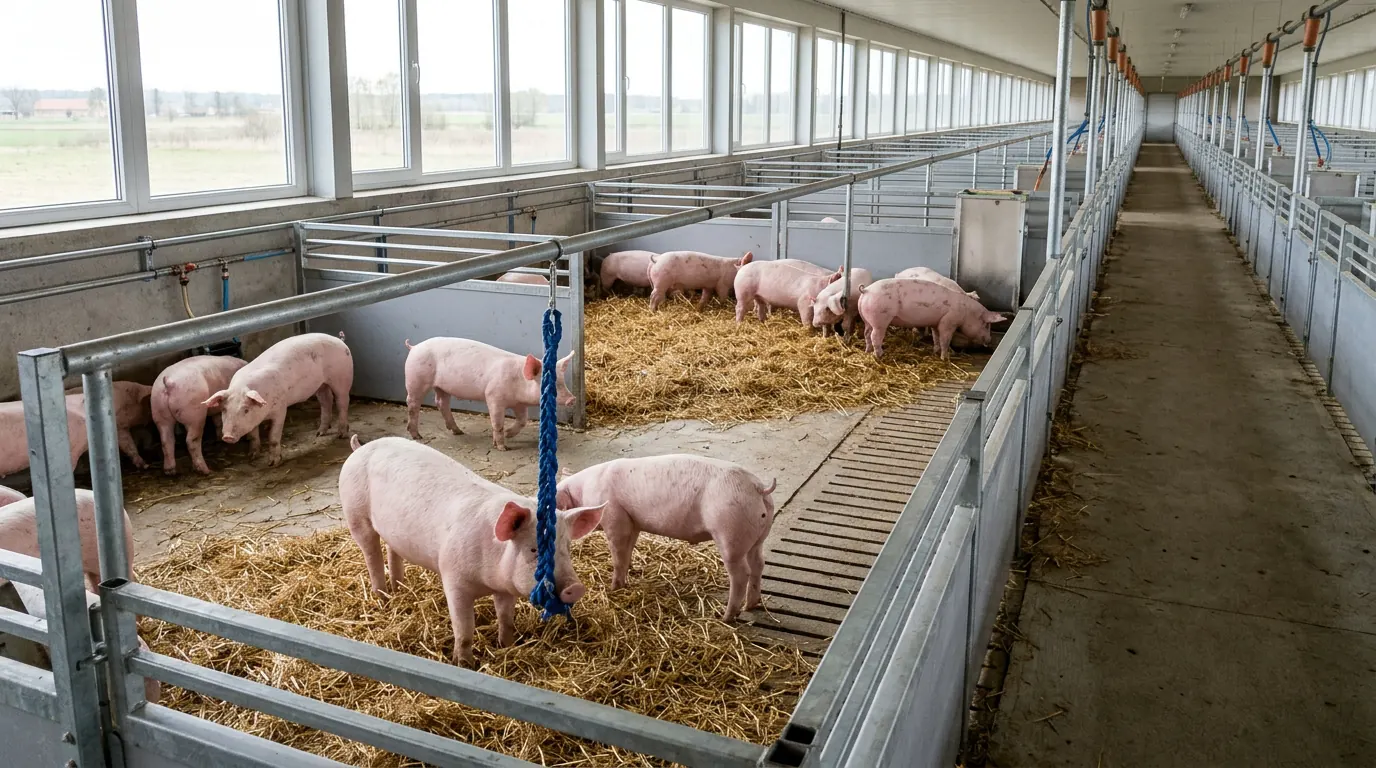
ASF biosecurity on a pig farm means stopping African swine fever virus from reaching your herd from outside. It covers control of people, vehicles, equipment, feed, waste, wild animals and pests, plus a written plan that all staff work by. There is no single list for every farm. Requirements depend on whether outside people work on the farm, on herd size and on the county where the farm sits.
Why a checklist and not just rules
The regulations describe goals. In the pig house you need specific tasks tied to people and dates. So each point below has an owner, a way to check it and a paper trail. You can write the plan by hand, but it is easier to keep up to date in a system. The biosecurity plan generator helps you build the structure of the document and links each entry to daily work. Start by checking which of the points below you already have and which are missing.
The biosecurity plan: what the document must contain
Elements of the plan
The GIW base document on farm biosecurity rules lists, among other things, a staff register with signed statements, a crisis plan and the results of the last official inspection. The plan should also cover washing, disinfection and pest control, because these deal with pathogens carried in from outside. Every entry has to be put in place, maintained and checked from time to time. A plan hanging in the office that nobody follows gives no protection.
When every keeper needs a plan
GIW guidance on implementing Regulation 2021/605 said that a farm where at least one person from outside the farm works must have a biosecurity plan approved by the county veterinary officer (PLW). The deadline in that guidance has passed, so agree the scope of the document with your PLW now. The starting point is the Regulation of Poland's Ministry of Agriculture and Rural Development (MRiRW) of 12.03.2026 on measures to control African swine fever (Dz.U. 2026 poz. 344, Poland's Journal of Laws), legal status as of 22.11.2026. Before you start, check the current text in ISAP (Poland's legal database) and ask your PLW which duties apply to your county and species.
Staff and outside visitors
Statements and the staff register
The GIW document names a staff register with statements that the person has had no contact with pigs outside this farm for 48 h. The statement should also confirm that the person has had no contact with wild boar or their carcasses for 72 h before starting work. Keep the register current: a new worker, a vet or a service technician should also be in it before entering the pig house. The worker app helps you keep the crew register on a phone, with no binder.
Changing at the zone boundary
Set a place where each person changes clothes and footwear before entering the pig house. Work boots never leave the buildings, and clothes used in the pig house are not worn outside it. A worker coming from another farm should change clothes and bring nothing from the previous place. Describe the changing rules step by step in the plan, with a drawing of the changing room, because a new person remembers a picture faster than a line in a rulebook.
Vehicles, deliveries and visitors
Vehicle entry control
Record every vehicle entering the farm: who, when, where from and why. Treat official vehicles, feed trucks and animal transporters separately, because vehicles are a common carrier of contamination. Stop vehicles at a set point, and the driver does not enter the livestock buildings. We describe traffic organization in vehicle entry and deliveries and gate rules in farm entry control.
Entry log
The entry and exit log shows, on the day a disease is suspected, who was in the pig house in the last days. Each entry should have the date, time, full name, company and purpose of the visit. A paper log is possible, but hard to search quickly. An electronic QR entry and exit log records every entry at the gate, so tracing contacts does not depend on anyone's memory.
Wild boar, birds and pests
Why pests are a risk
The authors of an IZ PIB (National Research Institute of Animal Production) monograph on pig welfare note that washing and disinfection are usually done satisfactorily, but pest control is mostly treated casually and occasionally. Yet pests are a significant vector of animal diseases. The plan should therefore set a fixed inspection schedule and record the results, not call someone only when a mouse is seen. We describe how to protect farms from rodents and birds in pest and wild bird control.
Wild boar around the pig house
Fencing the outdoor area, keeping buildings tight and securing feed stores limit contact between pigs and wild animals. A fence is not enough if you leave feed waste within reach of wild boar or feed sacks stand by open doors. Check these places on every round and write what you find into the plan. Wild boar are the hardest part of the puzzle because you cannot exclude them completely, so you cut the risk by controlling the places a boar can touch.
Washing, disinfection and tests before moving pigs
Washing and disinfection procedure
Washing and disinfection need a written order: first remove soiling, then apply the disinfectant for the contact time given on the label. Put the procedure in the plan and sign off each time it is done. After pigs leave, run the full cycle in every room, not just a spray down the corridor. Agree the choice of product with your vet or the manufacturer's representative, because effectiveness depends on the virus and conditions in the building.
Official inspections and the testing exemption
The GIW document links an exemption from testing to a positive result of the last official inspection, carried out at least 4 months earlier. Veterinary Inspection (Inspekcja Weterynaryjna) checks take place 2 times a year, and the exemption is granted for a maximum of 6 months or until the conditions written in the document change. The SPIWET-ASF checklist applies to farms with such an exemption, and blood sample tests may be required 7 days before a move. Before you plan a sale, check your current status with your PLW.
The crisis plan and the situation in Europe
What a crisis plan should contain
The crisis plan sets out what staff do when disease is suspected: whom to notify, who closes the entrances and how to isolate animals. The GIW document also lists staff involvement, equipment and material resources, and designated places to destroy and dispose of feed, manure and, if needed, animals, including a reserve burial site. Fix these places in advance, because under stress the choice takes too long. We describe the data you will need on the first day of suspicion in ASF in the pig house: a record of every pen and data ready for day one of suspicion.
The EU epidemiological situation
According to the EFSA analysis for 2025, the number of member states affected by ASF rose from 13 to 14, after outbreaks in wild boar were reported in Spain. It was the first case in that country since the virus was eradicated in 1995. EFSA also noted that in 2025 no country reported outbreaks in domestic pigs for the first time, and Estonia returned to reporting after a year without any. The data show that the virus still circulates among wild animals, so treat contact with wild boar as a real risk.
Frequently asked questions
Does every pig farm need an ASF biosecurity plan?add
Duties come from the regulations and depend on the county, the species and whether outside people work on the farm. GIW guidance from 2021 linked a plan approved by the PLW to farms employing people from outside the farm. Agree the scope of the document with your county veterinary officer based on current rules.
What must a pig biosecurity plan include?add
The GIW base document lists a staff register with statements, a crisis plan and the results of the last official inspection. It should also include procedures for washing, disinfection and pest control. Every entry must be in place and checked from time to time.
How many hours should a worker stay away from pigs before entering the pig house?add
The GIW document gives 48 h without contact with pigs outside the worker's own farm. The person should also confirm no contact with wild boar or their carcasses for 72 h before work. Collect the statements and keep them in the register.
How often are farms inspected under the testing exemption program?add
Veterinary Inspection checks under this program take place 2 times a year. The exemption is granted for a maximum of 6 months or until the conditions written in the document change. It requires a positive result of the last official inspection, at least 4 months earlier.
Are washing and disinfection enough to protect a pig farm?add
No. The authors of the IZ PIB monograph note that pest control is often neglected, and pests are a significant vector of disease. Washing and disinfection have to go together with control of entry, vehicles and wild animals. Write all of it into the plan.
What should I do if I suspect disease in my pig house?add
Notify the county veterinary officer at once and follow your crisis plan. Close the entrances and limit the movement of people and vehicles. The places to destroy feed, manure and, if needed, animals should already be set in the plan.
Sources & resources
- linkGIW (Chief Veterinary Inspectorate) — Base document: farm biosecurity rules (testing exemption), v. 5.0
- linkPIW Wągrowiec (GIW guidance) — Guidelines on practical implementation of biosecurity requirements on farms keeping pigs (Annex II to Regulation 2021/605)
- linkIZ PIB — Pig welfare in a sustainable system of animal production (eds. A. Rekiel, G. Żak)
- linkEFSA — Epidemiological analysis of African swine fever in the European Union during 2025
- linkMRiRW / Journal of Laws — Regulation of the Minister of Agriculture of 12.03.2026 on measures to control African swine fever (Dz.U. 2026 poz. 344)
- linkEuropean Commission / EU Publications Office — Commission Implementing Regulation (EU) 2023/594 laying down special control measures for ASF (original version, PL)
Prepared by: DlaFerm Team based on data from the sources listed · Publisher: INSTA-TECH sp. z o.o.
Want your biosecurity plan and entry log in one place?
The DlaFerm biosecurity plan generator builds the structure of your document, and the QR entry and exit log records who entered the pig house and when. Create a free farm account and start with the plan.
Phone
+48 796 258 151