Vienna rabbit: blue, white and black
The Vienna rabbit is a medium-sized breed developed in Austria in the late 19th century. It comes in three colors: blue, white and black. We explain how to recognize each one, what it is good for and how to keep it.
verifiedFrom the team that has organised work on poultry farms for years.
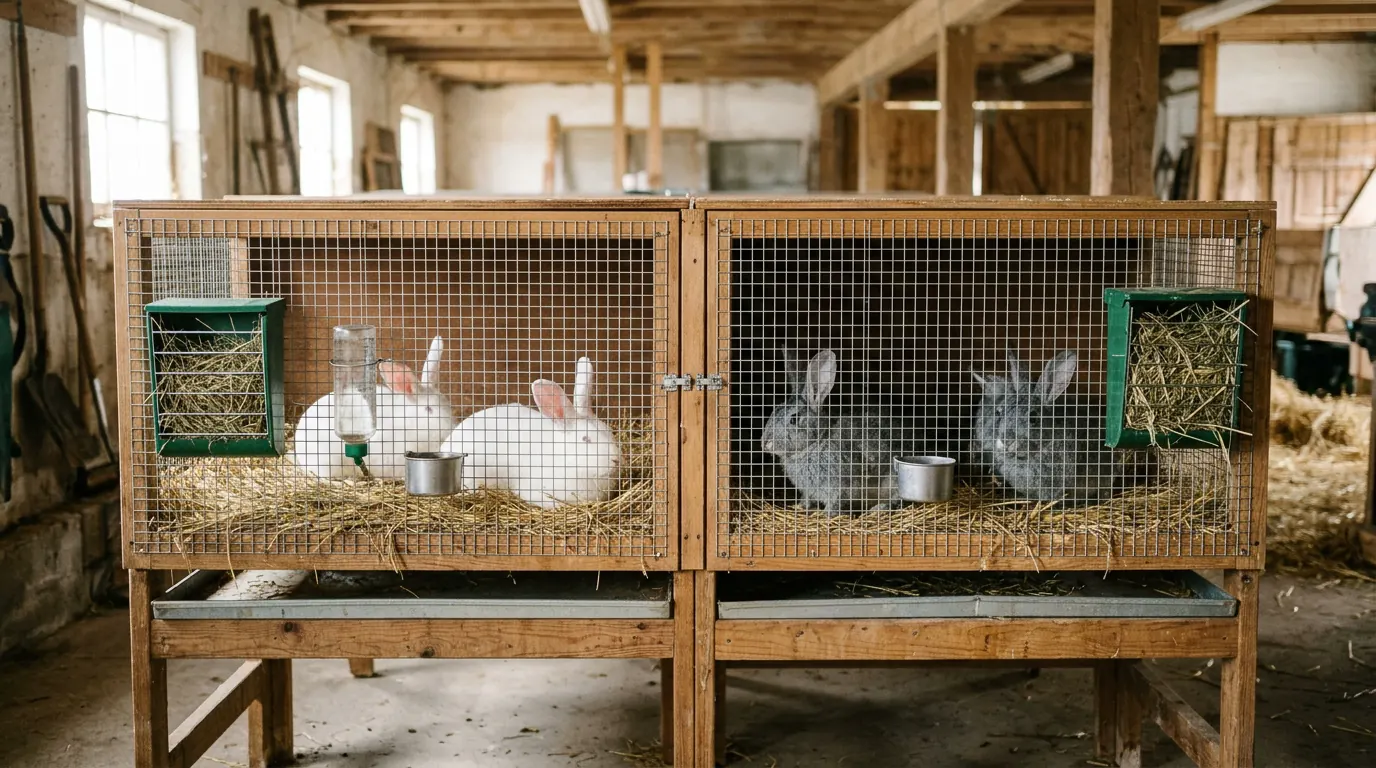
The Vienna rabbit is a compact, sturdy breed kept in blue, white and black varieties. It comes from Austria and is named after Vienna. It is medium-sized: clearly smaller than the giant breeds and heavier than dwarf breeds. Keepers value it for its even, dense fur and calm temperament, less for its growth rate. For intensive meat production, the breeds covered in our overview of meat rabbit breeds are a better choice.
Blue Vienna: the best-known variety
The blue Vienna has even, steel-gray fur with a bluish tint and dark bluish eyes. This variety made the breed popular. Blue in rabbits is a diluted form of black, so blue rabbits are sometimes mistaken for other gray breeds. When buying, check that the color is even over the whole body, with no rusty tinge and no white patches. Such faults lower the animal's score under the breed standard.
White and black Vienna
The white Vienna has snow-white fur and blue eyes. This sets it apart from albino white rabbits such as the New Zealand, which have red eyes. The black Vienna has deep, glossy black fur and dark eyes. In both varieties, an even coat, a compact body and no color faults matter. We cover white meat breeds separately: the New Zealand rabbit and the Termonde White rabbit.
What the Vienna rabbit is used for
A meat and fur breed with hobby reach
The Vienna rabbit goes mainly to hobby breeders, shows and backyard keeping. In Poland it is not a breed used on a large scale in commercial meat production. Wiadomości Zootechniczne (2017), a Polish animal science journal, describes how breeds and lines are chosen for meat production: commercial farms go for breeds and crosses with fast growth and good carcass yield. A Vienna can give good meat for your own table, but it will not match breeds selected for fattening.
Fur as the main asset
Even color and dense coat are the breed's main strengths. Well-kept Vienna rabbits have smooth, glossy fur, and you should judge it before you decide to keep an animal for breeding. The blue and black varieties show off coat quality well. The white needs a clean cage, because yellow urine stains immediately lower the value of the fur and the show score.
How to choose Vienna rabbits to keep
Where to buy and what to check
Buy Vienna rabbits from breeders with documented parentage, ideally people who show their animals. Check fur color, evenness, body build and eyes. In the white variety, check that the irises are blue, not red. The animal should be clean, with a dry nose and no signs of nasal discharge. Agree with the breeder on the age at which you take young rabbits. Ask about vaccination against RHD and myxomatosis, which we cover in our guide to rabbit vaccination.
Vienna rabbit price
Prices depend on the variety, age, the parents' background and whether the rabbit is meant for further breeding or only for keeping. Animals from show lines and with a pedigree cost more than ordinary young rabbits for home use. Ask the breeder, a market or the breed club for actual prices. Animals with color faults that do not meet the standard sell for less.
Mating and rearing young
Choosing a pair
When pairing, look at the color, build and health of both parents. The breed is small, so close relationships come easily. Keep records of each animal's parentage and avoid mating close relatives. Exact mating dates and the age for first mating are in our guide to mating rabbits. If you plan to keep blue and black varieties side by side, keep separate pedigrees and note which rabbits gave young that match the standard.
Kindling and weaning
The doe needs a quiet place, a nest of dry straw and access to fresh water. For the nest and weaning, read our guide to kindling and rearing young. Young Viennas grow more slowly than typical meat breeds, so do not rush weaning or selling. Select for color and build gradually as the young grow up.
What to feed Vienna rabbits
Energy needs
A guide from WODR Poznań (the agricultural advisory center in Poznań) says feed for adult rabbits outside the breeding period should not exceed 2400 kcal per 1 kg of ration. For pregnant and nursing does, the energy content must be higher, about 2600–2700 kcal per 1 kg of ration. Needs depend on the animal's physiological state: a doe after kindling needs much more feed than a resting buck.
Hay, pellets, water
The base of the ration is good hay and complete pellets, and the animals must always have clean water. We describe the details in our guide to feeding rabbits. Choose bowls and drinkers that cannot be tipped over or fouled. For an overview of options, see our text on drinkers and feeders for rabbits.
Cages, health and rules
Cage and hygiene
The cage should be dry, airy, free of drafts and easy to clean. The white variety needs bedding changed more often, because dirt shows at once. In its 2020 opinion, EFSA (the European Food Safety Authority) compared housing systems and named restricted movement as one of the main negative features of cages, including enriched cages. So give your rabbits as much space as your setup allows.
Diseases and rules
Vienna rabbits face the same diseases as other breeds: rabbit hemorrhagic disease, myxomatosis and pasteurellosis. We cover herd protection in our guides to rabbit hemorrhagic disease (RHD) and myxomatosis. Only a vet chooses the treatment, the medicine and the dose, and after medicines a withdrawal period applies before slaughter. Registration and sales requirements are in our text on rabbit keeping and the rules.
Frequently asked questions
What does a blue Vienna rabbit look like?add
It has even, steel-gray fur with a blue tint and dark bluish eyes. The body is compact and medium-sized. The color should be even, with no patches or rusty tinge.
Does the Vienna rabbit have blue eyes?add
The white variety has blue eyes, which sets it apart from albino rabbits with red eyes. The blue variety has dark bluish eyes and the black has dark eyes.
Is the Vienna rabbit good for meat?add
You can raise it for meat for your own use, but the breed is not selected for fast growth. Commercial production uses meat breeds and their crosses, described in our overview of meat rabbit breeds.
How much does a Vienna rabbit cost?add
The price depends on the variety, age and parentage. Animals with a pedigree and from show lines cost more than rabbits for backyard keeping. Ask a breeder or the breed club for the current price.
What should you feed a Vienna rabbit?add
The base is hay, pellets and constant access to water. For adult rabbits at rest, feed energy should not exceed 2400 kcal per 1 kg of ration, and for pregnant and nursing does it is about 2600–2700 kcal per 1 kg, according to the WODR Poznań guide.
Do Vienna rabbits need vaccinating?add
Yes, like any rabbit. Vaccination against RHD and myxomatosis protects the herd, and a vet sets the schedule.
Sources & resources
- linkIZ PIB — Wiadomości Zootechniczne — Little-known endangered rabbit breeds (D. Kowalska et al.), WZ XLV(2007)3:71–75
- linkIZ PIB — Wiadomości Zootechniczne — The rabbit: economic importance, choice of breeds and lines for meat production (J. Składanowska-Baryza), WZ LV(2017)3:13–23
- linkWODR Poznań — Rabbit keeping: basic rules and housing conditions
- linkEFSA AHAW Panel (copy in the CSIC repository) — Health and welfare of rabbits farmed in different production systems (EFSA Journal 18(1):5944)
- linkFAO — The rabbit: husbandry, health and production (F. Lebas et al., FAO Animal Production and Health Series 21, revised ed.)
Prepared by: DlaFerm Team based on data from the sources listed · Publisher: INSTA-TECH sp. z o.o.
Want to improve your farm's biosecurity?
The biosecurity plan generator in DlaFerm.pl helps you write down rules for farm entry, hygiene and handling new animals. Create a free farm account or get in touch, and we will show you how to use it.
Phone
+48 796 258 151