Rabbit farming regulations in Poland: registration, welfare, sales
Keeping rabbits for your own use or on a small scale is different from running a commercial farm. According to the IZ PIB guide (Poland's National Research Institute of Animal Production), the tax duty and registration with the municipality start when your breeding herd goes above 50 does. We explain what to report, how to look after welfare and what to watch when you sell.
verifiedFrom the team that has organised work on poultry farms for years.
Do you have to register a rabbit farm? It depends on herd size. The IZ PIB guide for breeders and cooperatives of meat rabbit producers says the tax duty starts when the breeding herd, meaning the does that kindle, goes above 50 animals. You then register the activity with your municipality as a special branch of agricultural production and report it to the tax office. Below 50 does the guide says this duty does not arise, but veterinary and animal welfare rules apply to you at any number of animals.
The legal position we describe is dated 23.11.2026. We do not give act numbers, because tax, veterinary and animal protection rules change independently of each other. Check the current wording in the Internetowy System Aktów Prawnych (Poland's online legal acts database), at your municipal office and with the county veterinary officer (powiatowy lekarz weterynarii). If you are only planning to start, begin with Rabbit farming: where to start.
When you have to register a rabbit farm
The 50-doe threshold
According to the IZ PIB guide, how you keep your rabbits does not matter. Cage type, outdoor keeping or housing indoors does not change the threshold. What counts is the does that kindle. When there are more than 50, you must meet the tax duty. This also applies to a farm run alongside another job. You count does in the breeding herd, not fattening rabbits or young stock. If your herd is growing, count does with a margin, because going over the threshold during the year requires a report.
How reporting works
The guide describes two steps. First, you register the activity at the municipal office as a special branch of agricultural production. Second, you report it to the tax office. This activity is taxed with a flat-rate tax, and the basis is the number of does you keep. Rates and forms change, so ask the municipal and tax offices what applies now. When you plan your scale, also work out costs with Rabbit farm profitability.
Your duties toward the Veterinary Inspection
Registration and veterinary supervision
Whether your farm needs a veterinary entry or supervision depends on scale and how you sell. The surest way is to ask the county veterinary inspectorate (Inspekcja Weterynaryjna). Do it before your first sale, not after. In practice, inspectorates expect you to know how many animals you keep, where you bought them and who you sell to. Record this data from day one.
Infectious diseases and vaccination
If you suspect an infectious disease, call a vet. Do not wait for another animal to die. For rabbits, RHD (rabbit hemorrhagic disease) and myxomatosis matter most. We describe symptoms and rules on Rabbit hemorrhagic disease (RHD) and Myxomatosis in rabbits, and the schedule in Rabbit vaccination. The vet always chooses the medicine and dose. You keep to the withdrawal period before slaughter and record every treatment.
Rabbit welfare: what the data and recommendations say
Equipment and farm organization
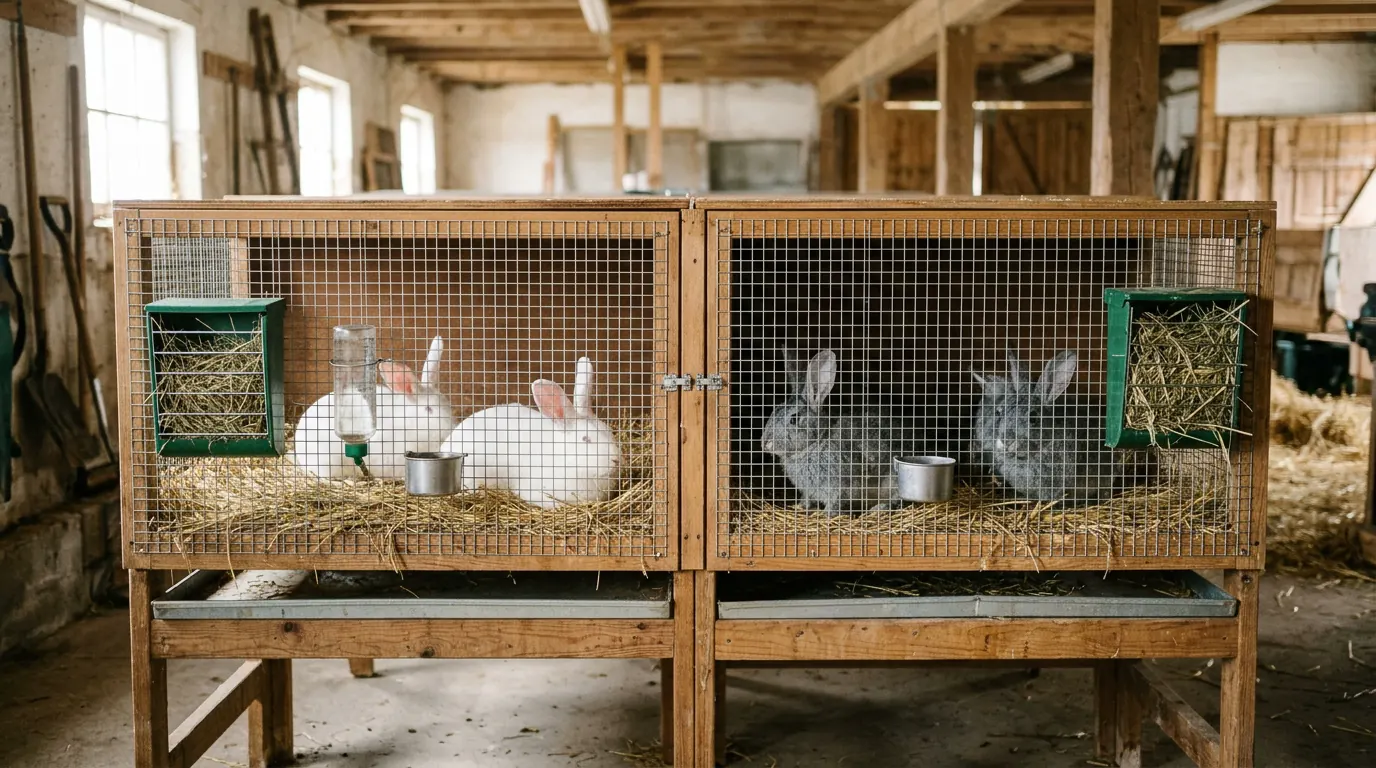
The IZ PIB guide on a higher welfare standard puts it simply: proper farm organization and suitable equipment matter most. Technical solutions should give animals good well-being and not make daily work harder. You choose cages or pens to fit the planned size of the farm and the buildings you have. Remember also to follow the rules that apply to this activity. We cover dimensions and materials in Cages and pens for breeding rabbits.
EFSA's assessment of housing systems
The European Food Safety Authority (EFSA), in its 2020 opinion (EFSA Journal 18(1):5944), compared rabbit housing systems. Enriched cages got the second highest overall welfare impact score for fattening rabbits (2.6). Among the main problems the opinion lists restricted movement: 0.9 for does, 0.2 for young rabbits and 1.3 for fattening rabbits. These are expert assessment scores, not a standard you must meet. They do show what to look at when you choose and set up cages.
Feeding and water
Welfare also means feed and water. According to a table in an IZ PIB publication (Potępka, 2011, after Kostro and Gliński 2005 and Maertens 1992), does rearing young need 17.5–18% crude protein and 11.5% crude fiber. Fattening young rabbits need 16.0–16.5% protein and 14.5% fiber. We cover details in Rabbit feeding, and watering equipment on Drinkers and feeders for rabbits.
Selling rabbits and rabbit meat
Live animals, carcasses and slaughter
Selling live rabbits for breeding is not the same as selling meat. If you want to sell carcasses, where and how you slaughter and who supervises it matter. The rules depend on scale and sales channel, so agree them with the county veterinary officer before you buy slaughter equipment. Before slaughter you keep to the withdrawal period after every treatment. We cover slaughter details and buy-in in Rabbit meat: slaughter, carcass sales and buying-in.
Scale and market
The rabbit meat market is export-oriented. According to FAO data from 2013, cited by Składanowska-Baryza in Wiadomości Zootechniczne (2017), 44% of meat sold abroad from Poland went to China (162,746 t). Farms producing for such a buyer keep at least 150–200 does in the breeding herd. This gives steady supplies of carcasses with similar quality standards. Buying prices change often, so we give no amounts. Check them with buyers and in offers from local customers.
Records worth keeping from day one
What to record
The rules do not set one breeding notebook format for every scale, but inspections usually ask about the same things. Record the number of does and bucks, litters, deaths, purchases and sales, and every treatment with its date and withdrawal period. A list of people entering the rabbitry also helps, and it matters for biosecurity. For treatment records use Treatment and withdrawal periods, and for visitors the QR entry and exit log.
Biosecurity on a small farm
Biosecurity does not need big spending. Quarantine new animals separately, limit entry for strangers and clean equipment between groups. Keep new rabbits apart before you add them to the herd. A written plan helps when a second person works with you. You can prepare one in the Biosecurity plan generator. We cover respiratory disease in Pasteurellosis and snuffles in rabbits.
Frequently asked questions
Do you have to register a rabbit farm in Poland?add
According to the IZ PIB guide, the tax duty starts when the breeding herd goes above 50 does. You then register the activity with your municipality as a special branch of agricultural production and report it to the tax office. With a smaller herd, ask the municipality and the county veterinary officer which rules apply to you.
How many rabbits can you keep before paying tax?add
The IZ PIB guide speaks of a threshold above 50 does that kindle, not of all rabbits. The flat-rate tax is based on the number of does you keep. Check current rates at the tax office.
Where do you register a rabbit farm?add
You register the activity in the special branch of agricultural production at the municipal office, then report it to the tax office. Discuss veterinary matters with the county veterinary inspectorate. Before the visit, gather data on the number of animals and how you keep them.
Can I sell rabbit meat from my own farm?add
Yes, but the rules depend on how you slaughter, your scale and where you sell. Settle them first with the county veterinary officer. Before slaughter, keep to the withdrawal period after treatment, which the vet sets.
What rules cover rabbit welfare?add
Animal protection rules apply, and you can check their wording in the Internetowy System Aktów Prawnych. The IZ PIB guide on a higher welfare standard and the 2020 EFSA opinion give practical guidance. Plan cage dimensions and housing conditions from these sources.
What should I do if I suspect RHD or myxomatosis?add
Call a vet and isolate sick animals. Do not move rabbits or equipment between cages. We describe details in our articles on RHD and myxomatosis, and you plan vaccination with your vet.
Sources & resources
- linkIZ PIB — Rabbit meat production technology under a higher animal welfare standard. Guide for breeders and members of meat rabbit producer cooperatives (ed. Z. Kryński)
- linkEFSA AHAW Panel (copy in the CSIC repository) — Health and welfare of rabbits farmed in different production systems (EFSA Journal 18(1):5944)
- linkIZ PIB — Wiadomości Zootechniczne — The rabbit: economic importance, choice of breeds and lines for meat production (J. Składanowska-Baryza), WZ LV(2017)3:13–23
- linkIZ PIB — Wiadomości Zootechniczne — Problems and options in rabbit feeding on small farms (W. Potępka), WZ XLIX(2011)2:37–42
- linkInternetowy System Aktów Prawnych (Poland's online legal acts database) — isap.sejm.gov.pl
- linkGłówny Inspektorat Weterynarii (Chief Veterinary Inspectorate) — gov.pl/web/wetgiw
Prepared by: DlaFerm Team based on data from the sources listed · Publisher: INSTA-TECH sp. z o.o.
Record treatments and withdrawal periods in one place
The Treatment and Withdrawal module in DlaFerm helps you keep track of treatment dates and withdrawal periods before you sell animals. Set it up on a free farm account, or get in touch and we will show you how to use it.
Phone
+48 796 258 151