Rabbit cages and pens for breeding rabbits: sizes and materials
A good rabbit cage is dry, protected from rain and wind, easy to clean and resistant to gnawing. We cover materials, wire mesh, floors, wooden hutches, modern designs and pens, and what to check before you buy.
verifiedFrom the team that has organised work on poultry farms for years.
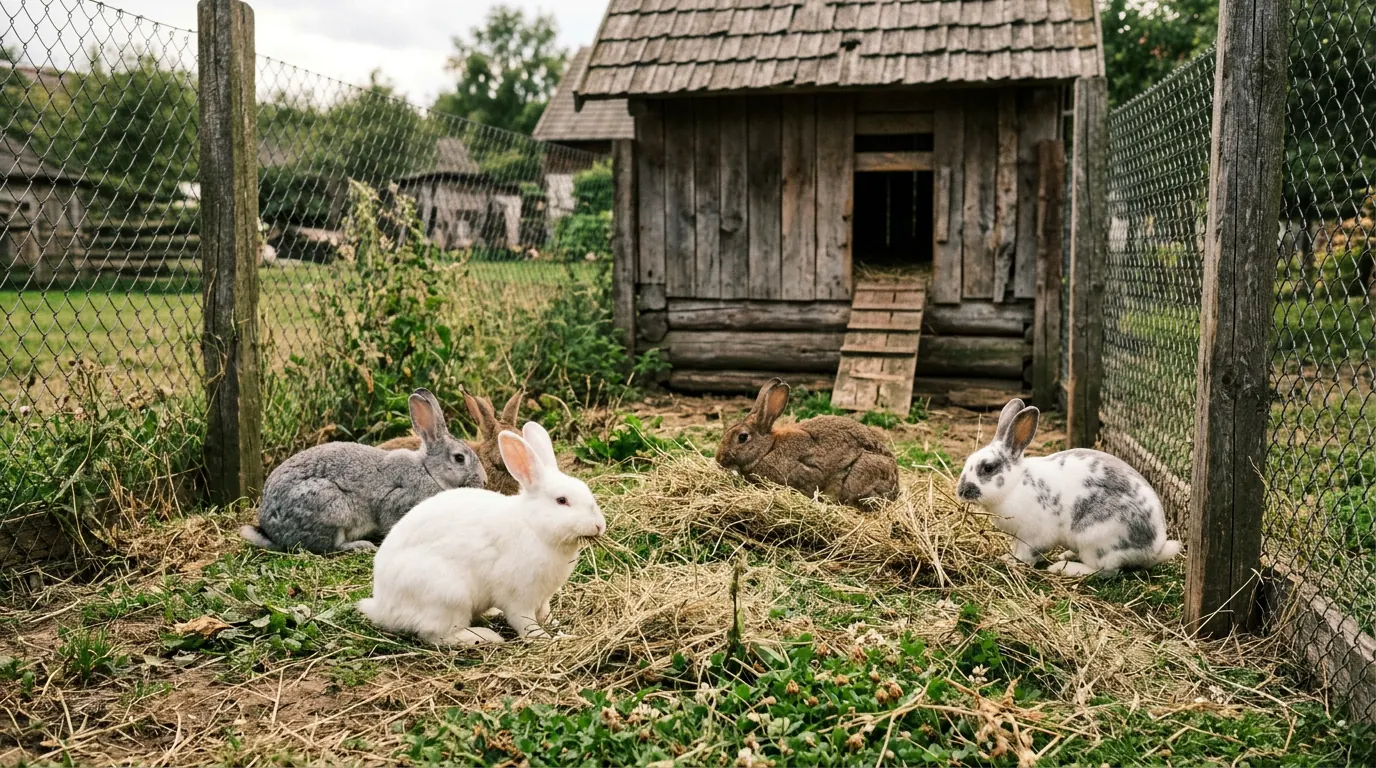
The most common housing for rabbits is the freestanding cage, with one or several tiers. According to a guide from WODR Poznań (the Wielkopolska agricultural advisory center), rabbits tolerate low temperatures, so you can keep them outdoors all year. The cage must then protect them from rain, wind and damp. Wood is the basic material, and surfaces rabbits can gnaw are covered with steel sheet.
Before you buy or build cages, settle the breed and the production purpose. A medium-size meat rabbit has different needs from a giant breed. We describe breed choice in our articles on meat rabbit breeds and rabbit breeds. The cost of cages feeds into the calculation in our text on rabbit farming profitability.
What to make a rabbit cage from
Wood and sheet metal
WODR Poznań states that the basic material for building cages is wood plus steel sheet parts. Sheet metal covers exposed surfaces, for example the sides by the door and the small shelves, so rabbits cannot gnaw them. Rabbits chew anything that sticks out, so protect edges and corners while you build, not after the first damage.
Mesh in the doors
Doors usually have galvanized mesh with 2.5 × 2.5 cm openings. This mesh gives ventilation and lets you see the animals. In winter you can cover the door with a piece of cardboard cut to size. It keeps wind out of the cage and prevents excessive chilling.
Roof and tiers
Build the roof at a slight angle so rainwater does not stand on it. Cover it with a waterproof material, for example roofing felt. In multi-tier cages the tiers must be sealed off from each other. That way droppings and urine from above do not fall on the animals below.
Floor, litter and cleanliness
WODR Poznań recommends that the floor of every cage always be covered with clean litter. It insulates the animals from the ground, and well-chosen litter makes cleaning easier. Change litter regularly, because damp litter encourages disease.
Cage floors
A guide from IZ PIB (Poland's National Research Institute of Animal Production) describes floor grids for cages that can be cleaned with chemical agents. The total size of a grid is 25 × 25 cm or 25 × 36 cm. A 25 × 50 cm grid is also available and can be joined into larger modules. According to the guide, such floors make it easier to keep cages clean and hygienic and improve animal comfort. When choosing, check that the grid is level and has no sharp edges.
Wooden rabbit hutch: ready-made or homemade
Example of a 6-compartment hutch
The IZ PIB guide describes a wooden hutch for medium-size rabbits with 6 compartments, offered online for about PLN 750 (the price from the publication; it may be different today). The hutch is 180 cm long, 75 cm deep and 120 cm high. One compartment measures 60 × 77 × 60 cm. The floor and dividers are made of dry, planed pine boards, and the sides and back of tongue-and-groove boards. The whole hutch is painted with wood preservative.
Building your own
The guide's authors note that you can also build wooden hutches yourself. Use dry wood and protect it from damp. Remember sheet metal on edges, sealed tiers and a roof with roofing felt. Before you build, plan where the drinkers and feeders will go. We describe the principles in our article on drinkers and feeders for rabbits.
Modern rabbit cages
The IZ PIB guide points out that, when buying cages for professional meat rabbit farming, it is worth looking at the offer of the French company Meneghin and the Italian company Clerici. They are aimed at producers who want to keep rabbits in above-standard welfare conditions. The authors also suggest that the diagrams in the guide's appendix be used to develop Polish cage designs for "happy rabbits", or to import them.
Regulations and cages
We describe welfare and registration requirements in our article on rabbit farming regulations in Poland. Before a bigger investment, check them and talk your plan through with the county veterinarian (powiatowy lekarz weterynarii).
Rabbit pen and nest boxes
Pen and portable cage
The EFSA report on rabbit welfare describes an example of an organic system: a portable wire-mesh cage that lets rabbits graze on pasture. It has a covered part with solid walls. For does with a litter it serves as the nest, and for young rabbits reared in a group it is a place to rest and shelter. A feeder with feed or hay goes in the shelter, and water is given by hand.
Nest boxes
Research by IZ PIB at the Chorzelów Experimental Station showed that closed wooden nest boxes, placed in the cage or outside it, increased the number of rabbits raised per litter by about 1.2 kits. Losses while kits were with their mothers fell by about 15%. We describe rearing in detail in our article on kindling and raising kits.
Cage selection checklist
Check in turn: whether the roof is angled and covered with waterproof material, whether the tiers are sealed apart, whether edges have sheet metal, whether the mesh has 2.5 × 2.5 cm openings, and whether the floor has clean litter or an easy-to-clean grid. Also leave room for a nest box for does. Once you have chosen cages, move on to a plan for feeding rabbits and a vaccination schedule. We cover the whole business on our page about rabbit farming.
Frequently asked questions
What are the best cages for rabbits?add
According to WODR Poznań, the basics are wood with steel sheet on exposed edges, galvanized 2.5 × 2.5 cm mesh in the doors and a roof covered with waterproof material. For professional farming, consider designs with a higher welfare standard.
Is a wooden rabbit hutch a good choice?add
Yes. Wooden cages are the most commonly used, also by hobby keepers. The wood must be dry and protected from damp, and edges covered with sheet metal against gnawing. The IZ PIB guide also describes building such a cage yourself.
What size is a cage for medium-size rabbits?add
The IZ PIB guide gives the example of a 6-compartment hutch: 180 cm long, 75 cm deep and 120 cm high, with a compartment of 60 × 77 × 60 cm. This is one example, not a rule. Check welfare requirements in the regulations and with a veterinarian.
Can rabbits live outside in winter?add
According to WODR Poznań, rabbits tolerate low temperatures and can be kept outdoors all year. The cage needs a dry roof, wind protection and clean litter. In winter you can cover the doors with cardboard.
What should I put on a rabbit cage floor?add
WODR Poznań recommends clean litter, which insulates from the ground and makes cleaning easier. An alternative is cage floors of 25 × 25 cm, 25 × 36 cm or a 25 × 50 cm grid, described in the IZ PIB guide.
Is a nest box worth it?add
According to IZ PIB research at Chorzelów, closed wooden nest boxes increased the number of young raised per litter by about 1.2 rabbits and cut losses by about 15% while kits were with their mothers.
Sources & resources
- linkIZ PIB — Technology of rabbit meat production under a higher animal welfare standard. Guide for breeders and members of rabbit meat producer cooperatives (ed. Z. Kryński)
- linkWODR Poznań — Rabbit keeping: basic rules and housing conditions
- linkIZ PIB — Farming and breeding of livestock over 70 years: Poultry Breeding Department and Small Livestock Breeding Department (ed. D. Kowalska, K. Połtowicz)
- linkEFSA AHAW Panel (copy in the CSIC repository) — Health and welfare of rabbits farmed in different production systems (EFSA Journal 18(1):5944)
Prepared by: DlaFerm Team based on data from the sources listed · Publisher: INSTA-TECH sp. z o.o.
Keep biosecurity tight in your animal housing
The <a href="/generator-planu-bioasekuracji">biosecurity plan generator</a> in DlaFerm helps you set entry and cleaning rules for your farm. Create a free farm account or get in touch.
Phone
+48 796 258 151