Meat rabbit breeds: which grow fastest
Hybrid rabbits grow fastest. According to a guide from Poland's IZ PIB (National Research Institute of Animal Production), they reach a slaughter weight of 2.5 kg at 70 days of age, while the parent breeds need 90 days. Among pure breeds, commercial keepers most often choose New Zealand White, Termond White and Californian. We explain how they differ and how to match animals to your farm.
verifiedFrom the team that has organised work on poultry farms for years.
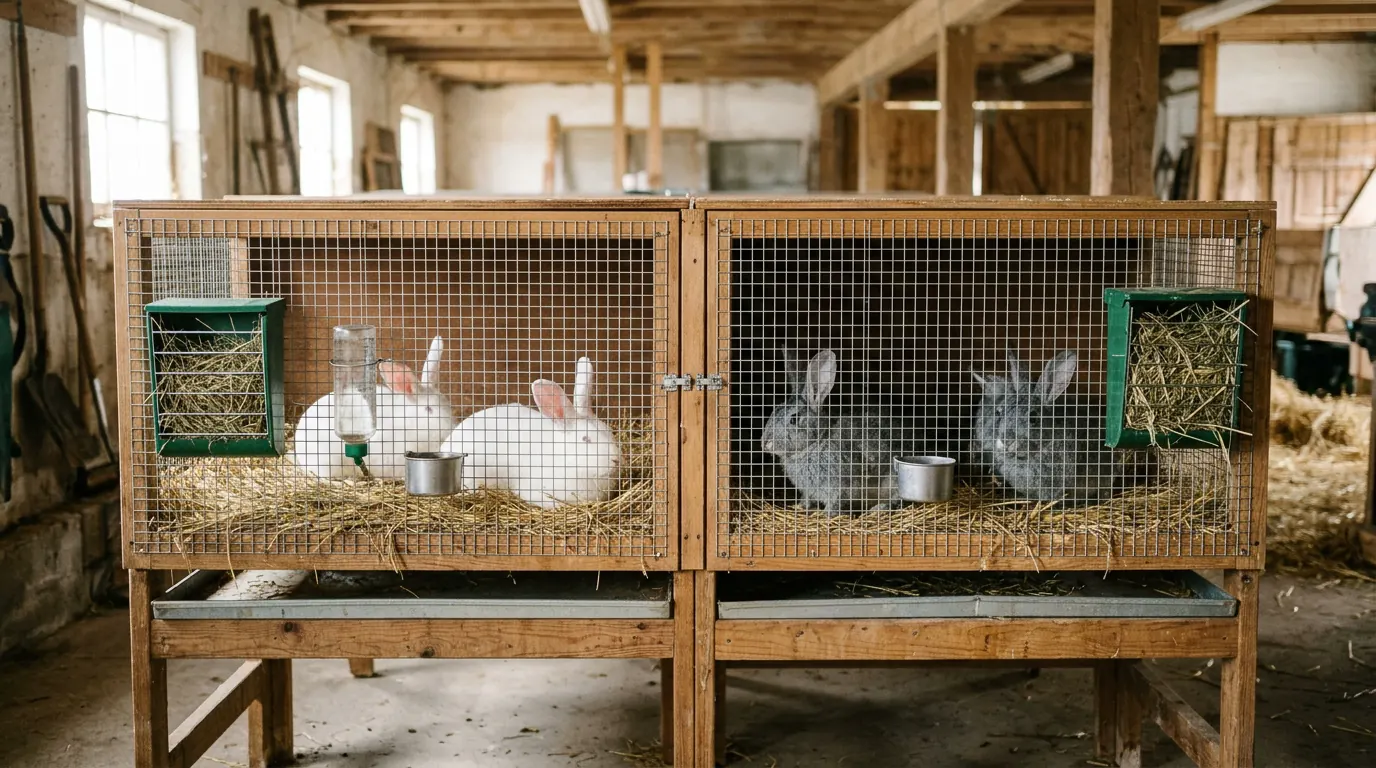
Hybrid rabbits give the fastest gain, not pure breeds. The IZ PIB guide for rabbit meat producers says hybrids reach a slaughter weight of 2.5 kg at 70 days of age, while the parent breeds need 90 days. If you start with pure breeds, look among New Zealand, Termond and Californian rabbits. For an overview of all the production types, see Rabbit breeds: meat, fur and giants.
What are broiler rabbits
Broiler rabbits are animals meant for fast fattening and slaughter. They can be meat breeds or crossbreds from several lines. Breeds are grouped by purpose: meat, meat and fur, fur, wool, laboratory and ornamental. The Institute of Animal Science (Instytut Zootechniki PIB) notes that there are about 100 rabbit breeds worldwide, differing in build, size, and the color and structure of the coat. Only a small share of them are used for meat. How to start and what it costs is covered in Rabbit farming: where to start, costs and profitability.
Meat breeds worth knowing
New Zealand rabbit
The white and red varieties are among the most popular meat breeds. According to the IZ PIB guide, New Zealand White was one of the breeds on which Western hybrids were built. It is a popular choice to start with because it copes well with standard farm conditions. For a full description, see New Zealand rabbit: white and red meat breed.
Termond White rabbit
Termond White is also a meat breed, used as a base for crossing. It needs stable conditions and good feed. We cover body weight, requirements and use in Termond White rabbit: a meat breed.
Californian rabbit
The Californian is a meat breed with dark markings on the ears, nose, feet and tail. The same guide lists it next to New Zealand and Termond as a base for hybrid lines. You will find the breed description in Californian rabbit: a meat breed with dark markings.
Other working breeds
Other breeds are also used for meat and for meat and fur. We describe them separately: the Giant Chinchilla and the Burgundy rabbit. The native Popielno White breed (popielniańska biała) was studied by IZ PIB as a base for commercial meat production, including in crossing.
Which rabbits grow fastest
Broiler hybrids
The IZ PIB guide describes hybrids as highly prolific animals with clearly better growth rate. They reach a slaughter weight of 2.5 kg at 70 days of age, and the parent breeds at 90 days. Hybrids were developed in Western countries, mainly from New Zealand White, Termond White and Californian breeds plus local breeds. Breeding companies from France and Germany lead here. Developing one line takes more than ten years on average, and work on the hybrids of one French company lasted over thirty years.
What hybrids need
The guide stresses that hybrids repay you with high output but need much better conditions than pure broiler breeds. This applies to feeding, housing and prevention. With artificial insemination, work on the farm takes less time than with a similar number of pure-breed does. When you buy hybrids, make sure they come from a grandparent stock, not a production stock.
Why you should not breed from hybrids
Rabbits from production stock are not suitable for further breeding. In the F2 generation the traits split, and you will not get the expected performance despite the money spent. If you want your own breeding stock, stay with pure breeds and select by the rules in Breeding rabbits: age, timing and pairing.
How to choose a breed for your farm
Scale and conditions
On a small family farm a pure breed is simpler to manage and lets you keep your own replacement stock. Hybrids make sense when you can give them a higher housing standard and have steady access to grandparent-stock animals. Before buying, work out the cost of feed, cages and vaccination using Rabbit farming profitability: costs and calculation.
Feeding decides gain
Even the best breed does not grow fast on poor feed. Dr W. Potępka of IZ PIB describes feeding problems on small rabbit farms, including the difficulty of providing a balanced ration. We cover feed, hay and water in Feeding rabbits: feed, hay, pellets and water.
Herd health
Fast growth does not help if the herd is sick. Vaccinate your rabbits following the schedule in Rabbit vaccination: RHD and myxomatosis schedule. A vet decides on vaccination and treatment.
Selling live rabbits and meat
Prices of live rabbits and carcasses vary by region, buyer and season. Check them directly with buyers and with local agricultural advisory centers. Slaughter and carcass sales rules are in Rabbit meat: slaughter, selling carcasses and buyers. Registration and welfare requirements are in Rabbit farming and the rules: registration, welfare, sales.
Frequently asked questions
Which rabbits grow fastest?add
Hybrid rabbits grow fastest. According to the IZ PIB guide, they reach a slaughter weight of 2.5 kg at 70 days of age, and the parent breeds at 90 days. They need better conditions than pure breeds.
What are the best meat rabbit breeds?add
For meat, keepers most often choose New Zealand White, Termond White and Californian. These are the same breeds on which Western hybrids were built. The choice depends on farm scale and housing conditions.
What are broiler rabbits?add
They are rabbits meant for fast fattening and slaughter. They can be meat breeds or hybrid crossbreds. Hybrids grow faster but need a higher housing standard.
Can you breed hybrid rabbits?add
No. Rabbits from production stock are not suitable for further breeding, because in the F2 generation the traits split and performance drops. Buy animals from a grandparent stock.
How many rabbit breeds are there in the world?add
According to the Institute of Animal Science (Instytut Zootechniki PIB), there are about 100 breeds, differing in build, size, and coat color and structure. Only a small share is used for meat.
Do meat rabbits need vaccinating?add
Yes. Vaccination protects the herd from serious diseases, including RHD and myxomatosis. Agree the schedule and details with your vet.
Sources & resources
- linkIZ PIB — Technology of rabbit meat production under raised animal welfare standards. Guide for keepers and members of rabbit meat producer cooperatives (ed. Z. Kryński)
- linkIZ PIB — Wiadomości Zootechniczne — Rabbit: economic importance, choice of breeds and lines for meat production (J. Składanowska-Baryza), WZ LV(2017)3:13–23
- linkIZ PIB — Wiadomości Zootechniczne — Little-known endangered rabbit breeds (D. Kowalska et al.), WZ XLV(2007)3:71–75
- linkIZ PIB — Wiadomości Zootechniczne — Problems and options in feeding rabbits on small farms (W. Potępka), WZ XLIX(2011)2:37–42
Prepared by: DlaFerm Team based on data from the sources listed · Publisher: INSTA-TECH sp. z o.o.
Protect your rabbit herd with a biosecurity plan
The DlaFerm <a href="/generator-planu-bioasekuracji">biosecurity plan generator</a> helps you write down the rules for entering the farm and handling animals, and the <a href="/ksiega-wejsc-na-ferme">QR entry and exit log</a> records visits. Create a free farm account or get in touch, and we will show you how to use them.
Phone
+48 796 258 151