Termonde White Rabbit: A Meat Breed
The Termonde White (Polish: termondzki biały, TB) is a large meat rabbit with a snow-white coat and red eyes. It came to Poland from Belgium in 1977. We cover the breed standard, body weight, feeding and where the breed fits among meat rabbits.
verifiedFrom the team that has organised work on poultry farms for years.
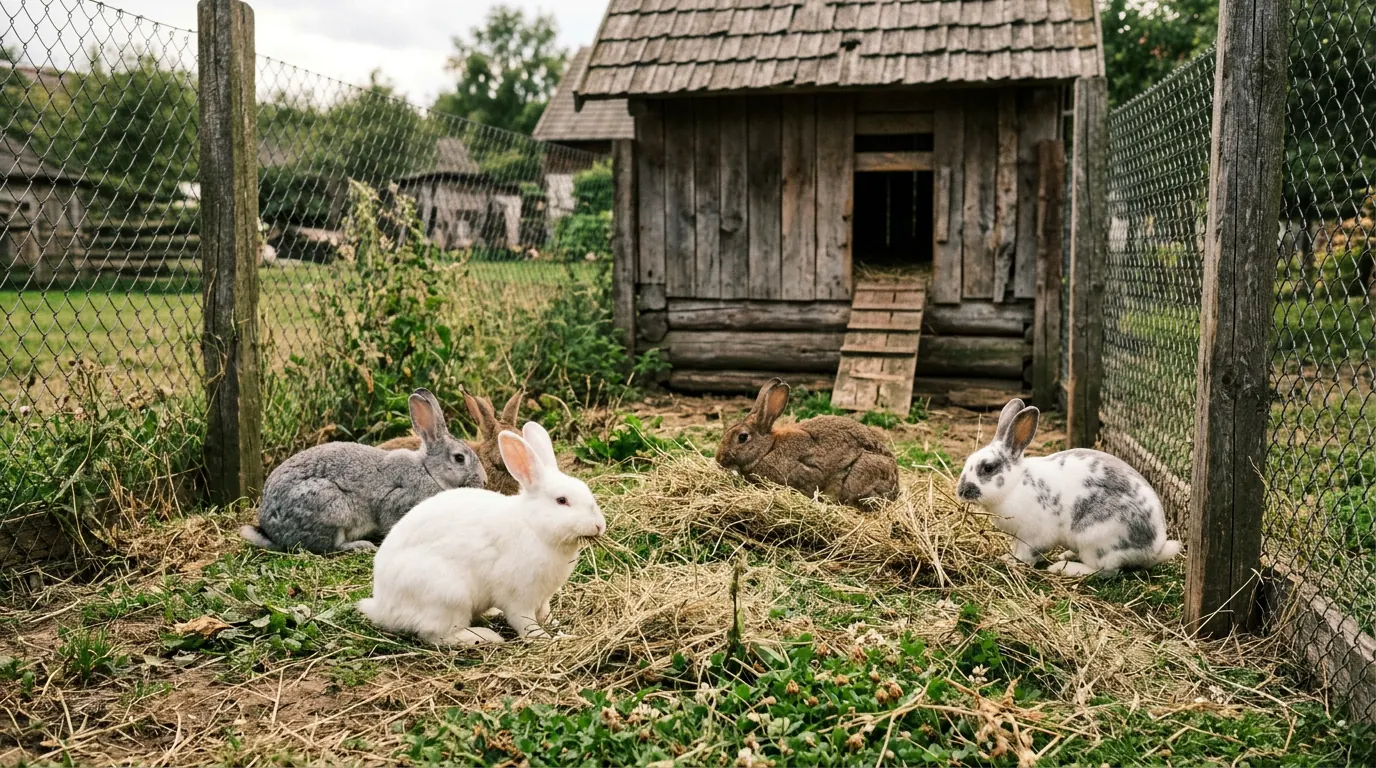
The Termonde White is a meat breed with a uniformly snow-white coat and red eyes. By the breed standard it should reach 2.5 kg at 3 months of age, and an adult weighs 3.5 to 5.7 kg. Breeders shorten the name to "TB". The breed is described in a guide for meat rabbit breeders from the Instytut Zootechniki PIB (National Research Institute of Animal Production, IZ PIB).
Where the breed comes from
According to the IZ PIB guide, the first Termonde rabbits were brought from Belgium to the IZ Experimental Station in Chorzelów in 1977. The white Flemish Giant was used to develop the breed. That is why Termonde rabbits have large ears, a long body and a long muzzle. You can read more about the giant breed in the article on the Flemish Giant.
Where the breed fits in production
A scientific article in Wiadomości Zootechniczne (Animal Science News, 2017) lists the Termonde White among the breeds suited to producing rabbit broilers, next to New Zealand Whites and Reds, Californians and Popielno Whites. A handbook from WODR Poznań (an agricultural advisory center) describes it as one of the breeds most often kept in backyard conditions. If you are just starting out, begin with our page on rabbit farming.
What a Termonde White rabbit looks like
Body build
The IZ PIB guide describes a well-proportioned build: a long, well-muscled body with a broad rump and a slightly narrower front. The head is slightly elongated and set firmly on a long neck. The legs are strong, and the short tail lies close to the body. In does older than one year, the standard allows a small, symmetrical dewlap, which is a fold of skin under the neck. When you judge breeding animals, look at the broad rump and well-muscled back, because that is where most of the meat is.
Ears and coat
The ears are medium thick, well set, rounded at the tips and furred. They are 13 to 15 cm long. The coat is medium dense and springy, and the guard hair is about 3 cm. Guard hair and undercoat are uniformly snow-white over the whole body. The eyes are red, and the claws are flesh-colored or white. Any departure from this color is a breed fault.
Body weight by the standard
By the standard, Termonde rabbits should reach 2.5 kg at 3 months of age. The lowest acceptable weight for a rabbit aged 8 months or older is 3.5 kg, and the highest is 5.7 kg. Weighing young rabbits at the same age lets you compare litters and pick animals to replace breeding stock. Record the results for every litter.
The Termonde White in meat production
A breed for rabbit broilers
Składanowska-Baryza, writing in Wiadomości Zootechniczne (2017), ranks the Termonde White among the breeds very well suited to producing rabbit broilers. The author writes that rabbit meat production in Poland grows every year, although consumption is lower than in Western Europe. Pure breeds are also crossed into hybrid lines for intensive production. Compare it with the New Zealand rabbit and the Californian, the most common breeds in the same role.
Comparison with other breeds
The Termonde has a larger body and bigger ears than the New Zealand, because it inherited them from the Flemish Giant. You will find a full comparison in our article on meat rabbit breeds, and a general overview in rabbit breeds. Before you buy, ask the breeder about the parents' weights and the growth results of the young, not only about coat color.
What to feed Termonde rabbits
Energy in the feed
The WODR Poznań handbook says feed for adult rabbits at rest from breeding should not exceed 2400 kcal per 1 kg of ration. For pregnant and nursing does, the energy content should be higher, at about 2600–2700 kcal per 1 kg. The ration must also contain protein, crude fiber, vitamins and minerals. When you change feed, do it gradually, because a sudden change upsets the digestive tract.
Protein and litter size
The IZ PIB guide notes that feeds with more protein than feed for New Zealand rabbits can give larger litters. The guide gives no figures here, so set the ration with a feeding adviser or the feed producer. We cover hay, pellets and water in our article on feeding rabbits.
Cages, vaccination and breeding
Cage equipment
The WODR handbook says the basic equipment of every cage includes a feed bowl and a water drinker. The bowl should be made of a material rabbits cannot easily tip over or destroy. With a large breed, choose heavy, stable dishes. We explain how to choose in our article on drinkers and feeders for rabbits.
Health and vaccination
A white breed is not more resistant than others. Plan vaccination against RHD and myxomatosis with a vet, following the schedule in our article on rabbit vaccination. We describe the symptoms of this dangerous disease in rabbit hemorrhagic disease (RHD). The vet always chooses the medicine and dose. Observe the withdrawal period before slaughter.
Kindling and rearing
Preparing the nest, caring for the litter and weaning the young are the same as for other breeds. We describe the steps in kindling and rearing young rabbits. You can work out costs and results using rabbit farming profitability.
Frequently asked questions
How much does a Termonde White rabbit weigh?add
By the breed standard it should reach 2.5 kg at 3 months of age. At 8 months and older it weighs 3.5 to 5.7 kg. The data comes from the IZ PIB guide.
Where does the Termonde rabbit come from?add
The rabbits were brought from Belgium to the IZ Experimental Station in Chorzelów in 1977. The white Flemish Giant was used to develop the breed.
What does a Termonde White look like?add
It has a snow-white coat, red eyes and flesh-colored or white claws. The ears are 13 to 15 cm long. The body is long and well muscled.
Is the Termonde rabbit suited to backyard keeping?add
Yes. The WODR Poznań handbook lists it among the breeds most often kept in backyard conditions. It does need a larger cage than small breeds.
Is the Termonde White a meat breed?add
Yes. Wiadomości Zootechniczne (2017) lists it among the breeds suited to producing rabbit broilers.
How much energy should rabbit feed contain?add
According to the WODR handbook, feed for adult rabbits at rest from breeding should not exceed 2400 kcal per 1 kg. For pregnant and nursing does it is about 2600–2700 kcal per 1 kg.
Sources & resources
- linkIZ PIB — Technology of rabbit meat production under raised animal welfare standards. Guide for breeders and members of meat rabbit producer cooperatives (ed. Z. Kryński)
- linkWODR Poznań — Rabbit keeping: basic rules and housing conditions
- linkIZ PIB — Wiadomości Zootechniczne — Rabbit: economic importance, choice of breeds and lines for meat production (J. Składanowska-Baryza), WZ LV(2017)3:13–23
- linkInstytut Zootechniki PIB — izoo.krakow.pl
Prepared by: DlaFerm Team based on data from the sources listed · Publisher: INSTA-TECH sp. z o.o.
Keeping rabbits alongside other animals? Look after biosecurity
DlaFerm.pl has no separate rabbit module, but the <a href="/generator-planu-bioasekuracji">biosecurity plan generator</a> and the <a href="/ksiega-wejsc-na-ferme">QR entry and exit log</a> help you keep order on any farm. Create a free farm account or get in touch.
Phone
+48 796 258 151