New Zealand rabbit: White and Red meat breed
The New Zealand rabbit is a medium-sized breed kept for meat. The White variety is the best known in Poland, and in production it is often crossed with other breeds. We cover its origin, traits, use in crossbreds and what the breed needs on the farm.
verifiedFrom the team that has organised work on poultry farms for years.
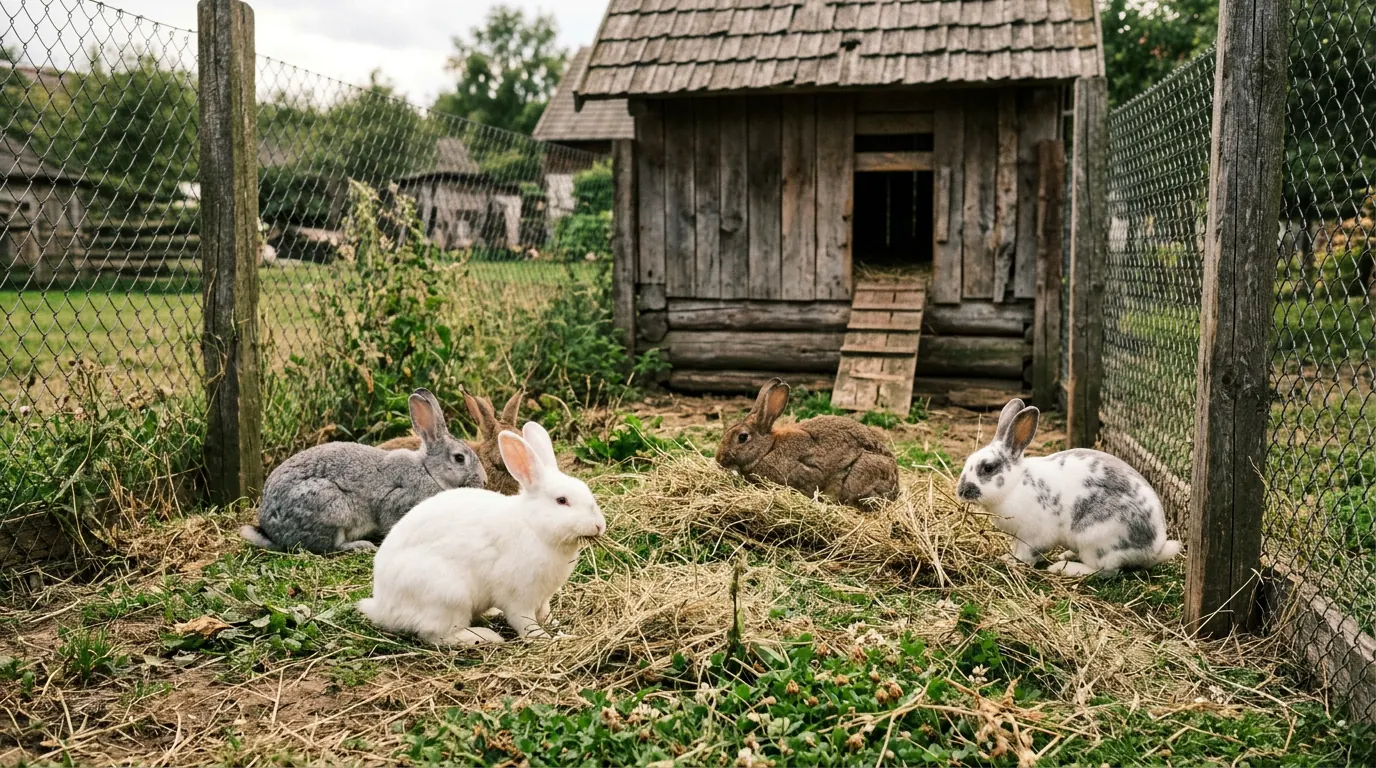
Despite its name, the New Zealand rabbit is a meat breed of American origin. You will most often meet the White variety, an albino with red eyes, and it is usually what people mean by "New Zealand White rabbit". Keepers also raise the Red variety, which is less common. The breed is medium-sized, so it does not match giants such as the Flemish Giant (olbrzym belgijski), but it works well in commercial meat production.
Where the breed comes from
According to the IZ PIB guide for keepers and members of rabbit meat producer cooperatives (IZ PIB is Poland's National Research Institute of Animal Production), the New Zealand White comes from the western USA. The same handbook notes that the Californian rabbit comes from the same region. If you are comparing the two breeds, read about the Californian rabbit. So the name does not mean the breed was developed in New Zealand. It simply follows a naming tradition used when the breed was created.
Who the breed suits
The New Zealand is a sensible choice if you want to produce carcasses, not ornamental or fur rabbits. It is useful both as a purebred and as a component of crossbreds. Before you buy your first animals, read the general guide to raising rabbits and the comparison of meat rabbit breeds.
Varieties and production use of the New Zealand rabbit
White variety
The New Zealand White is an albino: it has white fur and red eyes. The coat is solid white, without markings on the muzzle, ears or paws, unlike the Californian. It is a medium breed with a compact, fleshy build. For exact body weights at each age, see the breed standard and the materials of the Polish Rabbit Breeders Association (Polski Związek Hodowców Królików). A white carcass is easy to judge by eye, because there are no dark patches on the skin.
Red variety
The Red variety has a reddish-ginger coat and is meant for meat in much the same way as the White. It is less common, so finding healthy breeding stock can be harder. If you are considering this variety, ask the breeder to show the pedigree and the production data of the parents. Coat color does not change the value of the carcass, but it does affect how easy it is to get breeding stock and how fast you can find more rabbits to renew your herd.
Use in meat production
Polish specialist literature describes the breed as suitable for carcass production. S. Niedźwiadek studied carcass production from New Zealand White rabbits as early as 1974, taking the value of the pelts into account. In 2016, A. Rybarczyk and A. Łupkowska compared the meat quality of non-breed rabbits and of crossbreds of the Californian and New Zealand White breeds. So the breed and its crossbreds have been studied in Poland for decades.
The New Zealand in commercial crossbreds
Why crossbreds
Crossbreds combine traits of two breeds in one animal, for example the growth rate of one and the fertility of the other. On Polish farms the New Zealand White is used for such crosses. In W. Potępka's article on feeding rabbits on small farms, a photo shows crossbreds of the Giant Papillon (olbrzym srokacz) and the New Zealand White kept in a pen on litter. It is a good example of a practical small-farm setup. You do not have to buy animals from expensive lines, but you should know the origin of both parents.
Which breeds are crossed with the New Zealand
The breeds named most often are meat and meat-fur breeds that you can look up in our catalog: the Giant Papillon, the Californian rabbit, the Thuringian-type Termond White (termondzki) and the Giant Chinchilla. The choice depends on your goal: bigger carcasses, a more even litter or easier sales? Before you cross breeds, ask your buyer what type of carcass they want, and check their requirements for weight and skin color.
What you lose with crossing
You do not breed crossbreds on within your own herd, because the parents' traits split apart in the next generation. If you want a steady line of does and bucks, keep the purebred parent breeds separately. That takes more cages, more records and a mating plan. For a small farm it can be too much, so many keepers buy young fattening stock from a proven breeder and stop there.
Husbandry requirements
Housing
Meat rabbits are kept in cages, pens or a mixed system. We describe welfare and registration rules in the article on rabbit farming regulations. The IZ PIB guide we use covers keeping rabbits under an enhanced welfare standard. For cage size, nest size and stocking density, check the current recommendations of WODR (a regional agricultural advisory center) and IZ PIB. Choose drinkers and feeders as described in the article on rabbit drinkers and feeders.
Feeding
Rabbits need constant access to water and feed matched to their age and physiological state. W. Potępka notes that in 2010, after large rises in rabbit purchase prices, rabbit farming was more profitable than in earlier years, but further rises in feed prices cut profits again. The lesson is simple: feed cost decides the result. You will find the rules for building rations in the article on feeding rabbits.
Health
The breed gives no immunity to infectious diseases. Before you buy, ask whether the seller vaccinates the herd, and once the animals arrive on your farm, give them a separate place for quarantine. We describe vaccination in the article on rabbit vaccination, and the symptoms of the most dangerous diseases in the texts on rabbit hemorrhagic disease (RHD) and pasteurellosis. A vet always chooses medicines and doses, and a withdrawal period applies after treatment.
How to start with the New Zealand rabbit
Where to get animals
Buy from a breeder who keeps records and can show you the parents. Ask about vaccinations, the herd's disease history and how litters are raised. Ask to see the housing. Avoid random online ads where you cannot see the animals on site. You agree the price with the breeder. It depends on age, origin and whether you buy breeding stock or animals for fattening. Do not confuse this price with the buying price for carcasses, which you must check with your specific buyer.
Profitability
Profitability depends on feed price, the number of young weaned per doe and the selling price. The breed helps only partly. Work out your costs using the scheme in the article on rabbit farming profitability, and only then decide how many does to keep. We describe kindling and rearing the young in the text on kindling.
Frequently asked questions
Where does the New Zealand rabbit come from?add
According to the IZ PIB guide, the New Zealand White comes from the western USA, like the Californian rabbit. So the name does not point to breeding in New Zealand.
What is the difference between the New Zealand White and Red?add
The White variety is an albino with white fur and red eyes. The Red variety has a reddish-ginger coat. Both are kept for meat, but the White is more common in Poland.
Is the New Zealand rabbit good for crossbreeding?add
Yes. The literature describes crossbreds of the New Zealand White with the Giant Papillon and with the Californian rabbit. You do not breed crossbreds on within your own herd, though.
How much does an adult New Zealand rabbit weigh?add
It is a medium breed. Exact body weights at each age depend on the line and are given in the breed standard. Check with the Polish Rabbit Breeders Association or an animal science institute.
Where can I buy New Zealand rabbits?add
Best from a breeder who keeps records, vaccinates the herd and lets you see the animals and their parents. You agree the price directly, because it depends on age and origin.
Do New Zealand rabbits need to be vaccinated?add
Yes, the rules are the same as for other breeds. Set the vaccination schedule against RHD and myxomatosis with your vet.
Sources & resources
- linkIZ PIB — Technology of rabbit meat production under an enhanced animal welfare standard. Guide for keepers and members of rabbit meat producer cooperatives (ed. Z. Kryński)
- linkIZ PIB — Wiadomości Zootechniczne — Rabbit: economic importance, choice of breeds and lines for meat production (J. Składanowska-Baryza), WZ LV(2017)3:13–23
- linkIZ PIB — Wiadomości Zootechniczne — Problems and options in feeding rabbits on small farms (W. Potępka), WZ XLIX(2011)2:37–42
- linkWODR Poznań — Rabbit keeping: basic rules and housing conditions
Prepared by: DlaFerm Team based on data from the sources listed · Publisher: INSTA-TECH sp. z o.o.
Want to keep visitors and biosecurity under control on your farm?
With DlaFerm.pl you can keep a QR-code visitor log and build a biosecurity plan for your farm. Create a free farm account or get in touch.
Phone
+48 796 258 151