Is rabbit farming profitable? Costs and calculation
Rabbit farming pays when your selling price covers feed, losses and your own labor with room to spare. Feed is the biggest running cost, and feed prices decide the profit. We show what goes into the sums and how to run them on your own numbers.
verifiedFrom the team that has organised work on poultry farms for years.
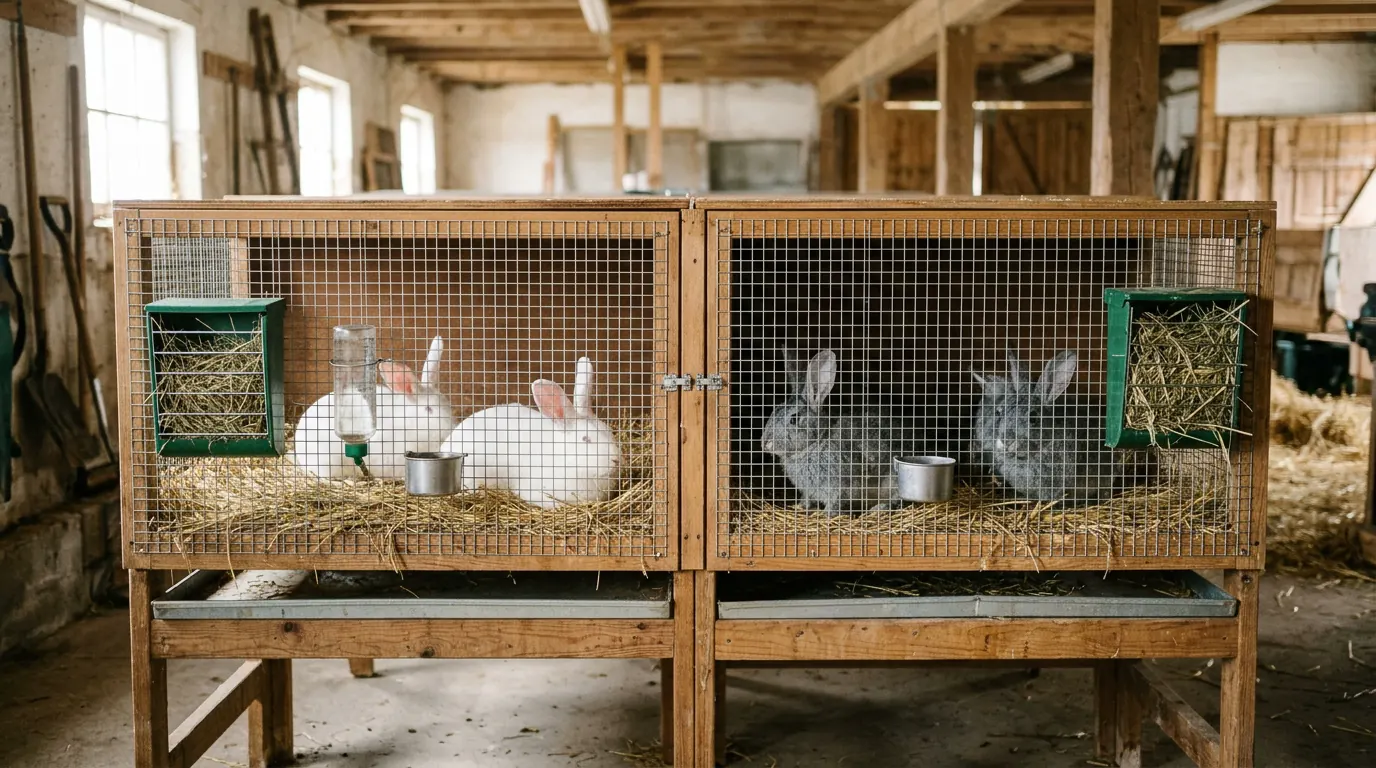
Is rabbit farming profitable? It depends on three numbers: the price you get per kilogram of live weight or per carcass, the feed cost per rabbit, and how many rabbits you actually sell per doe each year. When feed gets dearer and buyers do not raise prices, the profit disappears. When losses are low and rearing runs well, the same sum comes out positive. There is no single answer for everyone. There is a calculation you do for your own farm.
The authors of Wiadomości Zootechniczne (a Polish animal science journal; W. Potępka, 2011) describe a Polish example: in 2010, after big rises in purchase prices, rabbit farming became more profitable than in earlier years. Further large rises in feed prices then cut farm profits again. For a general overview of getting started, read Rabbit farming: where to start, costs and profitability.
Startup costs of a rabbit farm
What the investment consists of
A guide from IZ PIB (Poland's National Research Institute of Animal Production) for keepers and members of rabbit meat producer cooperatives splits startup costs into three items: breeding stock, cages, and cage equipment. As a model, the authors calculate a farm with 100 breeding does. Copy that split in your own list. Add the building or room conversion, ventilation, and slaughter tools if you plan to sell carcasses. We give no amounts here because they change every season. Collect quotes from three suppliers.
Cages and equipment
Cages are usually the biggest one-off expense. Look beyond the price to how durable the material is and how easy it is to wash, because these affect herd health and your working time. We describe sizes and materials in Cages and pens for breeding rabbits. For equipment, count drinkers and feeders, nest boxes for does, and a scale. Spread the cost of a cage over the years you will use it and enter it in your sums as yearly depreciation.
Running costs: feed, health, labor
Feed is the biggest item
According to Potępka (2011), swings in feed prices change how profitable rabbit meat production is, and feed price rises after 2010 again cut farm profits. Feed covers pellets, hay and water for the whole herd, not just the rabbits being fattened. Does and bucks in the breeding herd eat too, though they bring no direct income. We cover feeding principles in Feeding rabbits: feed, hay, pellets and water. Record feed use in kilograms and prices from invoices, not from memory.
Vet, vaccination, bedding, power
Add vaccination, treatment, bedding, water, energy and disinfectants to running costs. Vaccination against RHD and myxomatosis is a fixed expense; the timing is in Rabbit vaccination: RHD and myxomatosis schedule. Your vet chooses the treatment. Remember the withdrawal period: after a rabbit gets a medicine, you cannot send it to slaughter until the period set by the vet has passed. That lengthens rearing and raises the feed cost per head. Also count your own labor, even if you pay no one for it.
What you earn: sales and herd performance
What sets the price
Buyers, demand and season shape the price of live rabbits and carcasses. We give no amounts because they change week to week. Check current rates directly with buyers and with local agricultural advisory centers. The rules on slaughter and carcass sales are in Rabbit meat: slaughter, selling carcasses and buyers. Direct sales usually bring a higher price per kilogram but take time and require you to meet formal rules. Before you plan that income, check the rules in Rabbit farming and regulations.
Performance, breed and losses
You count income from rabbits that lived to be sold, not from those that were born. So what matters is litters per doe per year, litter size, growth rate and losses during rearing. Faster-growing breeds shorten the time you pay for feed; compare them in Meat rabbit breeds: which grow fastest. A good start for the young depends on kindling and the first weeks of life, covered in Kindling and rearing the young.
How to calculate the profitability of your farm
Cost of 1 kg of live weight
The IZ PIB guide works out profitability in several steps: assumptions and production results, value of final marketable output, production costs, cost of 1 kg of live weight, and a profitability index. You can repeat that order on your farm. Add up all yearly costs: feed, vet, bedding, energy, cage depreciation and your own labor. Divide the total by the kilograms of live weight sold in the year. The result is your cost per kilogram. Compare it with the price you get from buyers or customers.
Profitability index and break-even point
The profitability index is income divided by costs. Below 1 you are subsidizing the farm; above 1 you earn. Also work out the break-even point: the live weight price and loss rate at which you come out at zero. Run three scenarios, cautious, normal and optimistic, and see how the result changes when feed gets dearer and the selling price stays put. If you keep treatment records, note the cost of each treatment there too. Data from your notes, invoices and scale readings will form the basis of your next calculation.
When rabbit farming does not pay
Disease and losses
Disease can wipe out the result of a whole year in a short time. This applies above all to rabbit hemorrhagic disease (RHD) and myxomatosis; we describe the signs in RHD in rabbits and Myxomatosis in rabbits. The cost of vaccination is small next to losing the herd. Put a reserve for losses in your sums and do not assume every young rabbit will live to be sold.
Small scale and no buyer
A small farm for your own needs looks different in the sums than a farm built for sales: you are not counting profit, you are counting savings. If you plan to sell, first find a buyer and agree how many rabbits they will take and when. Farming without a secure outlet is the biggest risk, because you cannot hold rabbits back forever. Every extra week means extra feed.
Frequently asked questions
Is rabbit farming profitable?add
It pays when your selling price is higher than the cost of producing 1 kg of live weight. The most depends on feed prices, losses and a reliable buyer. Run your calculation in three scenarios before you buy cages.
What is the biggest cost in rabbit farming?add
Feed is usually the biggest running cost. Research described in Wiadomości Zootechniczne shows that feed price rises again cut the profits of rabbit farms. Record feed use and the price from invoices.
How much does it cost to start a rabbit farm?add
The amount depends on the number of does, the type of cages and the building. The IZ PIB guide splits costs into breeding stock, cages and cage equipment, and its example is for 100 breeding does. Check current prices in supplier quotes.
How much money can you make from rabbits?add
Profit is the difference between sales income and costs, including your labor. It depends on rabbits sold per doe, price per kilogram and losses. An exact figure cannot be given without your own data.
Do I have to pay for vet care and treatment of rabbits?add
Yes, it is a running cost. Vaccination and treatment are set by a vet, and after a medicine is given a withdrawal period applies before slaughter. Include both in the cost of 1 kg of live weight.
Sources & resources
- linkIZ PIB — Technology of rabbit meat production under a raised animal welfare standard. Guide for keepers and members of rabbit meat producer cooperatives (ed. Z. Kryński)
- linkIZ PIB — Wiadomości Zootechniczne — Problems and options in feeding rabbits on small farms (W. Potępka), WZ XLIX(2011)2:37–42
- linkIZ PIB — Wiadomości Zootechniczne — Rabbit meat production (L.A. Gacek), WZ XLVIII(2010)2–3:34–40
- linkWODR Poznań — Rabbit keeping: basic rules and housing conditions
Prepared by: DlaFerm Team based on data from the sources listed · Publisher: INSTA-TECH sp. z o.o.
Keep treatments and withdrawal periods in one place
Treatment costs and withdrawal dates go into the sums of every farm. DlaFerm.pl has a general <a href="/ewidencja-leczenia-i-karencja-lekow">Treatment and withdrawal period</a> module where you keep a record of treatments. Get in touch or create a free farm account and see how to organize the records for your herd.
Phone
+48 796 258 151