Rabbit feeding: hay, pellets, farm feeds and water
Rabbits eat grass hay, pellets and farm feeds, and water must be available at all times. We explain how to match feed to the category of animal, how to judge hay and how to avoid digestive disease.
verifiedFrom the team that has organised work on poultry farms for years.
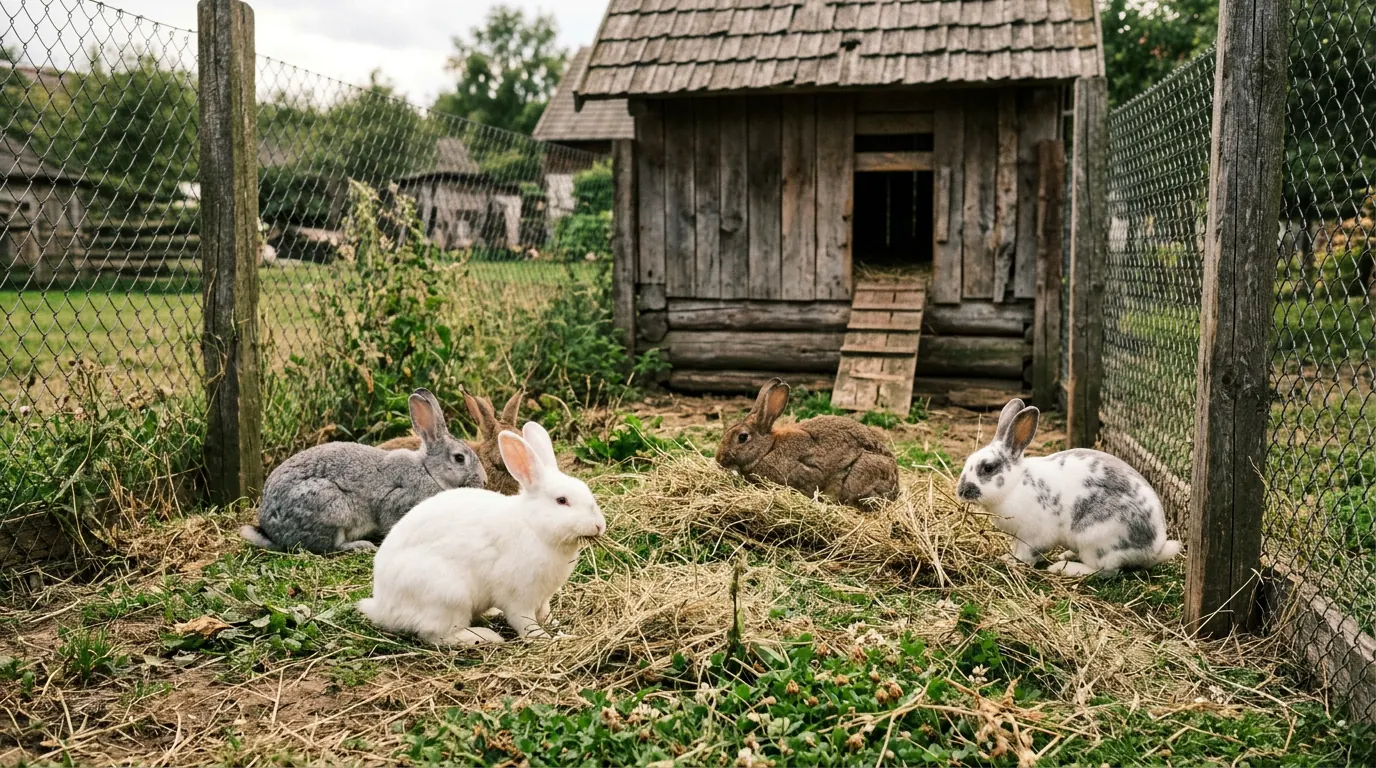
A rabbit's diet rests on good grass hay, a complete pelleted feed and constant access to clean water. On Polish farms the most common system is mixed feeding: pellets plus farm feeds. This is reported by Potępka in "Wiadomości Zootechniczne" (2011), citing a survey by the magazine "Króliki". This system lowers feed cost, but you must weigh portions accurately.
Why feeding decides the result
Rabbits easily develop digestive problems. A mistake in the ration, spoiled hay or a lack of water ends in diarrhea, slower gains and deaths. Sensible feed distribution also decides profitability, as L.A. Gacek writes in "Wiadomości Zootechniczne" (2010). Before you set rations, plan space for drinkers and feeders and for cages, because their design affects how much feed an animal really eats.
Hay: what rabbits eat every day
Which hay to choose
According to the IZ PIB (Polish National Research Institute of Animal Production) guide for keepers, edited by Z. Kryński, the best hay is second-cut grass hay. The first cut gives plants with more protein relative to fiber. Second-cut hay contains a lot of fiber, which a rabbit needs to digest properly and use protein. Choose hay that is green, smells fresh, and has no dust or signs of mold.
Alfalfa: for fattening rabbits only
The IZ PIB guide recommends alfalfa hay only for rabbits raised for fattening. Substances in alfalfa can lower breeding performance when fed over a long period. Give it to breeding does and bucks only occasionally and in small amounts. Alfalfa meal loses this effect after heat treatment and pelleting, which is why it is a normal ingredient in pellets. We cover choosing breeding animals in our article on breeding rabbits.
Storage and spraying
Hay must be well dried and stored away from moisture. Any contact with water encourages fungi and mold. Hay from a damp room can look fine, because early mold is invisible to the naked eye. Also check when crop protection products were sprayed on your own and neighboring fields. Sprayed meadows are not fit for rabbit feed.
Rabbit pellets: how to dose them
Pellet quality
Gacek stresses that pellets should come from a reliable source and be of proven quality. It should be possible to test their composition. When further batches arrive, take samples so you can claim compensation if you suffer losses. Feeding stale, moldy or unknown-origin feed is unacceptable.
How much pellet for which animal
According to Gacek, the amount of feed in a herd of adult rabbits varies widely. It ranges from about 120 g for bucks and non-pregnant does to 600 g for nursing does. Measure the ration so you do not exceed the set amounts, while giving rabbits what they need. You do not have to weigh pellets every day. It is enough to know the weight of one portion that fits the scoop you use. Does around kindling and rearing have the highest needs: see our article on kindling and rearing young rabbits.
Young rabbits
According to FAO (Lebas et al.), young rabbits start nibbling solid food and drinking water from the third week of life. After a few days, their intake of solid feed and water exceeds their intake of milk. A young rabbit takes 25–30 solid or liquid meals a day, spread irregularly. So feed and water must be available in the cage without a break.
Mixed feeding on a small farm
What farm feed offers
Potępka points out that on smaller farms, traditional feeds can be used alongside expensive pellets to cut feeding cost. Interest is also growing in direct sale of meat, where the price can be higher than at the slaughterhouse. We write about selling in our article on rabbit meat, and about costing in the text on rabbit farming profitability.
Too little protein in farm-grown feed
According to the same study, feeds from your own farm usually contain too little protein for rabbits. In summer you can add protein with green forage from legumes. Large amounts of such feed sharply reduce gains, because the nutrients in it are diluted. It is better to balance the ration with a supplementary mix that has more protein, vitamins and minerals and less fiber. In farm feed the proportions are the other way round.
Safety rule
Weigh portions and give them in constant proportions. Introduce new feeds gradually, because a sudden change in ration risks digestive upset. If a rabbit has diarrhea or bloating, contact a vet. The vet chooses the medicine and dose, and after treatment a withdrawal period applies before slaughter.
Water for rabbits
The IZ PIB guide recommends giving rabbits pellets with constant access to water. According to EFSA (European Food Safety Authority), low water intake from any cause can lead to low feed intake and prolonged hunger. Check drinkers every day, and in winter check them for freezing too. We describe choosing and maintaining the equipment in our article on drinkers and feeders for rabbits.
Needs depend on the category
According to EFSA, nutritional needs vary greatly with physiological state: age, stage of lactation and other factors. Feeding should cover needs for maintenance, movement, growth, pregnancy and milk production. FAO reports that an adult rabbit fed freely eats 140–150 g of dry matter a day, for example a 4 kg New Zealand White. A young rabbit at four weeks eats about a quarter of that amount. For fattening, breeds that use feed well matter: see meat rabbit breeds.
Feeding time
FAO notes that rabbits eat mainly at night. Feed intake is high just before the lights go off, and there is a longer gap in the morning. So the evening ration matters as much as the morning one. When feeding is restricted, give every animal access to a feeder so weaker ones do not lose their portion.
The most common feeding mistakes
The most common mistakes are: first-cut hay as the only source of fiber, too much alfalfa for breeding does, moldy hay, unmeasured pellets and no constant access to water. EFSA also lists deliberate, prolonged feed restriction of growing rabbits as a cause of hunger. A healthy herd also means vaccination: check the rabbit vaccination schedule. For an overview of keeping rabbits, see rabbit farming.
Frequently asked questions
What do rabbits eat?add
The base is grass hay, preferably second cut, plus complete pelleted feed. Small farms also use farm feeds. A rabbit must have access to clean water at all times.
What is the best feed for rabbits?add
The best is balanced pellets from a reliable source, of proven quality, given in a measured ration. Stale, moldy or unknown-origin feeds are unacceptable. Adjust the ration to the category of animal.
How much pellet should I give a rabbit?add
According to L.A. Gacek, the ration for adults ranges from about 120 g for bucks and non-pregnant does to 600 g for nursing does. You do not need to weigh it daily; just know the weight of a portion that fits your scoop.
Is alfalfa good for rabbits?add
Alfalfa hay should only go to rabbits raised for fattening. In breeding animals, long-term use can lower breeding performance. Occasional, small amounts do no harm.
Can rabbits eat only farm feeds?add
Feeds from the farm usually contain too little protein for rabbits. They need topping up with a mix higher in protein, vitamins and minerals. Green legume forage alone lowers gains.
When do young rabbits start eating solid food?add
According to FAO, from the third week of life young rabbits start nibbling solid food and drinking water. After a few days, their intake of feed and water exceeds their milk intake.
Sources & resources
- linkIZ PIB — Technology of rabbit meat production under higher animal welfare standards. Guide for keepers and members of rabbit meat producer cooperatives (ed. Z. Kryński)
- linkIZ PIB — Wiadomości Zootechniczne — Problems and options in feeding rabbits on small farms (W. Potępka), WZ XLIX(2011)2:37–42
- linkIZ PIB — Wiadomości Zootechniczne — Rabbit meat production (L.A. Gacek), WZ XLVIII(2010)2–3:34–40
- linkFAO — The rabbit: husbandry, health and production (F. Lebas et al., FAO Animal Production and Health Series 21, revised edition)
- linkEFSA AHAW Panel (copy in the CSIC repository) — Health and welfare of rabbits farmed in different production systems (EFSA Journal 18(1):5944)
Prepared by: DlaFerm Team based on data from the sources listed · Publisher: INSTA-TECH sp. z o.o.
Record treatment and withdrawal periods in one place
When a rabbit has a digestive problem, the vet chooses the medicine, and you have to keep track of the withdrawal period before slaughter. The "Treatment and withdrawal" module in DlaFerm helps you keep records of treatments and dates. Create a free farm account or get in touch with us.
Phone
+48 796 258 151