Breeding Rabbits: Age, Timing and Pairing
In intensive rabbit production you breed a doe again 10–14 days after kindling at the latest, and from day 7 when litters are standardized. We cover timing, buck workload, repeat mating and checking for pregnancy.
verifiedFrom the team that has organised work on poultry farms for years.
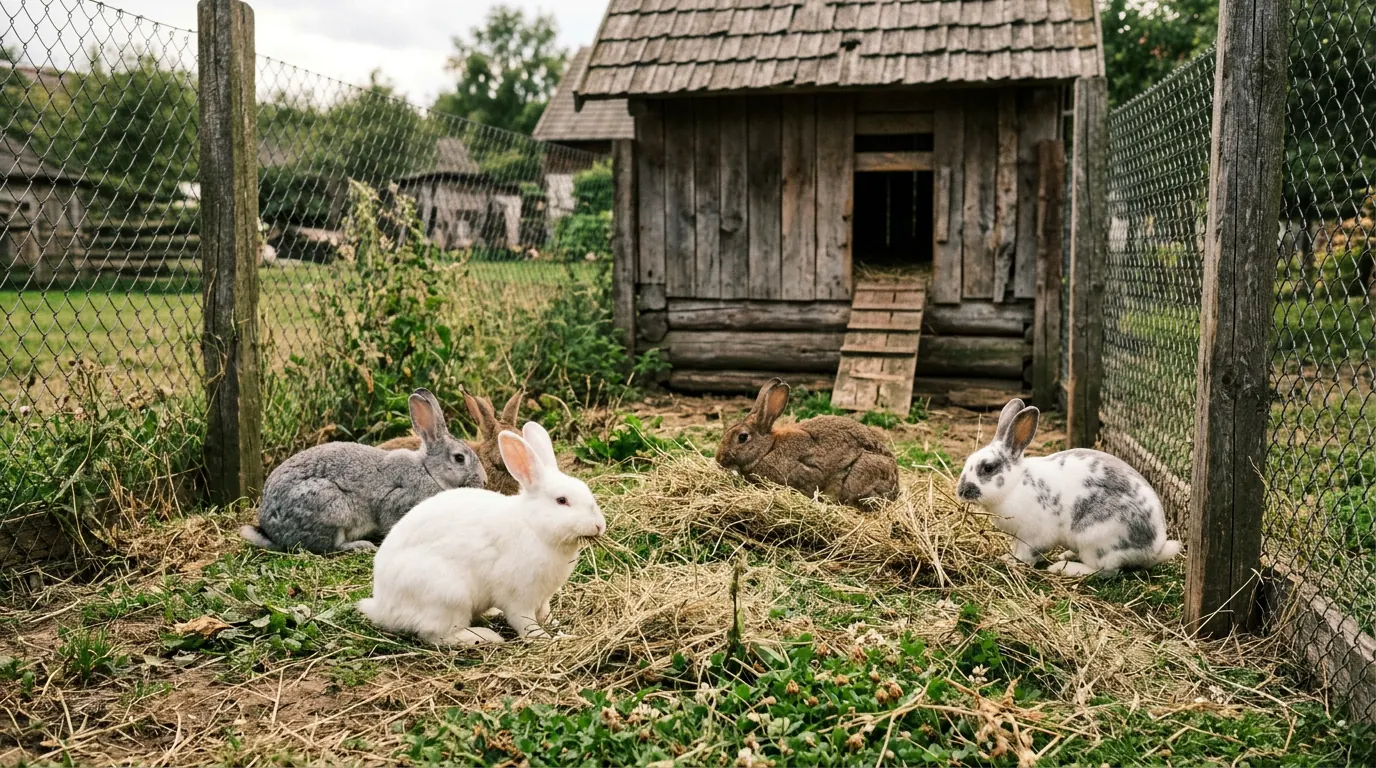
You breed a doe again 10–14 days after kindling at the latest. The IZ PIB guide (the Polish National Research Institute of Animal Production) for keepers and cooperatives producing meat rabbits allows the first mating from day 7 after kindling when litters are standardized. You then keep trying until day 14. Always move the doe into the buck's cage, never the other way round.
Why timing matters
Rabbit meat production rests on intensive breeding. According to L.A. Gacek (Wiadomości Zootechniczne 2010), success depends on selling 90 to 100 kg of rabbits per doe per year. At an average sale weight of 2.6 kg, that is more than 38 animals per doe. Every week lost between kindling and mating lowers that result. For the big picture of rabbit keeping, see rabbit farming: how to start, costs and profitability.
When to breed rabbits after kindling
Mating dates in the IZ PIB guide
The IZ PIB guide gives three dates: day 7, day 10 and day 14 after kindling. You use day 7 for standardized litters, meaning litters evened out in size. If mating on day 7 fails, you try again on day 10 and day 14. How often you mate depends on how many bucks the farm has. With several bucks you can keep to the earlier dates. With one buck you must spread the plan so you do not overwork him. Write down the kindling date right away, because you count every later date from it. We describe kindling in kindling and rearing young rabbits.
The doe's biology
The FAO handbook (Lebas et al.) lists the traits that make such fast breeding possible. A doe ovulates in response to mating. She accepts the buck on the day of kindling. She has no lactation anestrus and no clear seasonal anestrus. So the theoretical breeding pace is very high. FAO puts the reproductive potential at 150 young per doe per year, but warns that reaching it needs many more years of research and control of environmental factors. In practice, stick to the dates in the IZ PIB guide.
Age at first mating
There is no single age at which a young doe or buck may be bred for the first time. Age depends on the breed and growth rate. Giant breeds mature later than medium ones, as you can read in rabbit breeds: meat, fur and giant breeds. Agree the date with an adviser from the agricultural advisory center, a breeders' association or the breeder you bought the animals from. Do not breed animals that are still growing and clearly too light for their breed.
How mating works
Mating in the buck's cage
The IZ PIB guide describes it like this: once the doe is in the buck's cage, mating happens naturally if she is willing. If she refuses the buck, keepers often hold her so she does not run away. If the buck shows interest in the doe again within a few minutes of the first successful mount, you let him mount again. You record this as a single mating. Stay by the cage the whole time. If the doe attacks the buck, stop the mating to prevent bites.
Repeat mating with the same buck
To be sure the mating worked, you repeat it with the same buck after 12–24 hours. The IZ PIB guide treats this as protection against empty does. Record the second mating separately on the breeding card. Over time these records show which bucks and does perform best.
Checking for pregnancy
According to Gacek, checking for pregnancy is one of the daily jobs on the farm, along with feeding at fixed times and inspecting the nest boxes. Do not skip it, because a doe that has not conceived should be bred again as soon as possible. After each mating record the date, the buck's number and the result of the check. It is best to learn pregnancy-checking methods under an experienced keeper or adviser.
Buck workload and choosing a pair
How many times a day a buck can mate
The IZ PIB guide assumes a good buck can mate twice a day for 4 days, then needs one day of rest. How hard you use him depends on three things: his mating success judged from breeding records, his condition and his willingness to mate. Take a buck out of work if he refuses to mate or is in poor condition. Under heavy use, give him good feed, as we explain in feeding rabbits: feed, hay, pellets and water.
How to choose a pair
You choose the pair according to your breeding goal. For meat, Składanowska-Baryza (Wiadomości Zootechniczne 2017) lists New Zealand White and Red, Californian, White Termond (Termondzki) and White Popielno (Popielniańska) breeds. She also notes that hybrid lines suit intensive meat production. You will find an overview of these breeds in meat rabbit breeds: which grow fastest and the Termonde White rabbit, a meat breed. In purebred breeding, pair animals of the same breed and avoid closely related pairs.
Animal categories in the herd
EFSA divides breeding rabbits into categories: young females for breeding, counted from selection to first mating; young males for breeding; breeding bucks, from first mating to culling; non-pregnant females, from weaning a litter to the next successful mating; and breeding does, from first kindling to culling. This split helps you keep herd records and plan replacements.
Mating in the farm's daily rhythm
Kindling places instead of does
Gacek notes that in intensive breeding it is better to count kindling places than does. The target is 90–100 kg of rabbits sold per place per year. For example, 100 does must sell 10 t of rabbits a year. You will not reach that output without strict mating dates and fast replacement of does that do not conceive.
Daily tasks
Gacek lists the jobs you cannot skip: feeding at the same times in a strictly set amount, inspecting nest boxes, mating does and checking for pregnancy. That is why he considers the family farm model sensible, as it lets the work be done on time. Protect herd health with vaccination following the schedule in rabbit vaccination: RHD and myxomatosis schedule. Before mating, check the doe for signs of illness, because diseases described in pasteurellosis and snuffles in rabbits lower fertility. Treat any illness as your vet advises.
Frequently asked questions
When should you breed a doe after kindling?add
At the latest 10–14 days after kindling. With standardized litters, the IZ PIB guide allows the first mating from day 7. You then try again on day 10 and day 14.
How often can a buck be used for mating?add
According to the IZ PIB guide, a good buck can mate twice a day for 4 days, then rests for one day. Match the workload to his success rate, condition and willingness to mate.
Do you need to repeat the mating?add
Yes, to be sure it worked. The IZ PIB guide recommends repeating the mating with the same buck after 12–24 hours.
Whose cage do you put the rabbits in for mating?add
You move the doe into the buck's cage. If she is willing, mating happens naturally. With a reluctant doe, keepers often hold her so she does not run away.
Do rabbits have a breeding season?add
According to FAO, a doe has no clear seasonal anestrus and accepts the buck on the day of kindling. She ovulates in response to mating.
At what age should young rabbits first be bred?add
There is no single number, because age depends on breed and growth rate. Agree it with an agricultural adviser, a breeders' association or the breeder you bought the animals from.
Sources & resources
- linkIZ PIB — Technology of rabbit meat production under higher animal welfare standards. Guide for breeders and members of meat rabbit producer cooperatives (ed. Z. Kryński)
- linkIZ PIB — Wiadomości Zootechniczne — Rabbit meat production (L.A. Gacek), WZ XLVIII(2010)2–3:34–40
- linkFAO — The rabbit — husbandry, health and production (F. Lebas et al., FAO Animal Production and Health Series 21, revised edition)
- linkIZ PIB — Wiadomości Zootechniczne — The rabbit: economic importance, choice of breeds and lines for meat production (J. Składanowska-Baryza), WZ LV(2017)3:13–23
- linkEFSA AHAW Panel (copy in the CSIC repository) — Health and welfare of rabbits farmed in different production systems (EFSA Journal 18(1):5944)
Prepared by: DlaFerm Team based on data from the sources listed · Publisher: INSTA-TECH sp. z o.o.
Keep biosecurity tight on your rabbit farm
DlaFerm.pl has no separate module for rabbits, but the biosecurity plan generator and the QR entry log help you protect your breeding herd from disease. Create a free farm account or get in touch.
Phone
+48 796 258 151