Rabbit breeds: meat, fur and giant
About 100 rabbit breeds are known worldwide. They differ in build, size, color and coat. We show how to group them and which breeds work on a meat farm.
verifiedFrom the team that has organised work on poultry farms for years.
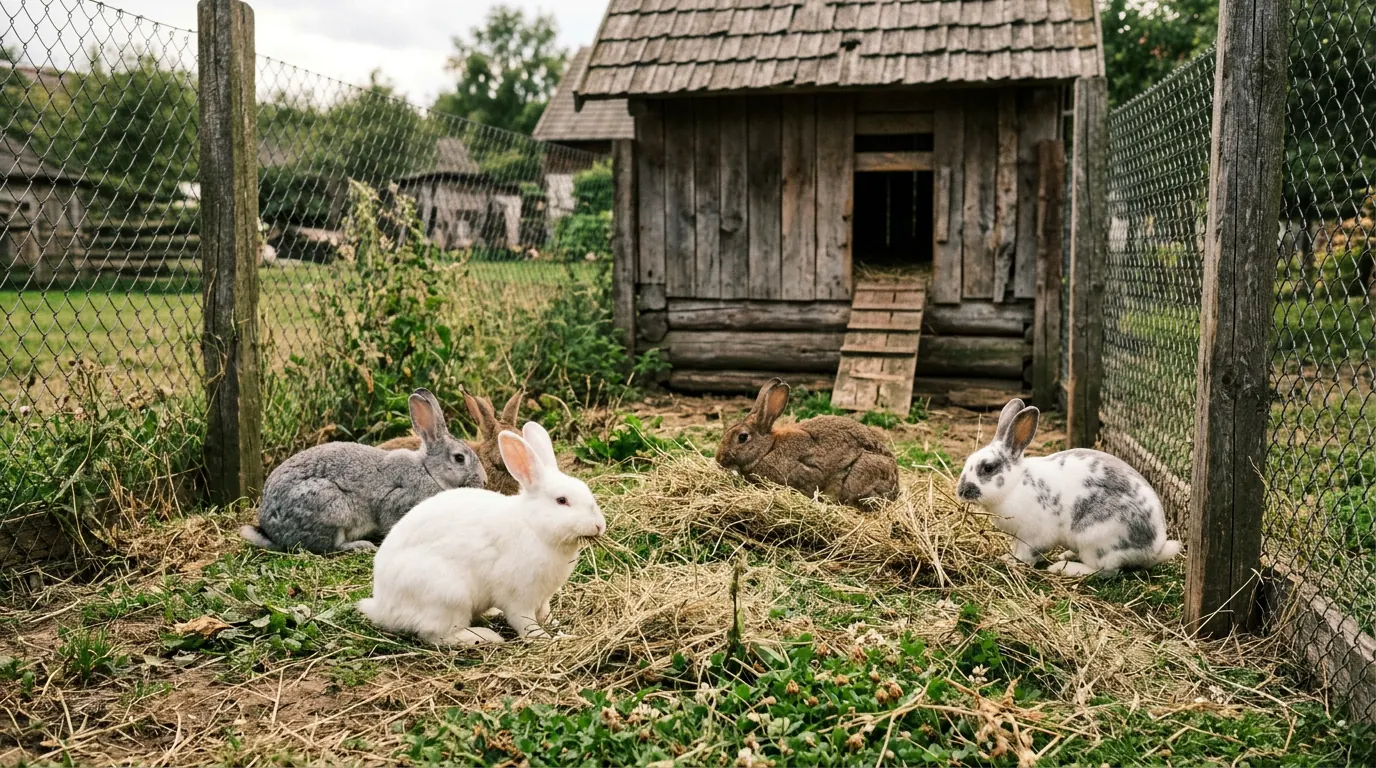
Rabbit breeds are grouped by three criteria: type of use, coat structure and body weight. According to the Institute of Animal Science (IZ PIB), about 100 breeds are known worldwide. On Polish meat farms a few of them count: New Zealand White, Californian, Termond White and Burgundy Fawn, plus the giants. We cover them all below. For a general introduction to keeping rabbits, see Rabbit farming: where to start.
How to read breed names
The same breed may be described as meat, meat-and-fur or hobby, because the keeper decides how it is used. So when you choose, look at three things: adult weight, doe fertility and growth rate of the young. These numbers tell you more than the name.
Three ways to group rabbits
Type of use
According to Wiadomości Zootechniczne (Kowalska et al., 2007), rabbits are divided into meat, meat-and-fur, fur, wool, laboratory and hobby breeds. For live-weight production, the meat and meat-and-fur groups matter most. Fur and hobby breeds are kept more for the breed standard, shows and pelts than for meat. If you plan to sell carcasses, look for breeds with good fertility and fast growth of the young. You will find an overview in Meat rabbit breeds: which grow fastest.
Coat structure
The second criterion is the coat. There are normal-haired rabbits, short-haired rabbits (rex, with a plush-like coat) and long-haired rabbits: Angoras and Lionheads (fox rabbits). Until the 1980s, normal-haired fur rabbits such as New Zealand Red, Chinchilla, Alaska and German Pied Giant were popular. Today normal-haired pelts have little use in the fur trade, because products made from them are not durable. Rex pelts matter more, as their coat is much more durable.
Body weight
The third criterion is weight. According to the same source, large rabbits are breeds whose minimum weight should not be below 5.5 kg. An upper limit is usually not set. There are known cases of Flemish Giants reaching very high weights. Keep in mind that a big rabbit eats more feed and needs a larger cage.
Meat and meat-and-fur breeds
New Zealand White
The IZ PIB guide for live-weight producers says the breed was developed in 1910 in California. It is a typical meat-and-fur breed, recommended for producing slaughter rabbits, both purebred and in crosses. It was first brought to Poland in 1964. Animals grow to 5.5 kg, mature early, and can be used for breeding from 4 months of age and a weight above 3.0 kg. Under good conditions, the guide says a doe rears about 40 young a year. We give details in the article on New Zealand rabbits.
Californian, Termond White and Burgundy Fawn
Besides the New Zealand, on farms you will meet the Californian, Termond White and Burgundy Fawn. All are treated as meat breeds and are often used for crossing. Each has its own page: Californian rabbit, Termond White rabbit and Burgundy Fawn rabbit. When choosing, compare adult weight, number of young reared per doe and feed requirements.
Large Chinchilla
The Large Chinchilla is a meat-and-fur breed with a silvery gray coat. Keepers value it for combining meat use with an attractive coat. If you want to sell both live animals and pelts, see the page on the Large Chinchilla rabbit.
Giant rabbits
Flemish Giant (olbrzym belgijski)
This is the largest of the popular rabbit breeds. Wiadomości Zootechniczne notes that no upper weight is set for large breeds, and the Flemish Giant is often given as an example of very heavy animals. We describe the breed in a separate article on the Flemish Giant. Keep in mind that such animals need roomy cages and larger feed portions.
Giant Pied (olbrzym srokacz)
The Giant Pied has a patched coat, so it is easy to recognize at a show. It is a large breed that exceeds the 5.5 kg threshold. You will find the standard in Giant Pied: the patched rabbit breed. If you sell for meat, check whether slower growth and higher feed use pay off in your calculation.
Endangered and hobby breeds
The authors of the IZ PIB study on little-known rabbit breeds warn that some breeds will probably die out, because keeping them is unprofitable and they survive only on hobby farms. That is why it is worth preserving them in judging standards. If you run a commercial farm, treat endangered breeds as an add-on, not the base of your herd. For meat production, choose breeds with documented fertility and growth rate.
Purebred or crossbred
Heterosis in practice
The FAO manual "The rabbit: husbandry, health and production" explains that differences between breeds are used mainly through crossbreeding. Bucks of a breed with high growth potential are mated with does of another breed with good fertility and mothering traits. The benefit of crossing is heterosis: crossbred animals perform better than the average of both parent breeds. FAO notes, however, that not every cross pays off, so each combination has to be tested.
How to check it on your farm
For each doe, record the number of litters, the number born and reared, and the weight at weaning. After a few litters you will see which combination performs better. We describe rearing in the article on kindling and rearing the young.
How to choose a breed for your farm
Start with the goal: live animals, pelts or breeding stock. Then check your conditions: cage size, feeding method and access to a buyer. In Wiadomości Zootechniczne, Składanowska-Baryza describes the choice of breeds and lines for meat production. For a cost calculation, see Profitability of rabbit farming. We cover feed in Rabbit feeding. Whatever the breed, plan vaccination against RHD and myxomatosis: rabbit vaccination calendar.
Frequently asked questions
How many rabbit breeds are there?add
According to the Institute of Animal Science (IZ PIB), about 100 rabbit breeds are known worldwide. They differ in build, size, color and coat structure.
What is the best rabbit breed for meat?add
The most often recommended is the New Zealand White, which IZ PIB describes as a breed recommended for producing slaughter rabbits. The Californian and Termond White also work well. The final choice depends on your conditions and your buyer.
What is the largest rabbit breed?add
The Flemish Giant is among the largest. Large rabbits are breeds with a minimum weight of not less than 5.5 kg, and an upper limit is usually not set.
What is the difference between meat and fur rabbits?add
Meat breeds are chosen for growth rate and fertility. Fur breeds are valued for color and coat quality. Today normal-haired pelts matter little in the fur trade, while rex pelts matter more.
Is it worth crossbreeding rabbit breeds?add
Crossing can give heterosis, meaning crossbreds perform better than the average of the parent breeds. FAO notes, however, that not every cross is beneficial and you have to test it in practice.
At what age can a rabbit be used for breeding?add
For the New Zealand White, the IZ PIB guide gives 4 months of age and a weight above 3.0 kg. For other breeds, check the standard and breeders' recommendations.
Sources & resources
- linkIZ PIB, Wiadomości Zootechniczne: Little-known endangered rabbit breeds (D. Kowalska et al.), WZ XLV(2007)3:71–75
- linkIZ PIB: Technology of rabbit live-weight production under raised animal welfare standards. Guide for breeders and members of meat rabbit producer cooperatives (ed. Z. Kryński)
- linkFAO: The rabbit: husbandry, health and production (F. Lebas et al., FAO Animal Production and Health Series 21, revised ed.)
- linkIZ PIB, Wiadomości Zootechniczne: The rabbit: economic importance, choice of breeds and lines for meat production (J. Składanowska-Baryza), WZ LV(2017)3:13–23
Prepared by: DlaFerm Team based on data from the sources listed · Publisher: INSTA-TECH sp. z o.o.
Keeping up with biosecurity on your farm?
The biosecurity plan generator in DlaFerm helps you write down entry rules for your farm, and the QR-code entry and exit log records who came onto the site. Create a free farm account or get in touch.
Phone
+48 796 258 151