Flemish Giant (olbrzym belgijski): the largest rabbit breed
The Flemish Giant (in Polish, olbrzym belgijski) has a long, strong body and big ears. Polish keepers who search for "królik belgijski" (Belgian rabbit) almost always mean this breed. We cover its origin, traits, housing needs and place in meat production.
verifiedFrom the team that has organised work on poultry farms for years.
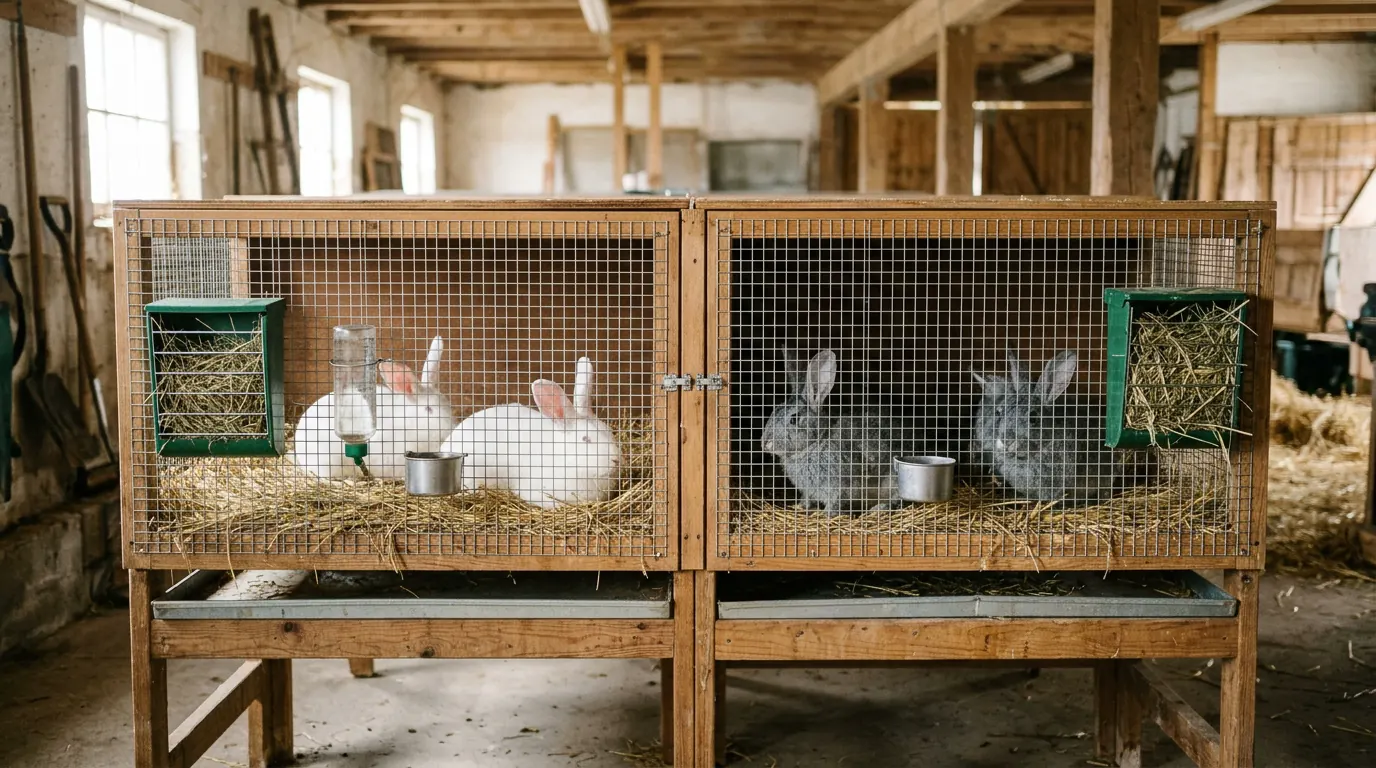
The Flemish Giant is one of the largest rabbit breeds kept in Europe. You can spot it by its long, strong body, elongated muzzle and big ears. In Poland, the phrase "królik belgijski" or "króliki belgijskie" (Belgian rabbits) in practice almost always means this breed. It comes in several colors, and one of them, white, matters for Polish breeding. For a wider overview of breeds, see Rabbit breeds: meat, fur and giants.
Why keepers ask about it
A big rabbit draws attention at shows and markets. Some keepers also hope for a larger carcass than from medium breeds. Remember, though, that a large animal needs more space and more feed, and it grows for longer. Before you buy stock, read the general guide Rabbit farming: where to start, costs and profitability and work out whether your farm can carry such a breed.
Where the Flemish Giant comes from and how it shaped other breeds
A breed with a big influence on others
The Flemish Giant was the base for developing several other breeds. According to the guide from IZ PIB (Poland's National Research Institute of Animal Production, ed. Z. Kryński), white Flemish Giant rabbits were used to develop the white Termonde rabbit (królik biały termondzki). The first Termonde animals were brought from Belgium to the IZ experimental station in Chorzelów in 1977. They inherited the large ears, long body and long muzzle from the Giant. Today this meat breed is described in White Termonde rabbit: a meat breed.
Part of conservation breeds
According to an article by D. Kowalska and co-authors in "Wiadomości Zootechniczne" (2007), Flemish Giants were also one of the components of the cross that produced the French Lop (barany francuskie). Normandy and English rabbits were used alongside them. This shows that the Giant's traits, a large head and strong build, pass to offspring and are valued by keepers who create new breeds.
Appearance and breed standard
Traits that identify the breed
The Flemish Giant has a long, well-muscled body, strong legs and a head set on a clear neck. The ears are large and upright. The breed is clearly bigger than the meat rabbits used in industrial fattening, such as New Zealand or Californian rabbits. For exact dimensions, body weight and permitted faults, check the breed standard from the breeders' association, because the standard also sets eye and claw color for each variety.
Body weight and growth rate
A large breed reaches its target weight later than medium breeds. For comparison, the IZ PIB guide says that Termonde rabbits, which inherited their build from the Giant, should weigh 2.5 kg at 3 months according to the standard. Adult males and females should weigh from 3.5 to 5.7 kg. For Flemish Giant values, see the standard for that breed. Weigh your animals regularly and compare the result with the standard, not with the weight of other breeds.
Does the Flemish Giant pay in meat production?
Meat breed or breeding breed
A big rabbit gives a big carcass, but it grows more slowly and eats more feed than specialized meat breeds. Keepers who produce live animals for sale usually pick fast-growing breeds and cross them with other breeds. Choosing breeds for meat is covered in Meat rabbit breeds: which grow fastest. The Flemish Giant works better as a starting breed for crossing, or as a show and breeding animal.
How to work out profitability
Feed cost decides the result. According to an article by W. Potępka from 2011, swings in feed prices sometimes raise and sometimes lower profit on rabbit farms. So calculate feed use per kilogram of gain separately for your own breed and compare it with the price your buyer pays. A detailed calculation is in Rabbit farming profitability: costs and calculation. We do not give current buying prices because they change often. Ask your buyer or check market quotes.
Keeping and feeding large rabbits
Cages and space
A big rabbit needs a larger cage or pen than a medium breed. The animal should have room to stretch out, lie down comfortably and turn around. The floor must be dry and not too hard, because a heavy animal gets sore hocks more easily. For welfare and housing recommendations, see the IZ PIB guide on the higher welfare standard and the WODR Poznań publication on basic rules of rabbit keeping (WODR is a regional agricultural advisory center).
Feed, hay and water
The basis is hay and feed matched to the animal's physiological state, plus constant access to clean water. The IZ PIB guide notes that breeds with higher needs, such as Termonde, can get feed with more protein than New Zealand rabbits, which gives larger litters. Rules for building rations are in Rabbit feeding: feed, hay, pellets and water. Choose drinkers and feeders to match the size of the animals.
Breeding, vaccination and herd protection
Kindling and raising young
A doe of a large breed needs a roomy nest and quiet before kindling. Leave the kindling doe in peace, prepare bedding and check the nest after birth. We describe weaning and care of the young in Kindling and raising young rabbits: nest, weaning. For a slow-growing breed, plan a longer rearing period and check the weight of the young more closely than you would with fast-growing breeds.
Vaccination and biosecurity
Giant rabbits get the same diseases as other breeds. This applies above all to RHD (rabbit hemorrhagic disease) and myxomatosis. Agree vaccination dates with your vet; a schedule is in Rabbit vaccination: RHD and myxomatosis, schedule. Medicines and their doses are always chosen by a vet, who also sets the withdrawal period before slaughter. Limit the movement of people onto the farm and keep a record of visits.
Frequently asked questions
Is a Belgian rabbit the same as a Flemish Giant?add
In Polish breeding, the phrase "królik belgijski" most often means the Flemish Giant (olbrzym belgijski). When you look for animals, ask the seller for the exact breed name and color variety.
Is the Flemish Giant the largest rabbit breed?add
It is among the largest breeds kept in Europe, and many other giant breeds are similar in size. Check exact body weights in the breed standard.
Which breed was the Termonde rabbit developed from?add
According to the IZ PIB guide, the white Flemish Giant was used to develop the white Termonde rabbit. The first rabbits were brought to Chorzelów in 1977.
Is the Flemish Giant good for meat?add
It gives a big carcass, but grows more slowly than specialized meat breeds. Keepers who sell live animals usually choose fast-growing breeds or crosses and use the Giant as a starting breed.
How big should a cage for a Flemish Giant be?add
Bigger than for medium breeds. The animal must be able to stretch out, lie down and turn around. For specific sizes, see the welfare recommendations in the IZ PIB guide and the WODR publication.
How much does a Flemish Giant rabbit cost?add
The price depends on age, pedigree and whether you buy a young rabbit, a breeding animal or a show animal. Agree the amount directly with the breeder or through a breeders' association.
Sources & resources
- linkIZ PIB — Technology of rabbit meat production under a higher animal welfare standard. Guide for breeders and members of rabbit meat producer cooperatives (ed. Z. Kryński)
- linkIZ PIB — Wiadomości Zootechniczne — Little-known endangered rabbit breeds (D. Kowalska et al.), WZ XLV(2007)3:71–75
- linkIZ PIB — Wiadomości Zootechniczne — Problems and options in feeding rabbits on small farms (W. Potępka), WZ XLIX(2011)2:37–42
- linkWODR Poznań — Rabbit keeping: basic rules and housing conditions
Prepared by: DlaFerm Team based on data from the sources listed · Publisher: INSTA-TECH sp. z o.o.
Protect your herd with a biosecurity plan
The <a href="/generator-planu-bioasekuracji">biosecurity plan generator</a> in DlaFerm helps you write down the rules for entering the farm and handling new animals. Create a free farm account or get in touch.
Phone
+48 796 258 151