Rabbit waterers and hay feeders: types and how to choose
In a rabbit cage, a nipple or drip waterer fixed to the outside of the wire works well. Add a pellet feeder and a separate hay rack. We explain how they differ, what to check before buying and how to keep them clean.
verifiedFrom the team that has organised work on poultry farms for years.
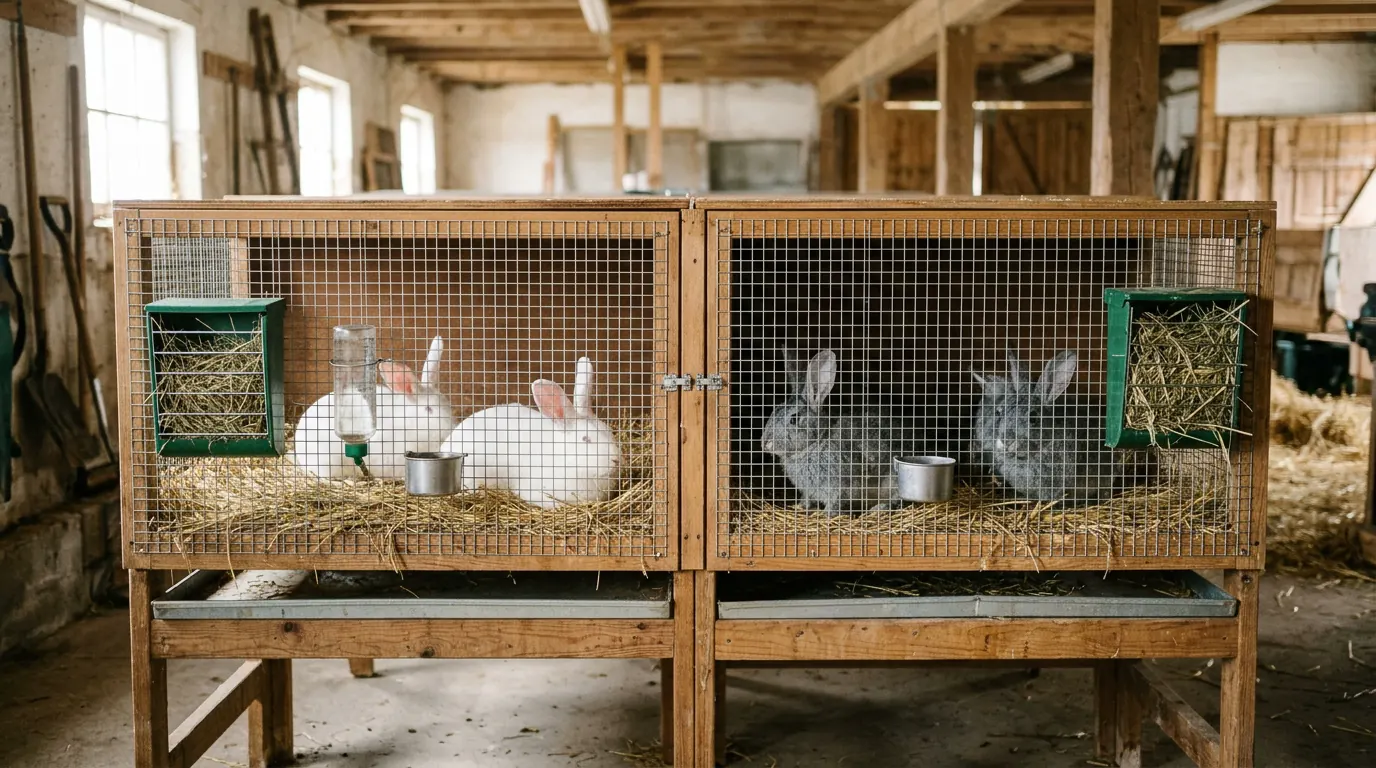
For a caged rabbit, the best waterer is one fixed to the outside of the wire, with a spout or nipple reaching inside. Water does not spill into the litter and droppings do not fall in. Give pellets in a hopper feeder or trough, and hay in a separate rack so it does not lie in the droppings. Cage sizes and room for fittings are covered in our guide to rabbit cages and pens.
Why the equipment matters
A rabbit eats and drinks many times a day, so poorly chosen dishes show their faults fast. A tipped bowl floods the cage, dirty water puts the rabbit off drinking, and hay from the floor ends up in wet litter. Well-chosen fittings cut daily work and feed waste. General rules for water, pellets and hay are in our article on feeding rabbits.
Rabbit waterers: types
Drip waterers with a spout
A guide from WODR Poznań (a regional agricultural advisory center) describes drip waterers fixed to the outside of the wire as a common type. The drinking spout passes through the wire into the cage. According to that source, they are easy to clean and let you check the water level and condition every day without opening the cage or disturbing the animals. This is a good choice when you walk past many cages and want to look into each one without lifting the animal out.
Nipple waterers for rabbits
A nipple waterer is a tube or tank with a metal valve that the rabbit triggers with its tongue. Water flows only while the rabbit drinks, so it does not flood the cage or collect dirt. You connect it to a tank or to a line serving several cages. Before buying, check that the valve does not leak and that the mounting height can be adjusted for young and adult animals. Young kits take several days to learn to drink from a nipple, so watch during that time that all of them drink.
Bowls and gravity waterers
A bowl is the cheapest option, but it tips easily and the water gets dirty fast. The WODR guide notes that water in an open dish can be spilled or contaminated by accident. If you use bowls, choose heavy, stable ones fixed to the cage wall, and change the water daily. In cold months a bowl has one advantage: you see right away that the water has frozen.
Rabbit feeders
Hopper feeder or trough
A hopper feeder, also called an automatic feeder, has a feed tank with a dispenser at the bottom. You fill it once a day or less often, and the pellets slide down by themselves. It suits cages with front access when saving time matters. A trough or small dish is simpler and shows how much the rabbit actually ate. The choice depends on your feeding method: a hopper feeder is more convenient with constant access to pellets, a trough with restricted rations.
Material and construction
A feeder should be made of galvanized sheet, stainless steel or thick plastic. Rabbits gnaw everything, so thin plastic gets chewed through fast and sharp edges can injure the animal. Look for a smooth interior without folds where feed dust collects, and for openings too small for the rabbit to dig pellets out with its paws. Fix the feeder so it cannot be knocked off and the feed stays out of the damp.
Hay racks for rabbits
Hay ladders and baskets
According to the WODR guide, special ladders or baskets for hay are extra cage equipment. They are usually metal frames that you fix to the side of the cage or mount as a shelf in the upper part. The hay then hangs above the floor and does not end up in the droppings. The rabbit pulls out stalks one at a time, so less hay is wasted than when it is thrown on the bottom. This kind of rack suits freestanding and modular cages.
Rack size
The IZ PIB guide (Poland's National Research Institute of Animal Production) for meat rabbit keepers shows a rack for hay and green forage in two sizes: a large one 30 cm wide and a medium one 25 cm wide. Choose the large one for a doe with young, which eats more, and the medium one for cages of fattening young. When choosing, check that the rack can be filled from outside and that the bars are spaced so the rabbit can pull out hay but cannot put its head through. Full access to fiber is the basis of a healthy digestive tract.
How to match waterers and feeders to your stock
Cage, age group and system
First check how the cage is built: which side you can reach, what the wire is like and whether there are places to hang fittings. The IZ PIB guide shows single- and multi-tier cages with feeders and waterers built in. When buying modular cages, compare what comes in the set, because fittings affect the total cost a lot. For a doe with a litter and for young stock, choose a larger feeder and hang waterers at a height the young can reach. We cover the costs of the whole enterprise in our article on rabbit farming profitability.
Checklist before you buy
Check five things before buying. First, can the waterer and feeder be taken apart without tools and washed. Second, does the material stand up to gnawing. Third, does outside mounting leave sharp ends inside the cage. Fourth, if something breaks, can you replace one part instead of the whole set. Fifth, do the parts fit the wire in your cages. Set prices vary by maker and season, so compare offers in several places instead of relying on one.
Cleanliness and daily routine
Daily water check
Check every waterer once a day: is water flowing, is there any green film in it, and is the tank leaking. You spot a blocked nipple when the rabbit does not drink even though the tank is full. In winter, make sure the water has not frozen, because an animal without water soon starts to eat less. In warmer weather, change the water more often. A change in appetite or in the amount of water drunk is often the first sign of illness. If you see nasal discharge or dullness, read about pasteurellosis and snuffles in rabbits.
Washing and disease prevention
Wash waterers, tubes and feeders regularly with a brush and warm water, and disinfect between litters or fattening batches according to your farm hygiene plan. Equipment shared by many cages can carry germs from one animal to another, so when disease hits the herd, replace and wash it first. Writing the washing and disinfection rules in one document makes them easier to follow. When planning your stock, also see our section on rabbit farming.
Frequently asked questions
What is the best waterer for rabbits?add
For cages, drip waterers with a spout or nipple waterers fixed to the outside of the wire are most often recommended. According to the WODR Poznań guide, they are easy to clean and let you check the water level without opening the cage. Bowls are cheaper, but they tip and get dirty easily.
Will a rabbit learn to drink from a nipple?add
Yes, but it needs several days. During that time, check that all animals drink, and with young kits make sure the nipple is at the right height. If an animal does not drink, consider a temporary extra waterer of another type.
Which hay rack should I choose for a rabbit cage?add
Choose a metal ladder or basket fixed to the side of the cage or as a shelf at the top. The IZ PIB guide gives two sizes: large 30 cm and medium 25 cm. The rack should be fillable from outside and keep hay off the floor.
Hopper feeder or trough: which is better?add
A hopper feeder saves time, because you fill it rarely and the feed slides down by itself. A trough makes it easier to see how much the rabbit ate and suits rationed feeding. The choice depends on your feeding method, which we describe in our article on feeding rabbits.
How often should I wash rabbit waterers and feeders?add
Check the water every day and wash waterers and feeders regularly, more often when disease hits the herd. Plan full disinfection between litters or fattening batches. If you are unsure about disinfectants, ask your vet.
Sources & resources
- linkWODR Poznań — Rabbit keeping: basic rules and housing conditions
- linkIZ PIB — Technology of rabbit meat production under higher animal welfare standards. Guide for keepers and members of meat rabbit producer cooperatives (ed. Z. Kryński)
- linkIZ PIB — Wiadomości Zootechniczne — Problems and possibilities in rabbit feeding on small farms (W. Potępka), WZ XLIX(2011)2:37–42
Prepared by: DlaFerm Team based on data from the sources listed · Publisher: INSTA-TECH sp. z o.o.
Write down your farm hygiene rules in the biosecurity plan generator
In the DlaFerm biosecurity plan generator you can record the washing and disinfection rules for equipment, including waterers and feeders, and the rules for entering the farm. Create a free farm account or get in touch, and we will show you how it works in practice.
Phone
+48 796 258 151