Rabbit meat: slaughter, selling carcasses and finding a buyer
You can sell rabbits live to a buyer, at a market or as carcasses. Each route has its own requirements and its own margin. We explain how to find a buyer, what weight to sell at and what to ask before you agree on a deal. Check the rules on slaughter and meat sales with your local veterinary inspectorate.
verifiedFrom the team that has organised work on poultry farms for years.
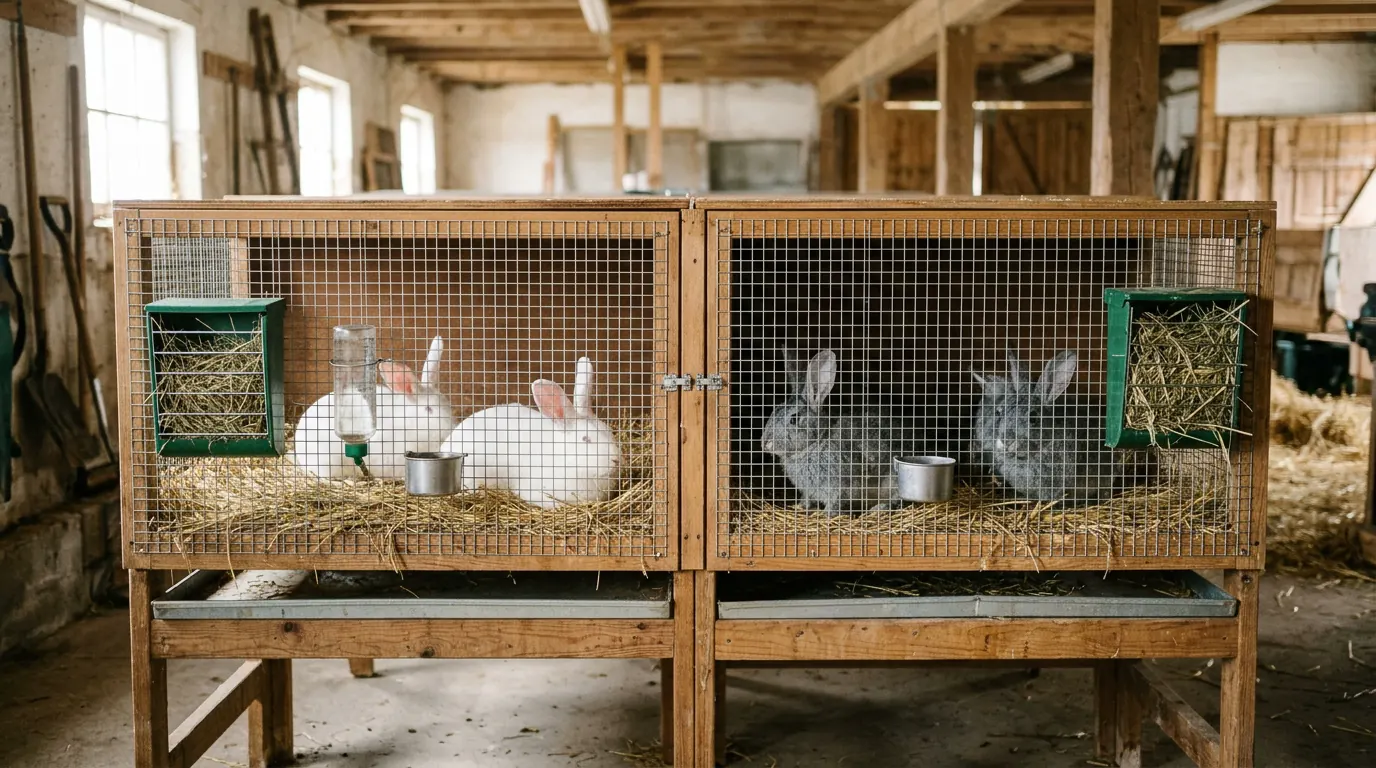
You can sell rabbit meat in three ways: live rabbits to a buyer or dealer, live animals directly to a customer, or carcasses after slaughter. The simplest route is to hand live animals to a buyer who has a slaughterhouse. Carcasses bring more income per animal, but the slaughter must take place somewhere that meets veterinary requirements. Check the rules with your county veterinary inspectorate (powiatowy inspektorat weterynarii) before you start selling meat.
A small market with few buyers
According to IZ PIB (the National Research Institute of Animal Production), most rabbit keepers in Poland hold from a few to a few dozen breeding animals. They treat it as a hobby or a side income. What gets sold is usually the surplus after the family's needs and the herd's replacement. An IZ PIB guide for the Podkarpackie region describes how, after the slaughterhouse in Rymanów closed, organized buying of small batches of rabbits practically stopped. Agents showed up at markets paying very low prices, with no room to negotiate. So find your buyer before you stock the first animals. For more on getting started, read Rabbit farming: where to start, costs and profitability.
Rabbit buyers: how to find one
Where to look
Start with rabbit slaughterhouses in your region. The IZ PIB guide names a large slaughterhouse in Dębica in Podkarpackie, but notes that for economic and organizational reasons not every keeper can deliver there. Also ask neighboring keepers, rabbit producer cooperatives, your agricultural advisory center and local butchers. According to IZ PIB, mobile collection of small batches has not delivered the expected results, so do not expect a buyer to drive out for a dozen animals.
What to ask before you agree
Find out the age and body weight the buyer accepts, and how the price is set: per kilogram of live weight or per animal. Ask about the minimum batch, pick-up dates, the loading point and who issues the paperwork. Find out whether the buyer wants vaccination certificates and requires withdrawal periods to be observed after treatment. Put everything in a contract, or at least in a message, so you do not argue over terms at pick-up. If you sell larger batches, you should keep sales records.
Buying price
We do not quote buying prices because they change from week to week. They depend on regional demand, animal weight, batch size and whether the buyer has a slaughterhouse and customers of their own. According to IZ PIB, in 2010, after significant rises in buying prices, rabbit farming became more profitable, but further feed price rises cut profits again. Check current rates with several buyers at once and compare them with your feed cost. You will find a calculation in Rabbit farming profitability: costs and calculation.
How much rabbit you can sell per doe
According to L.A. Gacek (Wiadomości Zootechniczne 2010), the basis of success in rabbit meat production is selling 90 to 100 kg of rabbits per doe per year. The author gives an example: from 100 does you need to sell 10 t of rabbits in a year. At an average selling weight of 2.6 kg, that is over 38 animals per doe. This needs maximally intensive breeding, which is why Gacek speaks of a "kindling place" rather than a doe. We describe mating and weaning dates in Mating rabbits and Kindling and raising the young.
Daily work
Gacek points out that some tasks on a rabbit farm cannot be skipped: feeding at the same times every day in a strictly set amount, checking the nest boxes, mating the does and checking for pregnancy. For that reason the author considers a family-run farm sensible, because it lets you do this work on time. With a few animals it is little trouble; with several dozen does it becomes a daily duty.
Breed and feed affect carcass quality
Slaughter results depend on breed, line and feeding. Crossbreeds are often used for meat, for example the Giant Pied (olbrzym srokacz) crossed with the New Zealand White, which IZ PIB shows in pen housing on litter. We describe breeds in Meat rabbit breeds and Giant Pied rabbit, and feeding in Feeding rabbits.
Rabbit slaughter and selling carcasses
Where to slaughter
Slaughter for meat sales comes with veterinary requirements that depend on scale and sales form: directly to the consumer, to a local shop or to a larger buyer. Ask your county veterinary officer (powiatowy lekarz weterynarii) which conditions to meet and which registration to complete. EU rules on slaughter on the farm, Council Regulation (EC) No 1099/2009, allow on-farm slaughter of rabbits for direct supply of small quantities of meat to the final consumer or to local retail, within a maximum number of animals that is set separately. We give a general overview of duties in Rabbit farming and regulations, and current information is on the website of the Chief Veterinary Inspectorate (Główny Inspektorat Weterynarii).
Withdrawal periods and animal health
A rabbit treated with a medicine must not be slaughtered before the withdrawal period ends. The medicine label gives the withdrawal period, and a vet chooses the medicine and dose. Record the treatment date and the planned slaughter date. Sick animals, for example with signs of RHD or myxomatosis, are not fit for slaughter. We describe prevention in Rabbit hemorrhagic disease (RHD) and Rabbit vaccinations.
Demand for rabbit meat
According to J. Składanowska-Baryza (Wiadomości Zootechniczne 2017), about 2 million rabbits are slaughtered worldwide each year purely for meat. China produces 735,000 t of meat, about 40% of world production (FAO, 2014). Europe is the second continent by production. W. Potępka (2011) notes growing interest in healthy food, a requirement that rabbit meat meets, and more and more retail chains are adding it to their range.
Selling rabbits at the market and to neighbors
A small rabbitry usually sells its surplus at a market or to neighbors. This gives you contact with the customer and room to set the price, but it takes time and regular customers. When selling live animals, transport them in clean, ventilated cages, without overheating or crowding. For your own protection, keep a record of who you sold animals to and when, and observe the withdrawal period after treatment. When you sell animals for further breeding, the customer should know the herd's vaccination status.
Biosecurity plan for sales
Every buyer and visitor can carry disease on boots, cages and hands. Set a handover point outside the rabbit building, do not let strangers into the herd and disinfect transport cages after they come back. You can prepare a ready set of rules in the biosecurity plan generator and log visits in the QR entry and exit book.
Frequently asked questions
Where can I sell rabbits for meat?add
Slaughterhouses and dealers buy rabbits, but availability depends on the region. According to IZ PIB, organized buying of small batches practically did not work in Podkarpackie. Ask neighboring keepers, your agricultural advisory center and the nearest slaughterhouses.
How much does rabbit meat or live rabbit cost?add
We do not quote amounts because they change every week. The price depends on region, animal weight, batch size and buyer. Call several buyers and compare their rates with your feed cost.
How many rabbits do I need to sell per doe?add
According to L.A. Gacek, success depends on selling 90 to 100 kg of rabbits per doe per year. At an average weight of 2.6 kg, that is over 38 animals. This needs very intensive breeding.
Can I sell rabbit carcasses from my own farm?add
It depends on the scale, the way you sell and where the slaughter takes place. Veterinary law sets the requirements, and you can confirm the details with your county veterinary inspectorate. Call them and ask about registration before your first carcass sale.
Can I slaughter a rabbit after treatment?add
Only after the withdrawal period given for the medicine has passed. A vet chooses the medicine and dose and will also give the withdrawal period. Record the treatment date so you do not mix up the slaughter date.
Who buys rabbits from small keepers?add
According to IZ PIB, these are usually neighbors, buyers at the market and agents who turn up on certain days. Terms are often unfavorable, so it pays to have several buyers and know current prices.
Sources & resources
- linkIZ PIB — Rabbit meat production technology under raised animal welfare standards. Guide for keepers and members of meat rabbit producer cooperatives (ed. Z. Kryński)
- linkIZ PIB — Wiadomości Zootechniczne — Rabbit meat production (L.A. Gacek), WZ XLVIII(2010)2–3:34–40
- linkIZ PIB — Wiadomości Zootechniczne — The rabbit: economic importance, choice of breeds and lines for meat production (J. Składanowska-Baryza), WZ LV(2017)3:13–23
- linkIZ PIB — Wiadomości Zootechniczne — Problems and options in feeding rabbits on small farms (W. Potępka), WZ XLIX(2011)2:37–42
- linkChief Veterinary Inspectorate (Główny Inspektorat Weterynarii) — gov.pl/web/wetgiw
Prepared by: DlaFerm Team based on data from the sources listed · Publisher: INSTA-TECH sp. z o.o.
Track withdrawal periods and farm visits before you sell rabbits
In DlaFerm you can record treatments and withdrawal dates in the <a href="/ewidencja-leczenia-i-karencja-lekow">treatment and withdrawal module</a>, and farm visits in the QR entry book. Create a free farm account or get in touch, and we will show you how it works.
Phone
+48 796 258 151