French Lop: a large rabbit with drooping ears
The French Lop is the best-known lop-eared rabbit. According to IZ PIB (Poland's National Research Institute of Animal Production), it belongs to the group of large meat-and-fur rabbits. We describe how to recognize it and what to watch for when you keep it.
verifiedFrom the team that has organised work on poultry farms for years.
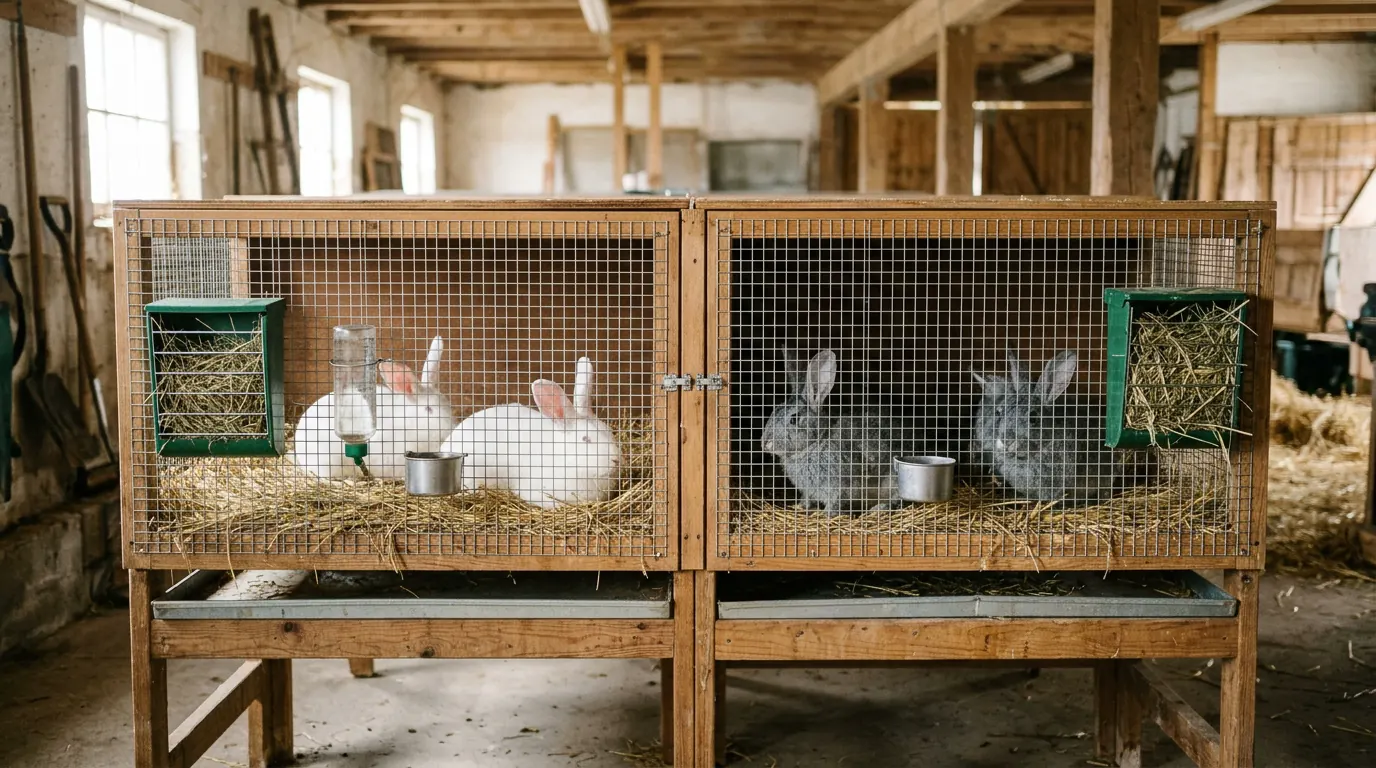
The French Lop is a large rabbit with drooping ears. According to the Institute of Animal Production (IZ PIB), it is the best-known of the breeds called lops (in Polish, "barany", meaning rams) and belongs to the group of large meat-and-fur rabbits. Lop ears are a mutation that breeders fixed, and it became the basis for a whole group of breeds.
Where the name "ram" comes from
In Polish the name comes from the drooping ears and the arched line of the nose, which looks like a ram's head. You will also find a general description of the breed in our overview of rabbit breeds. If you are still planning your herd, start with Rabbit farming: where to start.
The French Lop compared with other breeds
Lop ears as a breed trait
Wiadomości Zootechniczne (Kowalska et al., 2007), a Polish animal science journal, describes lop ears as one of the fixed mutations in rabbits. Breeders used it to separate the lop breeds. The French Lop is the best known. Breeders treat drooping ears as part of the breed standard, so when they judge breeding stock they check how the ears are set and whether they are symmetrical. The ears of this breed are fleshy and hang down the sides of the head. This sets it apart from breeds with upright ears, such as the Belgian Hare or the New Zealand White.
French Lop versus English Lop
The two breeds are easy to mix up, but they differ a lot. According to IZ PIB, English Lops are a typical fancy breed. They are smaller than French Lops and have grotesquely long ears, with a span that must exceed 70 cm. At shows you can even see animals with a span of up to 1.5 m. The French Lop, by contrast, is a large rabbit with meat-and-fur use, so it suits practical keeping and not only showing.
What the French Lop is good for
Meat and skin
Being in the meat-and-fur group means you can get both a carcass and a pelt from one animal. For intensive meat production, though, breeders usually choose medium breeds. According to IZ PIB (Składanowska-Baryza, 2017), in broiler-type production, where litter size and fast growth matter, medium, early-maturing breeds work better. When you pick a breed for fattening, large breeds usually come second. You can compare the most popular fattening breeds in Meat rabbit breeds.
Who the breed suits
The French Lop suits a keeper who wants a large, calm rabbit with a distinctive look, for example for a backyard herd, for selling breeding stock or for the home kitchen. If you mainly want a financial return, work out the costs using the tips in Profitability of rabbit farming. For comparison, according to IZ PIB the New Zealand White grows to 5.5 kg, and in good conditions does raise about 40 young per year.
Housing and feeding
Cages and ear hygiene
Large animals need a bigger cage than medium breeds, with dry, clean flooring. Drooping ears get less airflow, so check them regularly for dirt, moisture or skin changes. If you see signs around the ears or head, such as nasal discharge, read Pasteurellosis and snuffles in rabbits and contact a vet. We describe basic equipment in Drinkers and feeders for rabbits.
Drafts and ventilation
The FAO publication "The rabbit — husbandry, health and production" describes how air speed and temperature affect rabbit health. A cold draft can lead to gut problems. Keep rabbits in a ventilated building, but without a draft blowing onto the cages.
Feed
According to Wiadomości Zootechniczne (Potępka, 2011), growing rabbits during fattening need feed with 16.0–16.5% crude protein and 14.5% crude fiber. Does rearing young need 17.5–18% crude protein and 10.5 MJ/kg metabolizable energy. Large breeds eat more, so give them constant access to hay and fresh water. You will find ration details in Feeding rabbits.
Breeding, vaccination and regulations
Mating and raising young
Mating dates and the age of first breeding depend on how fast a given line matures. For comparison, according to IZ PIB a New Zealand White can go to breeding at 4 months and over 3.0 kg. For the French Lop, agree these values with the breeder you buy from. We describe pair selection in Mating rabbits, and nest preparation and rearing in Kindling and raising young rabbits.
Vaccination
Large animals need the same protection as other rabbits. The two main infectious diseases are RHD (rabbit hemorrhagic disease) and myxomatosis. Agree vaccination dates with your vet. We describe symptoms and what to do in Rabbit hemorrhagic disease (RHD) and Myxomatosis in rabbits, and the schedule in Rabbit vaccinations. A vet always chooses medicines and doses, and a withdrawal period applies after treatment.
Regulations
We describe registration, welfare and sales rules in Rabbit farming and regulations. Check current requirements with the Chief Veterinary Inspectorate (Główny Inspektorat Weterynarii) and your county veterinary officer (powiatowy lekarz weterynarii).
Frequently asked questions
Is the French Lop a meat breed?add
According to IZ PIB, the French Lop belongs to the group of large meat-and-fur rabbits. For intensive fattening, though, breeders usually choose medium, early-maturing breeds.
Why do some rabbits have drooping ears?add
Lop ears are a mutation that was fixed in rabbits. Breeders used it to create the lop breeds, and the French Lop is the best-known one.
What is the difference between a French Lop and an English Lop?add
According to IZ PIB, the English Lop is smaller and has very long ears with a span over 70 cm. The French Lop is larger and has meat-and-fur use.
Do lop ears need special care?add
Check the ears regularly and make sure they are dry and clean. If you see skin changes, discharge or snuffles, contact a vet.
How much does a French Lop rabbit cost?add
The price depends on age, origin and whether you buy breeding stock or an ordinary rabbit. Ask several breeders and compare offers.
Do French Lops need vaccinating?add
Yes, like other rabbits. The basic vaccinations cover RHD and myxomatosis, and your vet sets the dates.
Sources & resources
- linkIZ PIB — Wiadomości Zootechniczne — Little-known endangered rabbit breeds (D. Kowalska et al.), WZ XLV(2007)3:71–75
- linkIZ PIB — Wiadomości Zootechniczne — The rabbit: economic importance, choice of breeds and lines for meat production (J. Składanowska-Baryza), WZ LV(2017)3:13–23
- linkIZ PIB — Wiadomości Zootechniczne — Problems and options in rabbit feeding on small farms (W. Potępka), WZ XLIX(2011)2:37–42
- linkIZ PIB — Rabbit meat production under a higher animal welfare standard. Guide for breeders and members of rabbit meat producer cooperatives (ed. Z. Kryński)
- linkFAO — The rabbit — husbandry, health and production (F. Lebas et al., FAO Animal Production and Health Series 21, revised ed.)
Prepared by: DlaFerm Team based on data from the sources listed · Publisher: INSTA-TECH sp. z o.o.
Record treatments and withdrawal periods for rabbits too
The Treatment and withdrawal module in DlaFerm.pl helps you log treatments and keep track of withdrawal periods on your farm, and the <a href="/ewidencja-leczenia-i-karencja-lekow">module description</a> shows how it works in practice. Create a free farm account or get in touch with us.
Phone
+48 796 258 151