Goat breeds: dairy, meat and fiber
Polish farms keep dairy, meat, fiber and native goats. You will most often meet the Polish White and Colored Improved, Saanen, Alpine, Boer, Angora and Carpathian breeds. The right breed depends on whether you want milk, meat, fleece or to protect an old breed.
verifiedFrom the team that has organised work on poultry farms for years.
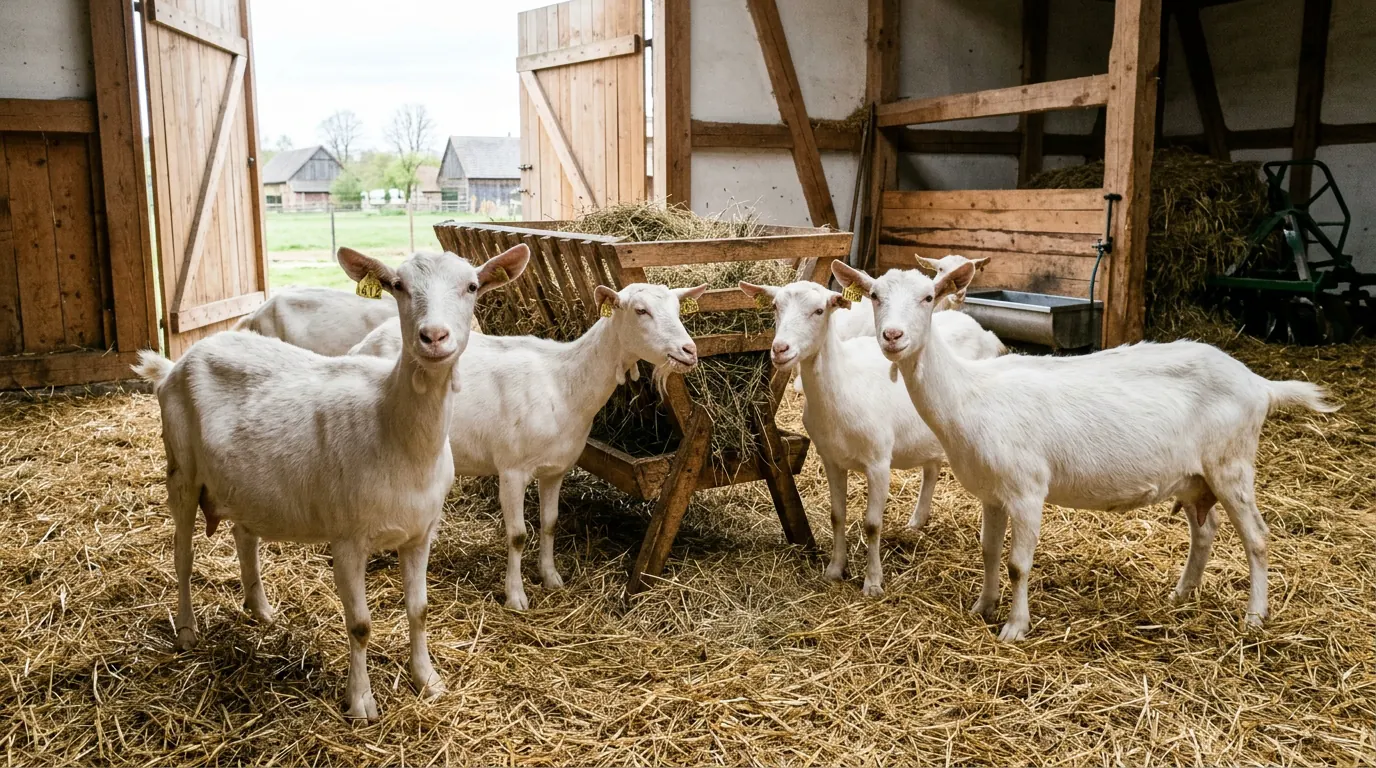
Goat breeds fall into three groups by use: dairy, meat and fiber. Native breeds kept in conservation programs come on top of that. First decide what you want to sell: milk, kids for meat, fleece or breeding stock. Only then look for a specific breed. We cover the general start in goat keeping: where to start, what it costs and whether it pays.
What the population data say about Poland
According to the Institute of Animal Science, National Research Institute (IZ PIB, Wiadomości Zootechniczne 2017), Polish White Improved and Polish Colored Improved goats were the most numerous in the population covered by performance recording. In recent years, Boer goats made up the largest group in recording. The authors point out that recording covers only a small part of herds, and that goats kept only for milk or goats of no recognized breed probably still dominate in the country.
Dairy goat breeds
Saanen goat
The Swiss Saanen goat has short white hair and is regarded as one of the highest-yielding dairy breeds. It copes well with indoor housing and needs full-value feed. We give the details in Saanen goat, one of the highest-yielding dairy breeds. If you plan to sell milk, also check how much milk a goat gives and what is in it.
Alpine and Toggenburg goats
Alpine and Toggenburg are dairy breeds from the Alps. The Alpine comes in many colors and manages well in different conditions. The Toggenburg is brown with light markings on the face and legs. We describe each one separately: Alpine goat and Toggenburg goat. High yield means higher feeding demands, so read the guide to feeding dairy goats.
Polish White and Colored Improved goats
These are Polish dairy breeds developed by upgrading local goats. According to IZ PIB, they are among the most numerous in the population covered by performance recording. They are a good choice when you want animals adapted to local conditions. Read more in the article on dairy breeds from Poland.
Meat breeds: the Boer goat
The most popular meat breed is the Boer goat, developed in South Africa. According to IZ PIB, the share of goats kept only for meat grew after 2007, and in recent years Boer goats were the largest group in performance recording. Keepers fatten Boer kids for slaughter and cross Boer bucks with dairy does. You will find the breed in Boer goat, a meat breed from South Africa. Before buying, work out income and costs in the guide to goat farming profitability.
Long-haired goat breed: the Angora
When people ask about a long-haired goat breed, they usually mean the Angora. It gives mohair, a long, lustrous fiber sheared from the fleece. It suits a keeper who wants to sell fiber, not milk. Keeping it differs from keeping dairy goats, especially in shearing and in protecting the fleece from damp. We describe the details in Angora goat: mohair and keeping fiber goats.
Long hair in a native breed
The Carpathian goat also has long or semi-long hair. According to IZ PIB, average hair length is 17 cm in does and 24 cm in bucks. It is a native breed, though, not a fiber breed in the industrial sense.
Carpathian goat: a protected Polish breed
The Carpathian goat is an old mountain breed. According to IZ PIB, it was considered extinct in the second half of the 20th century, and from 2005 the Institute of Animal Science tried to rebuild it from two herds that were found. Today the breed is covered by a genetic resources conservation program. The Institute gives average yield at about 500 kg of milk per lactation with about 4% fat. Adult does weigh 30 kg on average and bucks 55 kg. They are white and horned, with characteristic wattles ("dzwonki") on the neck. Breed profile: Carpathian goat, a native Polish breed.
How to choose a breed for your goal
Milk, meat or fleece
For milk or cheese sales, pick a dairy breed: Saanen, Alpine, Toggenburg or an improved breed. For kids for slaughter, pick Boer or Boer crosses. For fiber, pick Angora. To protect a native breed, pick the Carpathian under the IZ PIB program. Mixing purposes in one herd complicates management, so choose one at the start.
Conditions and costs
High-yielding dairy goats need better feed than native breeds. Needs rise with milk yield. According to INRA tables, as presented in an IZ PIB paper, a 50 kg goat giving 2 kg of milk a day needs 1.59 JPM (milk feed units) and at 4 kg of milk 2.49 JPM. See what goats eat through the year and compare prices in how much a dairy goat costs. Also prepare a solid fence.
After buying: registration and health
After you buy goats, complete the registration duties. We explain the rules in registering goats with ARiMR (Poland's Agency for Restructuring and Modernisation of Agriculture). Agree a worming plan with your vet. The vet always chooses the medicine and dose, and after treatment a withdrawal period applies to milk and meat. Also plan the breeding season and kidding. Check the legal state of the rules as of 23.11.2026 on the ARiMR website and the site of the Chief Veterinary Inspectorate (Główny Inspektorat Weterynarii).
Frequently asked questions
What goat breeds are kept in Poland?add
Polish farms keep dairy breeds: White and Colored Improved, Saanen, Alpine and Toggenburg. There is also the Boer meat breed, the Angora fiber breed and the native Carpathian. Many goats in the country are still of no recognized breed.
Which goat breed gives the most milk?add
The Saanen is regarded as the highest-yielding dairy breed. Actual yield depends on the line, feeding and stage of lactation, so ask for performance recording data before you buy.
Which goat has long hair?add
The Angora goat has long hair and gives mohair. The Carpathian goat has semi-long white hair, with an average length of 17 cm in does according to IZ PIB.
What is the best goat breed for meat?add
Most keepers raise the Boer goat for meat. After 2007 meat goats gained weight in Poland, and Boer goats were the largest group in performance recording.
Is the Carpathian goat a protected breed?add
Yes. The Carpathian goat is covered by a genetic resources conservation program run by IZ PIB. The breed had been considered extinct, and rebuilding began in 2005.
Which goat breed should I choose to start with?add
If you want milk, choose a dairy breed such as White Improved or Saanen. First set your goal and conditions, then work out costs in the article on goat farming profitability.
Sources & resources
- linkIZ PIB (Wiadomości Zootechniczne) — Current problems of dairy goat breeding in Poland
- linkIZ PIB (Wiadomości Zootechniczne) — Genetic resources conservation program for Carpathian goats
- linkIZ PIB — Farm animal keeping and breeding over 70 years. Cattle Breeding Department, Sheep and Goat Breeding Department
- linkIZ PIB (Wiadomości Zootechniczne) — Basics of goat feeding
- linkInstitute of Animal Science (IZ PIB) — izoo.krakow.pl
Prepared by: DlaFerm Team based on data from the sources listed · Publisher: INSTA-TECH sp. z o.o.
Keep biosecurity tight on your goat farm
The biosecurity plan generator in DlaFerm helps you write down farm entry rules, and the QR entry and exit log records visitors. Create a free farm account or get in touch.
Phone
+48 796 258 151