Alpine goat: a dairy breed from the Alps
The Alpine goat is a dairy breed developed in the Alps and valued for its hardiness and good milk yield. We describe how it looks, how it performs, what it needs to eat and what to check before you buy.
verifiedFrom the team that has organised work on poultry farms for years.
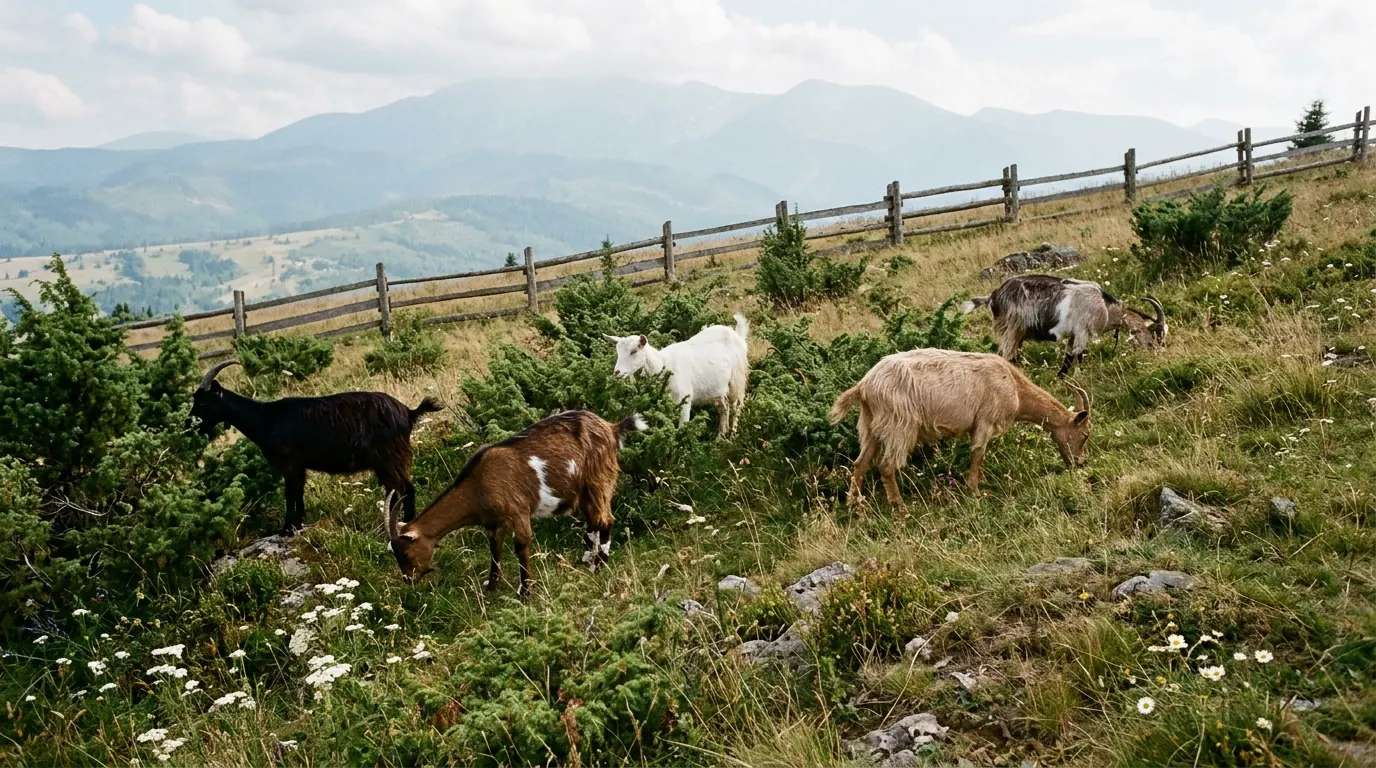
The Alpine goat is a dairy breed that came from the Alps, on the border of France and Switzerland. Keepers choose it for milking herds because it copes well on pasture, including hilly ground, and gives milk over a long lactation. In Poland it is kept alongside other dairy breeds: the Saanen, the Toggenburg and the Anglo-Nubian. For a full overview of breeds, see goat breeds: dairy, meat and fiber.
Who this breed suits
Consider the Alpine if you are starting a dairy goat herd and want a hardy animal that does not depend only on barn feeding. If you are still planning, first read how to start keeping goats and what it costs. Below we describe the breed so you can compare it with others before you buy your first animals.
Origin and appearance of the Alpine goat
Where the breed comes from
The Alpine goat comes from the Alps. It was selected as a dairy animal that uses mountain pastures with varied vegetation and tolerates changeable weather. That makes it suited to pasture keeping, but it needs solid fencing, because goats like to climb and jump over obstacles. In Poland you will find Alpine goats both in small herds on family farms and in larger herds producing milk for cheese.
How to recognize an Alpine goat
Alpines have no single coat pattern. You will see solid-colored and patched animals, with darker markings in different places, and the hair is short. This sets them apart from Saanens, which are white or cream, and from Toggenburgs, which are brown with lighter markings. So do not rely on color alone when buying. Ask for the herd records and check the animal's pedigree.
Milk yield and milk quality
How much milk an Alpine goat gives
We give no exact figure, because yield depends on the breeding line, the goat's age, lactation number and feeding. Reliable data come from milk performance recording, so ask the breeder for the results of the mother and grandmother of the goat you are buying. For comparison, according to IZ PIB (Poland's National Research Institute of Animal Production), the average yield of Carpathian goats, a native breed with more modest results, was about 350 kg of milk, and the best goat gave 498 kg. Dairy breeds imported from abroad usually give more, but need better feeding.
Milk composition
Goat milk composition changes during lactation and depends on the ration, the season and udder health. According to IZ PIB, the milk of Carpathian goats contained on average 2.9% protein and 3.11% fat. Values for Alpines may differ, so rely on tests of milk from your own herd. Also watch the somatic cell count, because a rise points to udder problems. We cover yield and properties in more detail in goat milk: yield, composition and properties.
What to feed Alpine goats
Needs during lactation
According to the 2007 INRA table (France's national agricultural research institute), quoted in the IZ PIB study, a goat weighing 50 kg and giving 2 kg of milk a day needs 1.59 JPM (milk feed units) and 135 g of protein (BTJ), and at 4 kg of milk a day, 2.49 JPM and 224 g of protein. Dry matter intake is 1.90 kg and 2.54 kg a day respectively. A dry goat that is not lactating needs 0.69 JPM and 44 g of protein. The differences are large, so adjust the ration to the yield of each goat, not to the herd average.
Pasture as a source of feed
IZ PIB also reports that the nutritional value of pasture changes through the season. Grass from 10 May had 17% dry matter, 0.97 JPM and 114 g BTJN per kilogram of dry matter. Grass from 26 June had 19% dry matter, 0.70 JPM and 61 g BTJN. In summer the grass has much less energy and protein, so high-yielding goats need supplementary feed. For detailed rations, see feeding dairy goats and what goats eat.
The Alpine goat compared with other dairy breeds
Most keepers choose between four dairy breeds. The Saanen goat is the highest yielding, but can be more sensitive to conditions. The Toggenburg is a Swiss breed with a calm temperament. The Anglo-Nubian gives milk with a higher fat content, which cheesemakers value. The Alpine sits in the middle: good milk yield and good tolerance of pasture keeping. If you care about a native breed and protecting genetic resources, consider the Carpathian goat. According to IZ PIB, it is kept in 17 herds, 205 does and 26 bucks in total.
How to buy an Alpine goat
What to check when buying
Check the pedigree and the mother's performance records, the udder, the legs and the general condition. Ask the breeder about diseases in the herd and how the animals are fed. It is best to buy a goat at the start of lactation or before kidding, when her potential is visible. The price depends on pedigree, age, the mother's yield and whether the goat is in kid. Check current prices with breeders in your area. We collected tips in how much a dairy goat costs.
Duties after buying
Goats must be registered. The Veterinary Inspection (Inspekcja Weterynaryjna) provides a template of the sheep and goat registration book, and ARiMR (Poland's Agency for Restructuring and Modernisation of Agriculture) gives information on current requirements. Before you bring new animals into the herd, set aside a quarantine area separate from the other goats. The biosecurity plan generator can help you prepare a plan to protect the herd from disease. Remember that profitability depends on feed costs and milk sales, and we explain the calculation in profitability of dairy goat farming.
Mating, pregnancy and kidding
Before mating, the doe should be in good condition, neither too fat nor too thin. During pregnancy, raise the ration in the last weeks, and about two months before kidding dry the doe off so she has time to recover. You will find the course of pregnancy in goat pregnancy, and what to do at birth in goat kidding. Kids of Alpine mothers are raised for milk or sold, and the skins of Alpine kids have been tested for suitability for tanning. If you treat a goat, a vet chooses the medicine and dose, and you must observe the withdrawal period and not send the milk for human consumption during it.
Frequently asked questions
How much milk does an Alpine goat give?add
Yield depends on the breeding line, the goat's age and feeding. It is best to ask the breeder for the performance records of the mother and grandmother. For comparison, the average yield of Carpathian goats according to IZ PIB is about 350 kg of milk.
What is the difference between an Alpine and a Saanen goat?add
The Saanen is white or cream and is regarded as the highest-yielding dairy breed. The Alpine has varied coat colors and copes well on pasture. The choice depends on your keeping conditions and how much feed you can provide.
How much does an Alpine goat cost?add
The price varies with pedigree, age, the mother's yield and whether the goat is in kid. Check market prices directly with breeders. We explain how to judge an offer in our article on dairy goat prices.
Can Alpine goats be kept on pasture?add
Yes, the breed comes from the mountains and tolerates grazing well. The value of pasture drops in summer, though. According to INRA, May grass had 0.97 JPM per kilogram of dry matter and late June grass 0.70 JPM, so high-yielding goats need supplementary feed.
How much feed does an Alpine goat need?add
According to INRA, a goat weighing 50 kg and giving 2 kg of milk a day eats about 1.90 kg of dry matter, and at 4 kg of milk, 2.54 kg. Energy and protein needs rise with yield.
Do I have to register Alpine goats?add
Yes, goats must be registered and the keeper maintains a registration book. The Veterinary Inspection provides the template. Check current requirements with your county veterinary inspectorate and ARiMR.
Sources & resources
- linkIZ PIB (Wiadomości Zootechniczne) — Basics of goat feeding
- linkIZ PIB (Wiadomości Zootechniczne) — Current state of breeding and the genetic resources protection program for Carpathian goats
- linkIZ PIB (Wiadomości Zootechniczne) — Current problems of dairy goat breeding in Poland
- linkPIW Pruszków (Veterinary Inspection) — Sheep/goat registration book (template)
Prepared by: DlaFerm Team based on data from the sources listed · Publisher: INSTA-TECH sp. z o.o.
Protect your goat herd from disease
DlaFerm.pl has a biosecurity plan generator and an entry and exit log with QR codes that help you control who enters the herd. Create a free farm account or get in touch, and we will show you how to use them.
Phone
+48 796 258 151