Anglo-Nubian goat: milk with a high fat content
An Anglo-Nubian gives less milk than a Saanen or an Alpine, but the milk is richer. According to Penn State Extension, Nubian goat milk averages 4.9% fat and 3.8% protein. We explain how to recognize the breed, how much milk to expect and how to feed it.
verifiedFrom the team that has organised work on poultry farms for years.
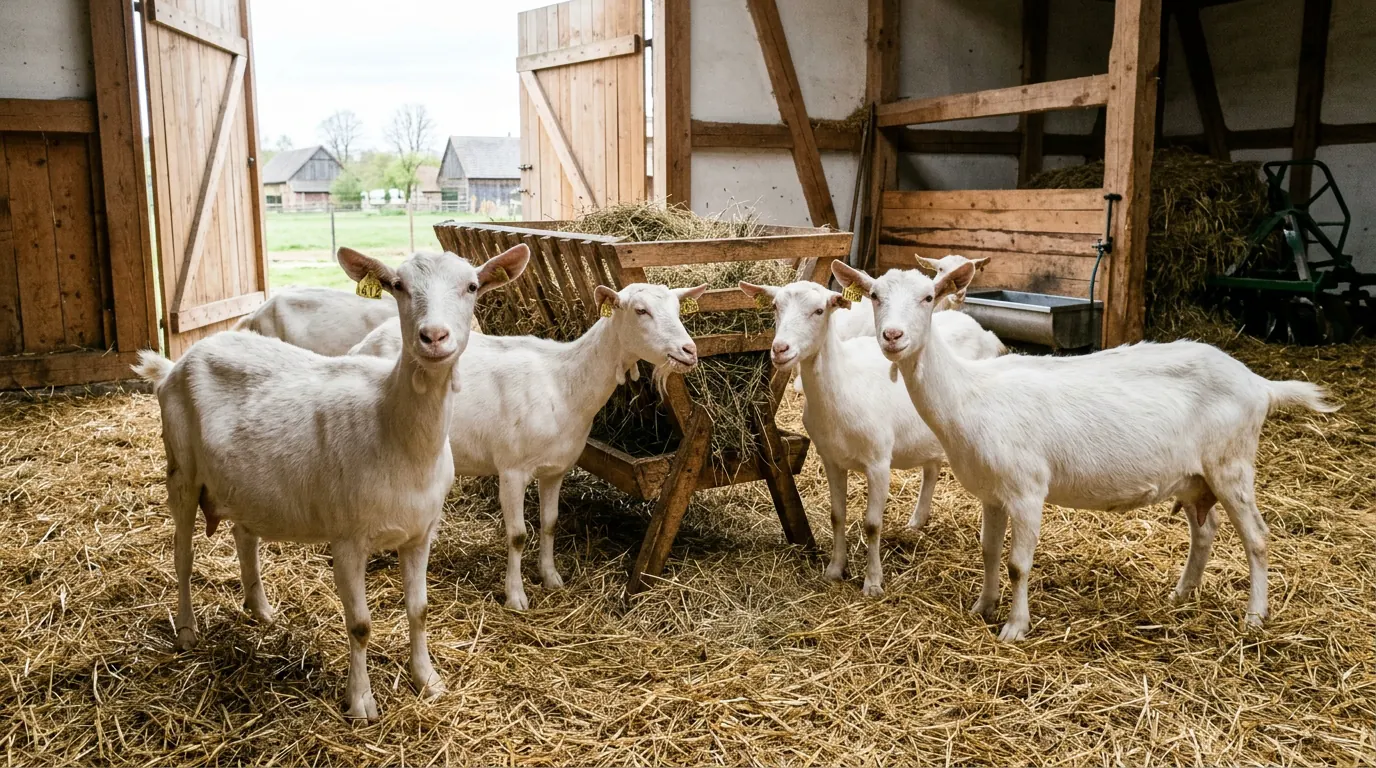
The Anglo-Nubian is a dairy breed valued for milk rich in fat and protein. A 2019 summary from Penn State Extension gives Nubian goats an average of 2,018 lb of milk per lactation (about 915 kg), with 4.9% fat and 3.8% protein. That is clearly more fat than in Saanen and Alpine milk, which have 3.3% each. In volume they come out lower: those two breeds average over 2,700 lb (about 1,230 kg).
Where the breed comes from
The Anglo-Nubian was developed in Great Britain by crossing local goats with bucks from Africa and India. That gives it its typical look: a prominent, convex nose and long, drooping ears. It has longer legs and a slimmer build than the Alpine breeds. Coat color varies, solid or spotted. Next to the breeds we describe on our site, such as the Saanen goat or the Alpine goat, the Anglo-Nubian is bred for milk quality, not milk quantity.
How much milk an Anglo-Nubian gives
Yield per lactation
Penn State Extension, citing 2019 DHIR data, gives Nubian goats an average of 2,018 lb of milk per lactation, about 915 kg. The spread is wide: from 510 to 3,840 lb (about 230–1,740 kg). The data covers records from 275–305 days of lactation and is not adjusted for the doe's age. The gap between a weak doe and the best one shows that herd income depends on choosing the right dams, not on the breed name.
Comparison with other breeds
In the same Penn State table, the Alpine averages 2,715 lb of milk (3.3% fat, 2.9% protein), the Saanen 2,702 lb (3.3% and 2.9%), and the Toggenburg 2,237 lb (3.1% and 2.9%). The Nubian gives the least milk of the four, but the most fat and protein. The Nigerian Dwarf gives 795 lb, yet its milk has 6.4% fat and 4.4% protein. We cover that in a separate article on miniature goats. For comparison, the Polish Carpathian goat averages 350 kg of milk with 3.11% fat and 2.9% protein, according to IZ PIB (Poland's National Research Institute of Animal Production).
What rich milk is good for
Higher fat and protein mean a better cheese yield: the same amount of milk makes more cheese. That is why the breed suits small farms making cheese and yogurt for direct sale. Milk composition also depends on feeding, the stage of lactation and udder health. We cover this in more detail in our article on goat milk.
What to feed Anglo-Nubian goats
Feed requirements
According to the 2007 INRA table published in Wiadomości Zootechniczne (IZ PIB), a 50 kg dry goat eats about 0.69 kg of dry matter per day. A goat giving 2 kg of milk a day needs about 1.59 kg of dry matter, and one giving 4 kg of milk about 2.49 kg. Energy concentration in the feed has to rise with yield. Because Anglo-Nubians give less milk than Alpine breeds, their rations can be lower, but always work them out for the individual goat at its stage of lactation.
Pasture
The authors of an IZ PIB study on grassland in organic goat keeping write that pasture is the best feed for goats: easily digestible, it stimulates lactation and is rich in nutrients. The value of the sward changes. In the INRA table, on 10 May the sward had 17% dry matter and 0.97 JPM/kg of dry matter in energy. On 26 June it was 19% and 0.70 JPM/kg. Young grass has much more energy than later growth. Goats graze selectively, so check the botanical composition and how heavily the pasture is used.
A year-round plan
In winter the base is good-quality hay, with concentrates added for goats in high lactation. You will find a detailed ration layout in our article on what goats eat. Always provide constant access to clean water and a mineral lick.
Keeping Anglo-Nubian goats in practice
Fencing and herd
Goats are agile and curious, and Anglo-Nubians have long legs, so the fence has to be solid. We discuss fence height, type of mesh and electric fencing in our article on goat fencing. Goats are herd animals, so do not keep one on its own.
Kidding and kids
We describe pregnancy and preparation for birth in the articles on goat pregnancy and goat kidding. With rich milk, keep an eye on milking hygiene and udder health from the start. Somatic cells in milk signal the state of the udder, and their level is checked in a milk test.
Treatment and records
Only a vet chooses medicines and doses. After treatment a withdrawal period applies: during that time you may not sell the goat's milk or process it into food. Record the treatment date, the product name and the end of the withdrawal period. The register of sheep and goats is kept to the template of the Veterinary Inspection (Inspekcja Weterynaryjna). For current requirements (as of 23.11.2026), check with your district veterinary officer and with ARiMR (Poland's Agency for Restructuring and Modernisation of Agriculture).
How to buy an Anglo-Nubian goat
What to look at
Ask the breeder for the milk recording data of the dam and the dam's dam: yield, fat and protein content. Inspect the udder, legs and hooves, and ask about vaccinations and herd testing. You agree the price of a kid or a milking goat with the breeder. It depends on parentage, age, the dam's yield and whether the animal has a pedigree. We outline the main factors in our article on how much a goat costs.
Which breed to choose
If you sell milk in bulk, a higher-yielding breed is the better choice, for example the Toggenburg goat or the Saanen. If you make cheese, the Anglo-Nubian gives more of it per liter of milk. For a general introduction to keeping goats, see our section on goat farming.
Frequently asked questions
How much milk does an Anglo-Nubian goat give?add
According to 2019 Penn State Extension data, a Nubian goat averages 2,018 lb of milk per lactation, about 915 kg. Results range from 510 to 3,840 lb. Yield depends on bloodline, age and feeding.
How much fat is in Anglo-Nubian goat milk?add
Penn State Extension gives an average of 4.9% fat and 3.8% protein for Nubian goats. For comparison, Saanen and Alpine goats have 3.3% fat and 2.9% protein each.
Do Anglo-Nubians give more milk than Saanens?add
No, they give less. The Saanen averages 2,702 lb per lactation, the Nubian 2,018 lb. The Nubian makes up for it with higher fat and protein in the milk.
What do Anglo-Nubian goats eat?add
Good pasture in summer and hay in winter form the base, with concentrates for goats in high lactation. Work out the ration for each goat. Always provide clean water and minerals.
Can I sell goat milk after treatment?add
Only after the withdrawal period set by the vet has passed. Only the vet chooses the medicine and dose. Write the end date of the withdrawal period in your records.
Where can I check current goat prices?add
You agree prices directly with the breeder, and they depend on pedigree, age and the dam's yield. Breeders' listings and goat breeders' associations are a good reference point.
Sources & resources
- linkPenn State Extension — Agricultural Alternatives: Dairy Goat Production
- linkIZ PIB (Wiadomości Zootechniczne) — Basic issues in goat feeding
- linkIZ PIB (Wiadomości Zootechniczne) — Effect of grassland in organic goat keeping on the quality of products
- linkIZ PIB (Wiadomości Zootechniczne) — Current state of breeding and the genetic resources conservation program for Carpathian goats
- linkIZ PIB (Wiadomości Zootechniczne) — Somatic cells in goat milk
- linkPIW Pruszków (Veterinary Inspection) — Sheep/goat registration book (template)
Prepared by: DlaFerm Team based on data from the sources listed · Publisher: INSTA-TECH sp. z o.o.
Track withdrawal periods in the Treatment and Withdrawal module
When you sell milk, every withdrawal end date matters. In DlaFerm you keep <a href="/ewidencja-leczenia-i-karencja-lekow">treatment and withdrawal records</a>, and you log farm visits in the <a href="/ksiega-wejsc-na-ferme">QR visitor book</a>. Create a free farm account or get in touch.
Phone
+48 796 258 151