Toggenburg goat: a Swiss dairy breed
The Toggenburg is a Swiss dairy goat with a brown coat and light markings. According to Penn State data from 2019, the average lactation is 2237 pounds, about 1015 kg of milk, with 3.1% fat and 2.9% protein. We cover looks, yield, feeding and what to check before you buy.
verifiedFrom the team that has organised work on poultry farms for years.
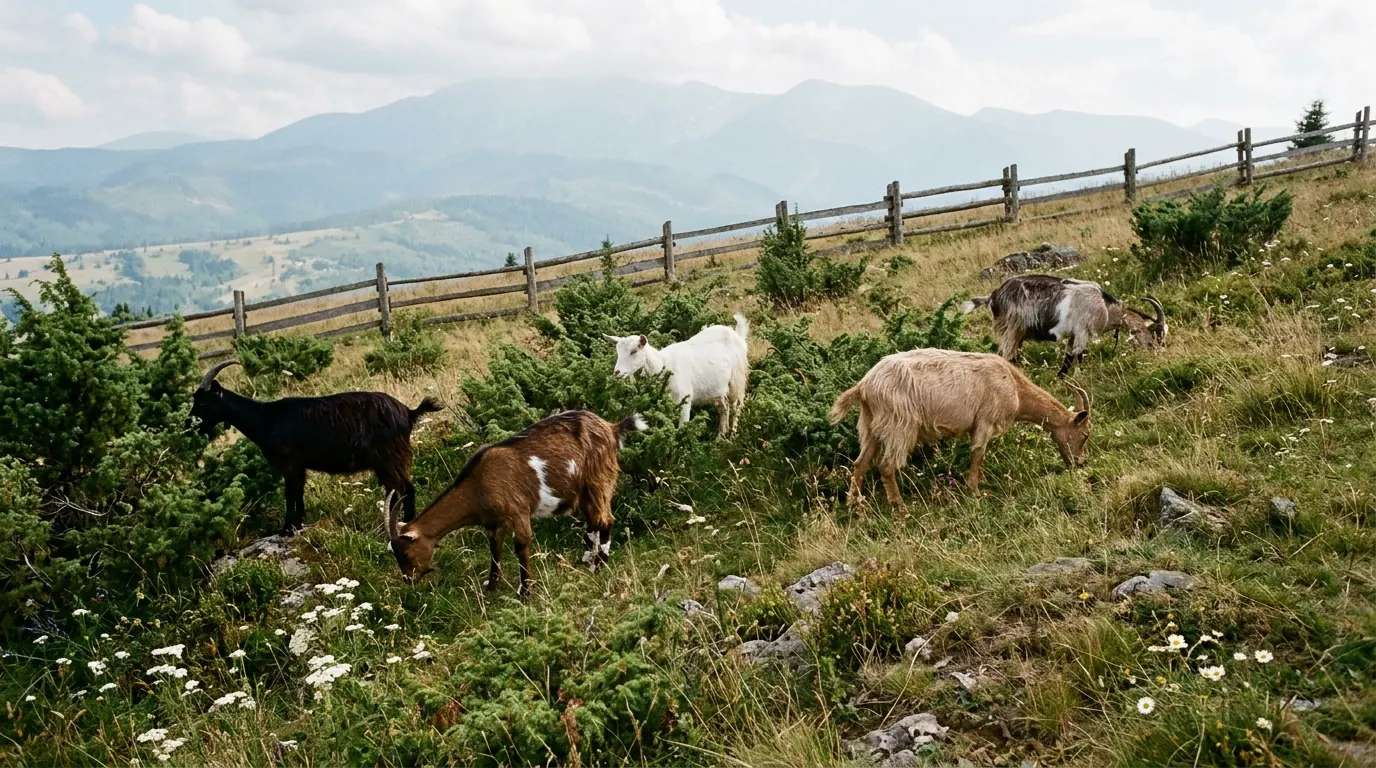
The Toggenburg comes from Switzerland and is one of the classic dairy breeds, alongside the Saanen and the Alpine. You recognize it by its brown coat with light, almost white markings on the face, ears and legs. It is medium-sized, lively and hardy. In Poland it is rarer than white and colored improved goats, but it appears as a separate breed in the statistics of the Polish Sheep Breeders Association (PZO) and in studies by the National Research Institute of Animal Production (IZ PIB).
For a keeper, the milk recording numbers matter most. Penn State Extension, using 2019 milk recording data, gives an average Toggenburg lactation of 2237 pounds (about 1015 kg), with a range from 1090 to 3840 pounds (about 494–1742 kg). The milk has 3.1% fat and 2.9% protein. For a general overview of breeds, see Goat breeds: dairy, meat and fiber. For how to start keeping goats, see Goat farming: where to start.
Looks and build of the Toggenburg goat
Coat and shape
The coat ranges from light brown to dark chocolate. Typical markings are light stripes on the face running from the eyes to the nose, light ears with a dark spot in the middle, and light legs below the hocks and knees. The hair is short or medium length, and can be longer on the back and thighs. The ears are upright and point forward. This makes the Toggenburg easy to spot in a herd and at a show.
Horns and temperament
The breed comes both horned and polled (hornless), so check what you are actually getting when you buy. Horns affect the safety of people and animals in the herd, and the design of feed barriers. Toggenburgs are described as lively and sociable, but not overly so. Like any goat, they like to climb and will get out over a fence that is too low or loose.
How much milk does a Toggenburg goat give?
Results according to Penn State
The Penn State Extension table (2019 DHIR data, 275–305-day lactations, no adjustment for age) gives the Toggenburg an average of 2237 pounds of milk, about 1015 kg. The lower end of the range is 1090 pounds (about 494 kg) and the upper end 3840 pounds (about 1742 kg). The spread is wide because yield depends on the line, the goat's age, the lactation number and feeding. So when you buy, ask about the dam's and grandam's yield, not just the breed. For more on quantity and composition, see Goat milk: how much a goat gives.
Comparison with Saanen and Alpine
The same table shows the Alpine averaging 2715 pounds (about 1232 kg) and the Saanen 2702 pounds (about 1226 kg). So the Toggenburg is less productive on average, but the gap should not settle your choice. Those two breeds have milk with 3.3% fat and 2.9% protein, while the Toggenburg has 3.1% fat. Compare them with the breeds in Saanen goat and Alpine goat. For reference, the same table gives the Anglo-Nubian 4.9% fat and 3.8% protein, so it suits cheesemaking better.
Milk composition and uses
Toggenburg milk is lower in fat than milk from most goat breeds. It works well for drinking, yogurt and fresh cheese. For aged cheese, protein and dry matter matter more, so you will more readily choose a breed with higher values, such as the Anglo-Nubian described in Anglo-Nubian goat. Milk composition changes over the lactation, with the season and with the ration. IZ PIB describes these factors in a study on the yield and processing suitability of goat milk, and a separate paper in Wiadomości Zootechniczne (a Polish animal science journal) covers somatic cells in goat milk. Check the somatic cell count regularly, because goat milk naturally has more of them than cow's milk.
Feeding Toggenburg goats
Requirements according to INRA
The 2007 INRA table, quoted in Wiadomości Zootechniczne, gives example requirements for a 50 kg goat. A goat not in milk eats 1.25 kg of dry matter a day. A goat giving 2 kg of milk a day eats 1.90 kg of dry matter and needs 1.59 milk feed units (JPM) and 135 g of protein truly digestible in the intestine. At 4 kg of milk a day the figures rise to 2.54 kg of dry matter, 2.49 JPM and 224 g of protein. The higher the daily yield, the more the need for dry matter and energy grows.
Pasture and winter ration
Pasture value falls over the season. According to the same INRA table, grass from 10 May has 17% dry matter and 0.97 JPM per kg of dry matter, and grass from 26 June has 19% dry matter and 0.70 JPM. High-yielding goats will not meet their needs on summer grazing alone. We describe rations for lactation and the dry period in Feeding dairy goats, and the plan for the whole year in What goats eat.
The Toggenburg in Polish conditions
Availability and place in Polish breeding
Poland mostly keeps white and colored improved goats, so there are fewer Toggenburgs, and finding them takes some searching among breeders and breed associations. PZO data, quoted by IZ PIB, show that the share of each breed among goats entered in herd books changed between 1995 and 2015. For a native alternative for mountain areas, see Carpathian goat. According to IZ PIB, 205 does and 26 bucks of that breed are now kept in 17 herds, with average milk yield of 350 kg.
What to check when you buy
Ask for the pedigree and the dam's performance records. Look at the udder: it should be soft and well attached, with two even teats. Check the health of the herd of origin and the entry in the register of sheep and goats. The Veterinary Inspection (Inspekcja Weterynaryjna) publishes the template for this register. Prices vary with line, age and pedigree, and we cover the details in How much a dairy goat costs. Judge the profitability of the whole operation with the calculation in Profitability of dairy goat farming.
Frequently asked questions
How much milk does a Toggenburg goat give?add
According to Penn State Extension (2019 DHIR data), the average lactation is 2237 pounds, about 1015 kg. The spread is wide: from 1090 to 3840 pounds (about 494–1742 kg), depending on line, age and feeding.
What is the composition of Toggenburg goat milk?add
Penn State Extension gives an average of 3.1% fat and 2.9% protein. That is lower in fat than milk from Anglo-Nubian goats, which have 4.9% fat and 3.8% protein.
Is the Toggenburg better than the Saanen?add
On average yield the Saanen does slightly better: 2702 pounds against 2237 pounds. The Toggenburg has milk with 3.1% fat against 3.3% in the Saanen. The choice depends on which animals are available, the line, and what you plan to do with the milk.
What does a Toggenburg goat look like?add
It has a brown coat from light to dark, with light stripes on the face, light ears with a dark spot and light legs. It comes both horned and polled.
Are Toggenburg goats common in Poland?add
They are not among the most commonly kept goats. Polish goat keeping is based mostly on white and colored improved goats. You will find Toggenburgs with a few individual breeders and in herds run under performance recording.
How much should you feed a dairy goat?add
According to INRA 2007, a 50 kg goat giving 2 kg of milk a day eats about 1.90 kg of dry matter. At 4 kg of milk a day, intake rises to about 2.54 kg of dry matter.
Sources & resources
- linkPenn State Extension — Agricultural Alternatives: Dairy Goat Production
- linkIZ PIB (Wiadomości Zootechniczne) — Basic issues in goat feeding
- linkIZ PIB (Wiadomości Zootechniczne) — Current problems of dairy goat breeding in Poland
- linkIZ PIB (Wiadomości Zootechniczne) — Current state of breeding and implementation of the genetic resources conservation program for Carpathian goats
Prepared by: DlaFerm Team based on data from the sources listed · Publisher: INSTA-TECH sp. z o.o.
Protect your goat herd with a biosecurity plan
The biosecurity plan generator in DlaFerm helps you write down the rules for entering the farm and contact with animals, and the QR-code visitor log records every visit. Create a free farm account or get in touch.
Phone
+48 796 258 151