Saanen goat: one of the highest-yielding dairy breeds
According to 2019 US data, a Saanen goat gives an average of 2702 lb of milk per lactation, about 1226 kg. That matches the Alpine and beats the Toggenburg. We cover the numbers, feeding and what to check before you buy.
verifiedFrom the team that has organised work on poultry farms for years.
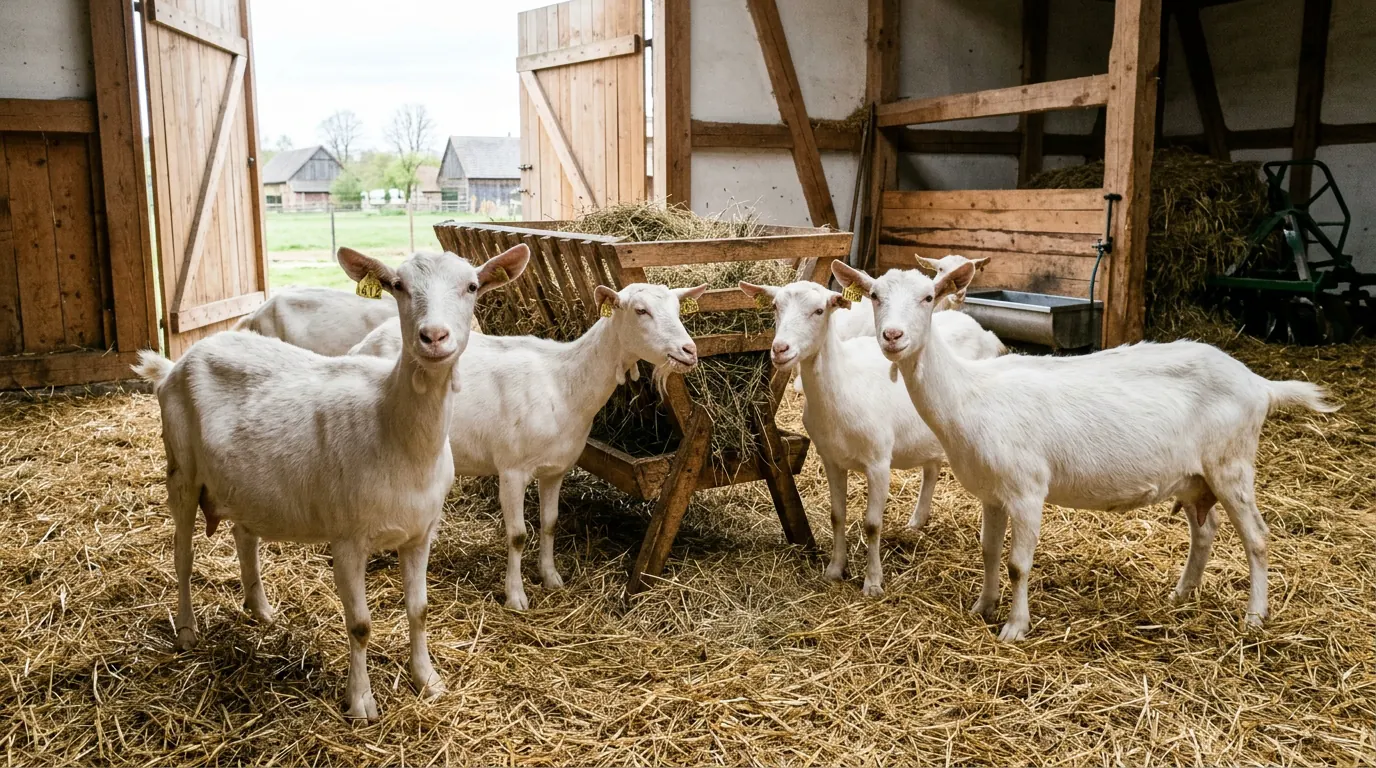
The Saanen is a dairy goat breed from Switzerland. According to 2019 DHIR records collected by Penn State Extension, the average yield per lactation is 2702 lb, about 1226 kg of milk. The milk averages 3.3% fat and 2.9% protein. In the same table Alpine goats reach 2715 lb, so the two breeds share the top spot. That is why we call the Saanen "one of the highest-yielding" breeds, not "the highest-yielding".
Who this breed suits
The Saanen works where milk volume matters: a commercial herd, selling milk or dairy products, and machine milking. Its milk has less fat than breeds with richer milk. If you make cheese and want high fat, compare it with the Anglo-Nubian goat. For an overview of all production types, see our article on goat breeds, and for the basics of starting a herd, see the guide to goat farming.
How much milk does a Saanen goat give
Average and spread
Penn State Extension gives the Saanen an average of 2702 lb of milk per lactation, about 1226 kg. The range is wide: from 920 to 4870 lb, about 417 to 2209 kg. The data cover records of 275–305 days in milk and are not adjusted for the goat's age. For a farmer this means one thing: the breed average guarantees you nothing. Bloodline, age, feeding and the course of lactation make the difference, and a single goat at the bottom of the range can give three times less milk than the best one. Before you buy, ask for the milk records of the dam and grandam.
Comparison with other dairy breeds
In the same Penn State Extension table, Alpine goats average 2715 lb (about 1231 kg), Toggenburg 2237 lb (about 1015 kg) and Nubian 2018 lb (about 915 kg). Nubians make up for it in composition: they average 4.9% fat and 3.8% protein, against 3.3% and 2.9% for the Saanen. The Nigerian Dwarf gives about 361 kg of milk, but with 6.4% fat. Want to compare it with a similar Swiss breed? See our pages on the Toggenburg goat and the Alpine goat.
Milk composition
Saanen milk is mild and lower in fat than milk from low-yielding breeds. Composition also depends on feeding, stage of lactation and udder health. Poland's Institute of Animal Production (Instytut Zootechniki PIB, IZ PIB) describes these factors in a paper on goat milk yield and composition, and covers somatic cells in goat milk separately. For detailed numbers on composition and properties, see our article on goat milk.
Saanen goats in Polish breeding
An IZ PIB paper on current problems in dairy goat breeding shows that Poland's milk recording now includes Saanen and Alpine goats, alongside the Polish White and Colored Improved and the Carpathian goat. After 2007 the share of goats kept for meat grew, and Boer goats in particular were added to recording. The authors note, however, that with so few animals recorded, the data do not reflect the whole population. In their view, herds are mostly goats of one-sided dairy type or of no breed. We describe the Polish dairy breeds in our article on the Polish White and Colored Improved goat.
Crossbreeding and kid skins
The Institute of Animal Production has studied crosses of Saanen with Anglo-Nubian goats. Among other things, it described the tanning suitability of skins from Saanen kids, Alpine kids and their crosses. For a dairy herd this is an extra source of information, but milk stays the main income. If you are considering crossbreeding, first work out whether the crossbreds will keep the yield you care about. We set out costs and income in the article on the profitability of goat farming.
What to feed a Saanen goat
Needs in lactation
An IZ PIB paper on goat feeding cites the 2007 INRA (French national agricultural research institute) norms for a 50 kg goat. At 2 kg of milk a day, the goat eats about 1.90 kg of dry matter and needs 1.59 JPM (Polish milk feed units) and 135 g of protein truly digestible in the intestine (BTJ). At 4 kg of milk a day, intake rises to 2.54 kg of dry matter and the requirement to 2.49 JPM and 224 g BTJ. A goat that is not milked and not in lactation needs only 0.69 JPM and 44 g BTJ. So the high yield of a Saanen means almost doubling the energy and protein of the ration compared with a dry goat.
Pasture and roughage
The same INRA tables show how pasture value changes. On 10 May the sward had 17% dry matter, and 1 kg of dry matter gave 0.97 JPM. On 26 June dry matter rose to 19% and the value fell to 0.70 JPM. So the same goat on the same good ration in May and June gets a different amount of energy. In summer, add concentrate or good hay and adjust the ration to current yield. We describe full rations in the articles on feeding dairy goats and on what goats eat through the year.
What to check when buying a Saanen goat
The price of a Saanen goat depends on its origin, its dam's results, its age and whether it is entered in a herd book. That is why we give no amounts: ask several breeders directly and compare offers. Ask for the parents' milk records, check the udder (symmetrical, no lumps, well attached) and ask about the health of the herd. You will find a practical checklist in the article how much a dairy goat costs.
Kidding and care of kids
The yield of the whole lactation starts at kidding. A goat that kidded without complications and quickly returned to full feed intake usually starts better in the milking parlor. Preparing for birth begins in pregnancy: body condition scoring, the right ration during the dry period and a clean place to kid. We cover this in the articles on goat pregnancy and goat kidding.
Registration, treatment and biosecurity in a goat herd
You must register and identify goats under Poland's animal identification rules. Check the current requirements with your county office of ARiMR (Agency for Restructuring and Modernisation of Agriculture) and your county veterinarian. A template register of sheep and goats is published by the Veterinary Inspection (Inspekcja Weterynaryjna). Record every treatment. The vet chooses the medicine and dose, and you must know the withdrawal period and not sell the milk until it ends. Limit and log visits by outsiders to the farm. In DlaFerm.pl the QR entry and exit log helps with that, and the treatment and withdrawal module helps with treatment records.
Frequently asked questions
How much milk does a Saanen goat give?add
According to 2019 DHIR data cited by Penn State Extension, an average of 2702 lb per lactation, about 1226 kg. The range of results is from about 417 to 2209 kg. The exact amount depends on bloodline, age and feeding.
Is the Saanen the highest-yielding goat breed?add
It is near the top, but not alone. In the same table the Alpine goat averages 2715 lb, slightly more. The gap is small, so the results of a specific bloodline matter more than the breed.
How much fat is in Saanen goat milk?add
On average 3.3% fat and 2.9% protein, according to Penn State Extension. That is less fat than in Nubian goat milk (4.9%) and much less than in Nigerian Dwarf milk (6.4%).
How much feed does a Saanen goat need in lactation?add
According to the 2007 INRA norms, a 50 kg goat giving 2 kg of milk a day eats about 1.90 kg of dry matter. At 4 kg of milk a day it is about 2.54 kg. Build the ration around the yield of the individual goat.
Are Saanen goats kept in Poland?add
Yes. IZ PIB lists the Saanen among the dairy breeds covered by milk recording, alongside the Alpine, Polish White and Colored Improved and Carpathian goats. The number of recorded animals is small, though.
How long should I withhold milk after treating a goat?add
For the withdrawal period your vet gives for the medicine used. The period depends on the product, so do not set it yourself. Record the treatment date and the end of the withdrawal period in your log.
Sources & resources
- linkPenn State Extension — Agricultural Alternatives: Dairy Goat Production
- linkIZ PIB (Wiadomości Zootechniczne) — Current problems in dairy goat breeding in Poland
- linkIZ PIB (Wiadomości Zootechniczne) — Basics of goat feeding
- linkIZ PIB — Livestock keeping and breeding over 70 years. Cattle Breeding Department, Sheep and Goat Breeding Department
- linkPIW Pruszków (Veterinary Inspection) — Sheep/goat register (template)
Prepared by: DlaFerm Team based on data from the sources listed · Publisher: INSTA-TECH sp. z o.o.
Keep treatment and withdrawal records in one place
The Treatment and Withdrawal module in DlaFerm.pl lets you record every treatment and track the end of the withdrawal period before you sell milk. Create a free farm account or get in touch, and we will show you how it works in practice.
Phone
+48 796 258 151