Goat kidding: how birth goes and a newborn kid's first hours
Kidding is the birth of one or more kids by a doe. We explain how to spot the start of labor, what the birth looks like and what to do with each kid in its first hours. We also list the signs that mean you must call a vet.
verifiedFrom the team that has organised work on poultry farms for years.
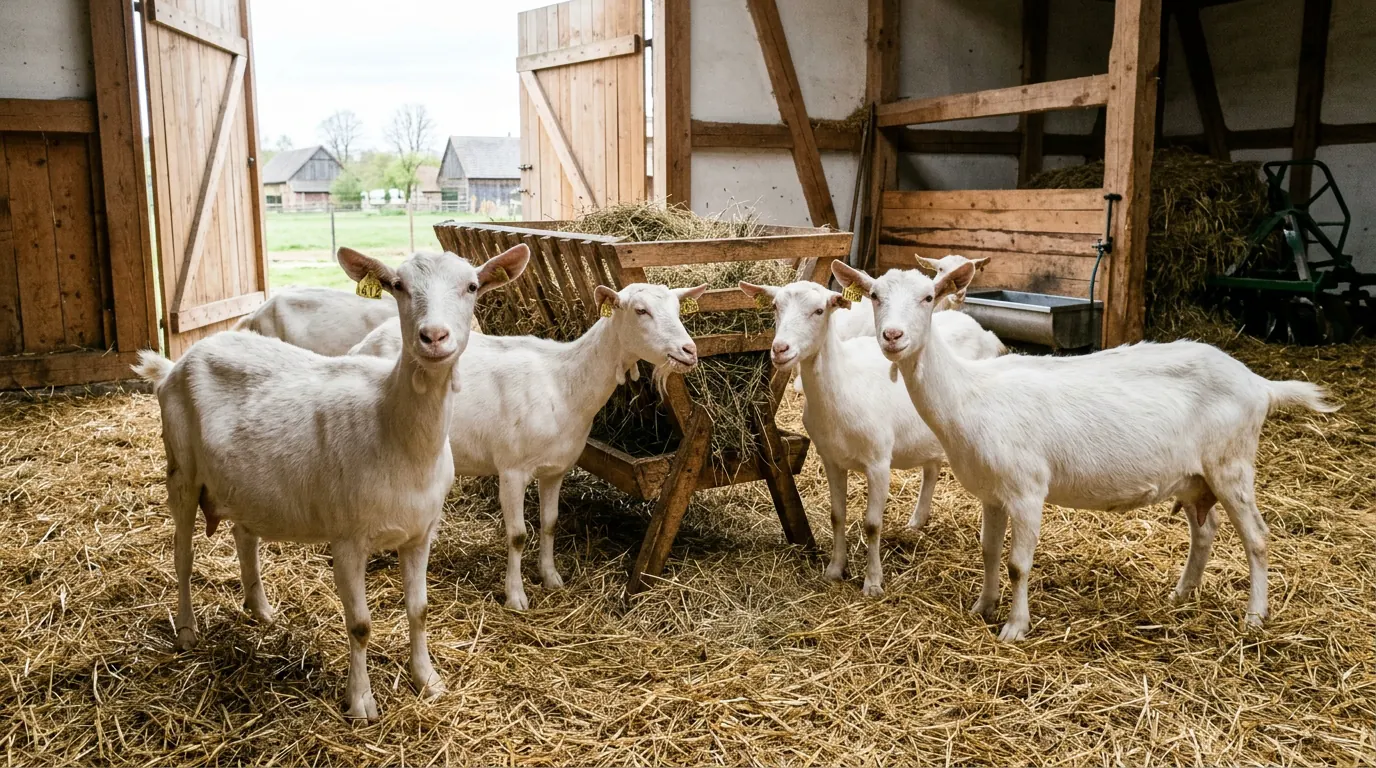
Most does kid without any help from you. Your job is to prepare a clean, dry place, watch quietly and look after the kids right after birth. A kid's first colostrum and a well-treated navel decide how it starts life. We describe the length of pregnancy and the signs of an approaching due date in a separate article on goat pregnancy.
Goat labor, birth and kidding: what the words mean
All of these describe the same event: the doe gives birth to kids. Polish keepers say "wykot" most often, while "kocenie" usually names the moment of birth itself. For the herd, it is one of the most important events of the year, because the number and condition of the kids born shape your breeding plan. For the bigger picture of running a herd, see goat farming.
Preparing the kidding pen and spotting the signs
Kidding pen
Prepare a separate, clean pen with fresh, dry bedding for the doe before birth. Poland's Ministry of Agriculture regulation on minimum conditions for keeping farm animals (Dz.U. 2019 poz. 1966, Poland's Journal of Laws, legal state as of 23.11.2026) requires at least 1.5 m² for an adult doe in a pen, plus at least 0.3 m² for each suckling kid. The regulation also allows tethering females during birth and kid rearing. In practice, give the doe more room than the minimum so she can turn and get up freely. Clean and disinfect the pen a few days before the due date.
Signs that kidding is near
Before birth the doe may be restless, paw at the bedding, leave the herd, and lie down and get up often. The udder is tight and enlarged, and the area around the vulva is swollen. Mucous discharge may appear. Some does lose appetite and look for a corner where they can be alone. When you see these signs, leave her in the prepared pen and keep noise and strangers away.
What to keep at hand
Prepare clean towels or paper towels, disposable gloves, navel disinfectant, a warm place to dry the kids and your vet's phone number. A clean bottle with a teat and a stock of colostrum also help. To learn how to feed a doe in the last weeks of pregnancy, read what goats eat.
How kidding goes, step by step
Start and pushing
Labor starts with contractions. The doe often lies down, stretches her neck, lies on her side and pushes with each contraction. Then the water bag appears, and the waters flow once it breaks. A normal kid is born with its front legs forward and its head resting on them. Leave the doe in peace and do not help while the birth is progressing.
Further kids
Does often have twins and sometimes triplets. The gap between kids is usually from a dozen or so to several dozen minutes, so do not assume the birth is over after the first kid. The doe usually starts licking the first kid and then delivers the next. Watch for a kid that gets stuck.
Afterbirth
After birth the doe passes the afterbirth, usually within a few hours. Remove it from the bedding so she does not eat it and it does not foul the pen. If it does not come away within a reasonable time, talk to your vet and do not pull it out by force.
A kid's first hours
Handling a newborn kid
When the kid is born, make sure its nostrils are clear and it is breathing. The doe usually licks it, which dries and stimulates the kid. If the mother does not, dry the kid with a clean towel. Disinfect the navel as your vet advises and check it over the following days, because it is a gateway for infection.
Colostrum: the first meal
The kid should take colostrum as soon as possible after birth, ideally in the first hours of life. Colostrum supplies antibodies, because a kid is born without its own immunity. Check that the kid has found a teat and is sucking. If it does not suck on its own, milk out colostrum and give it from a bottle, and contact your vet if problems continue. Keep a stock of colostrum from a healthy doe of the same herd at hand.
Warmth and observation
A wet, chilled kid loses heat fast. Provide dry bedding and a draft-free spot, and warm up weak kids. For the first days, check that every kid sucks, stands and has warm ears. Only then decide on further rearing, including buck kids intended for meat, which we cover in the article on goat meat.
When to call a vet
Warning signs
Call your vet if the doe pushes hard for a long time and no kid appears, if you see only one leg or just the head, or if there is foul-smelling discharge or a lot of blood. A retained afterbirth, a listless doe or a weak kid that will not drink are also reasons to phone. Do not put your hand into the birth canal without experience and clean gloves.
Treatment and medicines
Your vet chooses and doses all medicines, including antibiotics and aids after birth. Write down what was given and the date, because the animal is subject to a withdrawal period, the time when milk or meat is not fit to eat. The drug leaflet or your vet gives the withdrawal period. When you work with many animals, records help, for example treatment and withdrawal records in DlaFerm.
Caring for the doe and kids in the following days
The doe after kidding
Give the doe clean, lukewarm water and good-quality hay. Raise the feed ration gradually as lactation begins. Check the udder: it should be soft, with no redness, hot spots or lumps. Talk to your vet about any change in the udder or in the discharge from the birth canal.
Hygiene and biosecurity
Clean the kidding pen after every kidding and let strangers in only when necessary. It is good to log visitors and workers and to write down the rules for entering pens. General tools help here: the QR entry log and the biosecurity plan generator.
Frequently asked questions
What does goat labor look like?add
The doe becomes restless, lies down and pushes with contractions. The water bag appears, then the kid is born, usually with its front legs and head first. Does often have twins, so keep watching after the first kid.
How long does a goat take to kid?add
It depends on the number of kids and on the doe, so we give no fixed figure. If the doe pushes for a long time and you see no progress, call your vet.
What should I do with a kid right after birth?add
Check its breathing, dry it if the mother does not lick it, and disinfect the navel. Make sure it takes colostrum as soon as possible.
Why is colostrum so important for a kid?add
A kid is born without its own immunity. Antibodies from colostrum protect it in the first weeks of life, so give it in the first hours.
When should I call a vet for a goat birth?add
Call when the doe pushes for a long time without result, a kid is badly positioned, the afterbirth does not come away, there is heavy bleeding or foul-smelling discharge, or the doe or kid is weak.
Should a goat eat the afterbirth?add
No. Remove the afterbirth from the bedding as soon as it comes away so the pen stays clean.
Sources & resources
- linkMinistry of Agriculture (MRiRW) / Journal of Laws: regulation on minimum conditions for keeping farm animals, consolidated text (Dz.U. 2019 poz. 1966)
- linkWODR Poznań: Poradnik Gospodarski, May 2024 (welfare in sheep and goat keeping)
- linkIZ PIB (Wiadomości Zootechniczne): Basics of goat feeding
- linkChief Veterinary Inspectorate (Główny Inspektorat Weterynarii): gov.pl/web/wetgiw
Prepared by: DlaFerm Team based on data from the sources listed · Publisher: INSTA-TECH sp. z o.o.
Keep treatment and pen entries in one place
DlaFerm has general modules that also help at kidding: treatment records with withdrawal periods, a QR entry log and a biosecurity plan generator. We have no separate goat module. Create a free farm account or get in touch.
Phone
+48 796 258 151