What do goats eat? Feeding goats all year round
A goat eats mainly roughage: hay, pasture grass and green forage. You add concentrates only for high-yielding goats or at particular times. We show how much dry matter a goat eats and how the ration changes from pasture to winter.
verifiedFrom the team that has organised work on poultry farms for years.
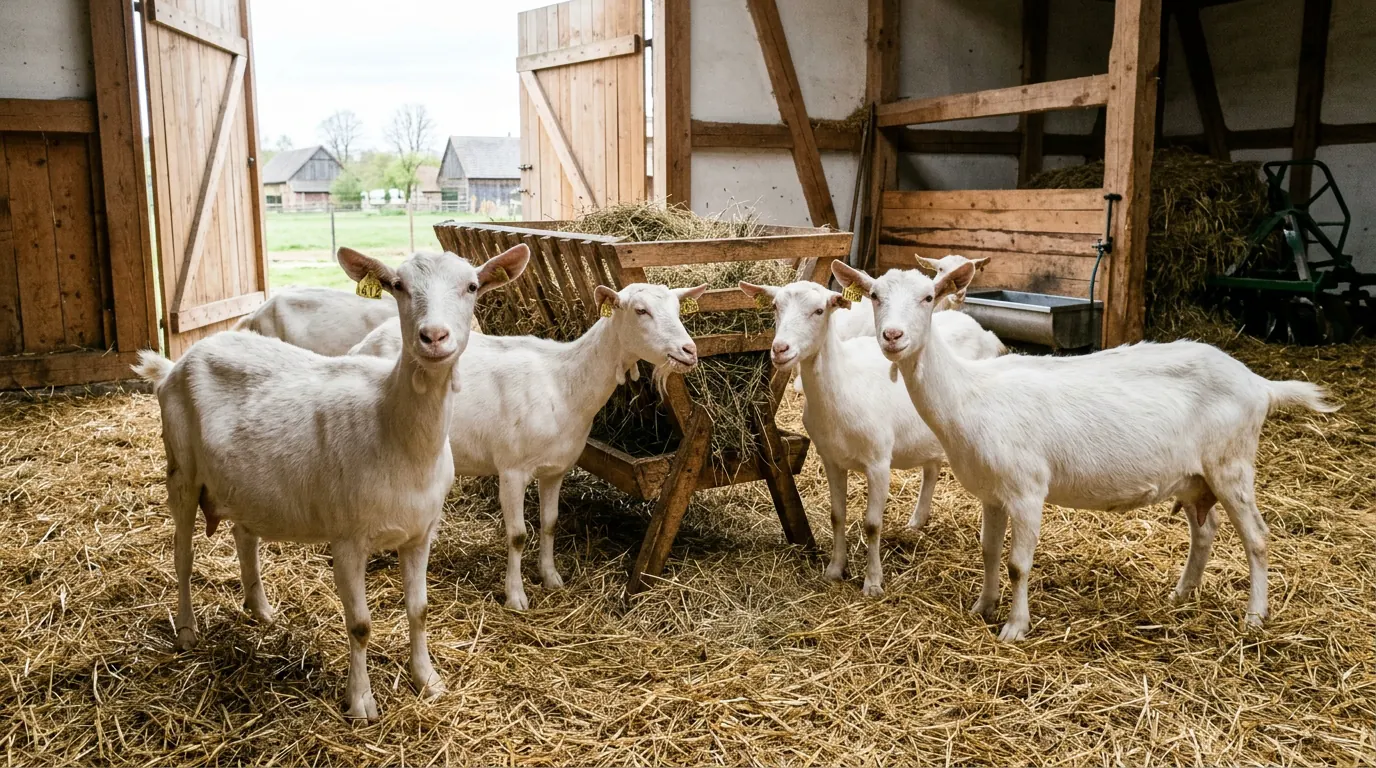
A goat is a ruminant, so its diet rests on roughage: good hay, pasture grass, green forage, and in winter silage or root crops if you have them. Concentrates (cereal meal, compound feed) top up the ration for milking goats at peak lactation and for goats before kidding. According to the 2007 INRA tables, a dry goat weighing 50 kg eats about 1.25 kg of dry matter a day.
Why a goat does not eat "everything"
A goat happily nibbles leaves, twigs and bark, but that does not mean it all suits her. She is a picky eater: she chooses the most valuable parts of plants and avoids soiled feed. Hay from the floor, damp or moldy hay is left untouched or does harm. So the quality of the feed and the way you offer it matter more than the amount.
This guide at a glance
We cover hay and pasture, the needs of goats with different yields based on the 2007 INRA data (tables published by IZ PIB, Poland's National Research Institute of Animal Production), concentrates, minerals and water, and how to switch from winter to summer feeding. For detailed rations in lactation and the dry period, see our separate article on feeding dairy goats.
Hay and roughage
Hay: what goats eat in winter
In winter, when there is no pasture, hay is the core of the ration. It should be fine-stemmed, sweet-smelling, and free of mold and dust. A goat rejects thick, woody stems, so some hay will always be left in the rack. Allow for that leftover in the amount you buy or cut. Good meadow hay with a fair share of legumes gives more protein than hay from late-cut grasses.
How to offer feed
Put hay in a rack or feeder at the height of the goat's muzzle, not on the ground. A goat will not eat feed that is trampled and fouled with droppings. Give every animal a place at the feeder, because weaker goats are often pushed away by dominant ones. We describe equipment and feeder space in the article on the goat house.
Green forage, root crops and branches
Besides hay, goats readily eat green forage, beets, carrots and branches of leafy trees, which you can cut in summer and dry for winter. Give root crops in pieces and in moderate amounts. Remove wet or damp feed from the trough after a few hours, especially in warm weather.
Pasture for goats
Pasture value in spring and summer
According to the 2007 INRA tables, described in the paper "Basic issues of goat feeding" (IZ PIB), pasture on 10 May had 17% dry matter, and 1 kg of dry matter contained 0.97 JPM (milk production feed unit) and 114 g of BTJN protein. By 26 June the grass had 19% dry matter, but only 0.70 JPM and 61 g of BTJN in 1 kg of dry matter. So young spring grass is richer in energy and protein than mature grass in early summer.
What this means for the ration
Grass value falls as it matures, so in summer high-yielding goats may need concentrates even if they spend all day on pasture. Low-yielding goats usually meet their needs from grass alone. Remember the fencing too; we cover it in the article on goat fencing.
Grazing and animal welfare
A May 2024 paper from WODR Poznań (an agricultural advisory center) states that the welfare option for goats requires grazing for at least 120 days in the growing season. If you use this eco-scheme, plan your paddocks so that this grazing time can be documented. Check current requirements with ARiMR (Poland's Agency for Restructuring and Modernisation of Agriculture) and in the rules in force on the day you submit your application.
How much feed a goat needs
Dry goat and milking goat
The 2007 INRA table (quoted in the IZ PIB paper) gives example requirements for a goat with a body weight of 50 kg. Dry goat: dry matter intake 1.25 kg, energy 0.69 JPM, BTJ protein 44 g. Milking goat giving 2 kg of milk a day: 1.90 kg of dry matter, 1.59 JPM and 135 g of BTJ. Goat giving 4 kg of milk a day: 2.54 kg of dry matter, 2.49 JPM and 224 g of BTJ.
Energy density of the feed
The same table shows the energy concentration in the dry matter of the ration: 0.55 JPM/kg for a dry goat, 0.83 for a goat giving 2 kg of milk and 0.98 for a goat giving 4 kg of milk. The more milk, the more concentrated the ration must be, because a goat cannot eat more than her stomach capacity allows. Hay alone rarely covers the needs of a good milking goat at peak lactation.
Putting it into practice
The table values are a starting point. The actual ration depends on hay quality, body weight, age, condition and production stage. Watch the goats' condition and yield, and adjust the ration gradually. We describe how much milk a goat can give in the article on goat milk, and rations for lactation and the dry period in the text on feeding dairy goats.
Concentrates, minerals and water
Concentrates: when they make sense
Give cereal meal or compound feed to milking goats in lactation, goats in late pregnancy and growing young animals. Dry goats and bucks outside the breeding season usually do not need it. Split the ration into several portions during the day, because one big portion of grain overloads the rumen. Choose the mix with a feeding adviser or follow the feed maker's guidance.
Minerals and licks
Hay and grass do not fully cover mineral needs. Give goats constant access to a mineral lick made for goats or sheep. Be careful with feeds and licks made for other species: their mineral content is often wrong for goats. Choose a mix on the advice of an adviser or a vet.
Water
A goat needs constant access to clean water, and in lactation she drinks much more. Clean the drinkers daily and in winter make sure they do not freeze. A goat reluctantly drinks water fouled with droppings, so set the drinker higher than the floor.
Changing the feed and the year's calendar
From winter feeding to pasture
Change feed gradually, over several days. Limit the first outings onto fresh, young grass to a short time and give hay beforehand. A sudden switch to lush green grass risks digestive upsets and diarrhea. Do the same when you change hay, compound feed or feed batch.
Kidding and lactation
Before and after kidding, a goat has higher nutritional needs. Do not let her condition drop in late pregnancy, but do not overfeed her with grain either. We describe the birth in the article on goat kidding. You will find breeding rules and dates in the text on goat reproduction.
Goats and their health
Gastrointestinal parasites reduce feed use, so worm goats as your vet advises; the vet chooses the drug, the dose and the withdrawal period for milk and meat. We explain the rules in the article on worming goats. Keep data on treatments and withdrawal periods in a record, for example in the treatment and withdrawal module.
What not to feed goats
Poisonous plants and spoiled feed
Plants poisonous to goats include yew and rhododendron. Do not plant them near the paddock or throw garden waste to the goats. Do not give moldy, heated, frozen or soil-contaminated feed. Cut branches only from trees you know are safe.
Feeds for other species and too much grain
Do not feed goats feeds made for other species without advice, because their composition may differ. Too much grain and bread acidifies the rumen. If a goat stops chewing the cud, has a bloated belly or has diarrhea, call a vet.
Breed and feeding
Dairy breeds have higher requirements than the native Carpathian goats, which IZ PIB describes as hardy, long-lived and undemanding in feeding. You will find an overview of breeds and their needs in the article on goat breeds, and general rules for starting out in the guide to goat keeping.
Frequently asked questions
What do goats eat every day?add
The base is hay in winter and pasture grass in summer, with some green forage and branches. Milking goats at peak lactation also get concentrates. Always provide water and a mineral lick.
How much hay does a goat eat a day?add
According to the 2007 INRA tables, a dry goat weighing 50 kg takes in about 1.25 kg of dry matter a day. A goat giving 2 kg of milk eats 1.90 kg, and at 4 kg of milk 2.54 kg of dry matter. The actual amount of hay depends on its moisture and quality.
What should you feed goats in winter?add
Mainly good hay, plus root crops or silage if you have them. Add concentrates for milking and pregnant goats, and give every animal a mineral lick and unfrozen water.
What is the best feed for goats?add
There is no single best feed. You match it to age, production stage and yield. Dry goats usually do well on hay and pasture, while milking goats need a mix chosen with a feeding adviser.
Can goats eat bread and table scraps?add
It is not worth it. Bread and large amounts of grain acidify the rumen, and kitchen scraps are often spoiled or too fatty. Give hay, root vegetables or branches instead.
Is pasture enough for a milking goat?add
In spring young grass has a high value: 0.97 JPM in 1 kg of dry matter on 10 May according to INRA 2007. By 26 June it falls to 0.70 JPM. A high-yielding goat then needs concentrates on top.
Sources & resources
- linkIZ PIB (Wiadomości Zootechniczne) — Basic issues of goat feeding
- linkWODR Poznań — Poradnik Gospodarski, May 2024 (Welfare issues in sheep and goat keeping)
- linkIZ PIB — Livestock keeping and breeding over 70 years. Cattle Breeding Department, Sheep and Goat Breeding Department
- linkIZ PIB (Wiadomości Zootechniczne) — Effect of grassland in organic goat keeping on the quality of products
Prepared by: DlaFerm Team based on data from the sources listed · Publisher: INSTA-TECH sp. z o.o.
Record treatments and withdrawal periods on your farm in one place
DlaFerm.pl has no separate goat module, but the treatment and withdrawal module helps you keep farm treatment records in order. Create a free farm account or get in touch, and we will show you how it works in practice.
Phone
+48 796 258 151