Feeding dairy goats: rations in lactation and the dry period
A 50 kg goat giving 4 kg of milk a day needs 2.49 JPM (milk-production feed units) according to the INRA tables and eats about 2.54 kg of dry matter. We show how to turn these numbers into hay, pasture and concentrate, and how to change the ration at drying off.
verifiedFrom the team that has organised work on poultry farms for years.
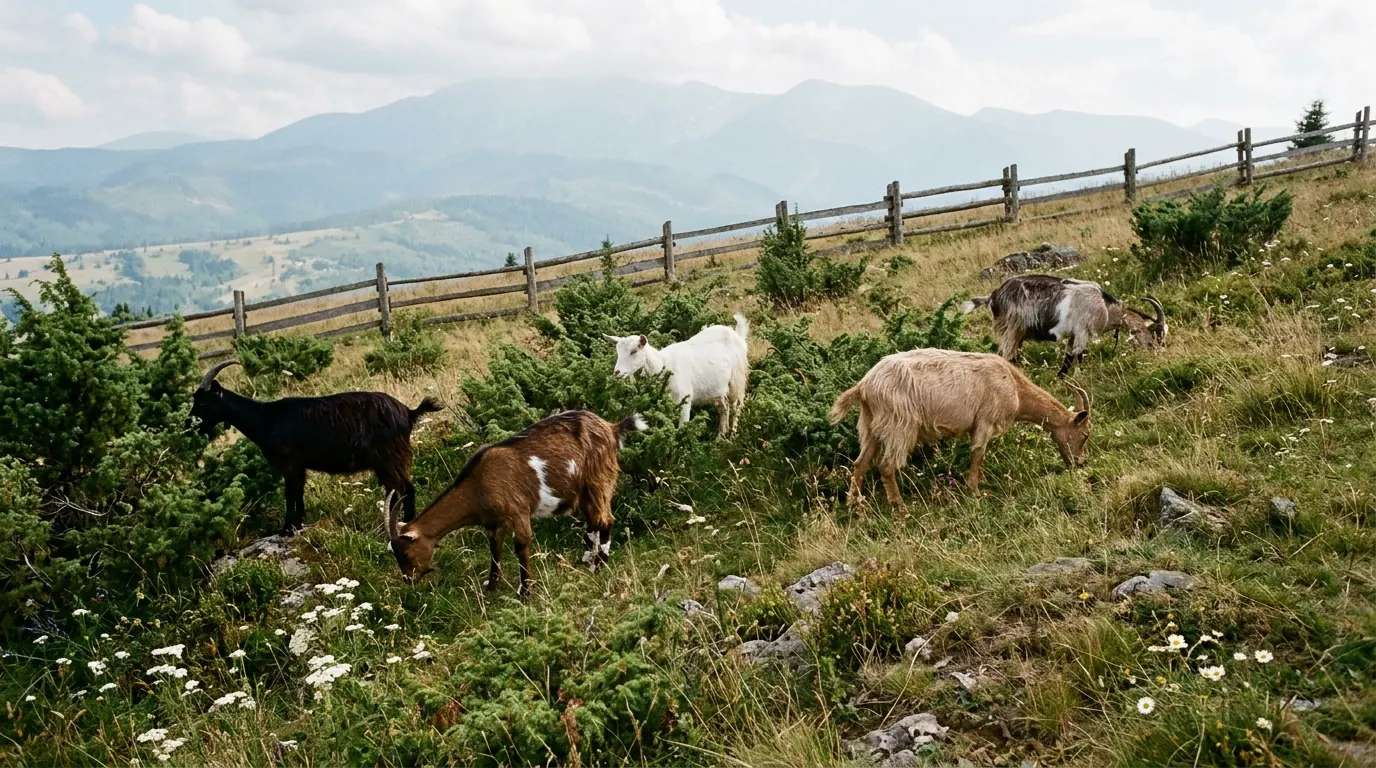
Feeding dairy goats rests on roughage: hay, silage and pasture. You add concentrate only to cover what milk production still needs. According to the INRA tables from 2007, a 50 kg goat that is not milked eats about 1.25 kg of dry matter a day. At 4 kg of milk a day, intake rises to 2.54 kg of dry matter. These figures come from the study "Basic issues in goat feeding" ("Podstawowe zagadnienia żywienia kóz") by IZ PIB, Poland's National Research Institute of Animal Production.
What the ration depends on
Three things set the ration: the goat's body weight, daily milk yield and stage of the cycle (lactation, dry period, late pregnancy). Roughage quality matters too. We describe dairy breeds in the articles on the Saanen goat and the Alpine goat. For a year-round overview of feeding, read What goats eat.
What a goat needs in lactation
Three production levels
According to the INRA tables from 2007, a 50 kg goat that is not milked needs 0.69 JPM (milk-production feed unit) and 44 g of protein truly digestible in the intestine (BTJ). A goat giving 2 kg of milk a day needs 1.59 JPM and 135 g BTJ. At 4 kg of milk a day, needs are 2.49 JPM and 224 g BTJ. Yield doubles, while energy needs rise more than threefold compared with a goat not milked. That is why a high-yielding goat loses weight fast on ordinary hay.
Dry matter intake and energy density
The INRA table also gives how much dry matter a goat can eat: 1.25 kg for a goat not milked, 1.90 kg at 2 kg of milk and 2.54 kg at 4 kg of milk. The energy concentration required per kilogram of dry matter rises as well: 0.55, 0.83 and 0.98 JPM. The numbers show that in a high-yielding goat, stomach capacity alone is not enough. Feed must be energy-dense, because a goat will not eat more than about 2.5 kg of dry matter. Good hay from an early cut and concentrate give that density.
How much hay a goat eats
Converting dry matter to hay
Hay usually contains about 85% dry matter. A 50 kg goat not milked, eating 1.25 kg of dry matter, would in theory eat about 1.5 kg of hay a day if she got hay only. A goat in full lactation takes in clearly more dry matter, but part of the ration must come from concentrate. Actual intake depends on hay quality. Goats pick the best parts, so feed hay in a way that limits waste. Remove the previous day's leftovers.
Hay quality matters more than quantity
Hay from a late cut, coarse and woody, has low digestibility. The goat eats it but gets little from it, so milk drops even with a full manger. When planning the winter ration, judge hay by sight and smell. It should be green, fine-stemmed and free of mold. A feed analysis from a laboratory helps. We describe feeders and stalls in the article on the goat house.
Pasture as goat feed
Pasture value changes through the season
The INRA 2007 table shows how fast sward value falls. On 10 May the pasture had 17% dry matter, 0.97 JPM per kilogram of dry matter and 114 g BTJN. By 26 June dry matter had risen to 19%, while energy fell to 0.70 JPM and 61 g BTJN. Spring grass is very dense feed, and in summer you need to add concentrate. In May a small supplement is often enough.
Selective grazing and milk quality
According to a study by Radkowska and Radkowski (IZ PIB, 2019), pasture sward is the best feed for goats: easily digestible and good for milk flow. Goats choose plants selectively, so part of the sward goes unused. The authors advise checking yield, botanical composition and the degree of pasture use often. Research cited in that paper indicates that milk from pastured goats has a more favorable fatty acid profile and more vitamins. Remember a tight fence, described in the article on goat fencing.
Dairy goat feed: concentrate and supplements
How much concentrate
Choose concentrate so the ration covers the requirement in the table. When hay and sward give less energy than the goat needs, a concentrate mix fills the gap. The higher the yield, the larger the share of concentrate, but do not raise it abruptly. A fast change in ration composition strains the rumen. Change amounts gradually over 1–2 weeks and watch body condition and yield. It is best to set the exact mix with a nutrition adviser from an agricultural advisory center.
Mixes, minerals and water
Dairy goats need constant access to a mineral lick and clean water. A goat drinks much more in lactation than outside it. A frozen or dirty drinker lowers feed intake and yield. Choose mineral mixes to suit the composition of your farm-grown feed, because deficiencies depend on the region and the roughage. Do not judge feed and mix purchases by price per tonne alone. See how they affect the cost of a liter of milk in the article on the profitability of goat keeping.
Feeding a goat in the dry period
Cut the concentrate
The dry period is the time without milking before the next kidding. It usually lasts about 6–8 weeks. The goat's requirement then falls toward the INRA table values for a goat not milked: 0.69 JPM and 44 g BTJ at 50 kg, although late in pregnancy needs rise because of the growing kids. Reduce concentrate gradually and keep good hay as the base. Do not let the goat get fat, because it makes kidding and the next lactation harder.
Late pregnancy and start of lactation
In the last weeks before kidding, raise the energy and protein content of the ration, because the goat eats less dry matter while the kids grow fast. After kidding, increase the ration gradually. You set mating and kidding dates by the rules in Heat and mating of goats. Remember deworming as advised by your vet and the withdrawal periods of medicines, which we cover in Deworming goats.
Frequently asked questions
How much hay does a goat eat per day?add
According to the INRA tables, a 50 kg goat eats from 1.25 kg of dry matter (not milked) to 2.54 kg (4 kg of milk a day). Hay has about 85% dry matter, so a goat not milked would in theory eat about 1.5 kg of hay. At high yield, part of the ration must come from concentrate.
What is the best feed for dairy goats?add
The base is good hay from an early cut and pasture. You add concentrate only up to the level of yield. Set the exact mix with a nutrition adviser and feed analysis results.
How many JPM does a dairy goat need?add
According to the INRA tables from 2007, a 50 kg goat needs 1.59 JPM at 2 kg of milk a day and 2.49 JPM at 4 kg of milk a day. A goat not milked needs 0.69 JPM.
Is pasture enough for a dairy goat?add
In spring pasture is very valuable. On 10 May the INRA table gives 0.97 JPM per kilogram of dry matter, and on 26 June only 0.70 JPM. In summer and at high yield you need to add concentrate.
How do you feed a goat in the dry period?add
Reduce concentrate gradually and keep good hay. Make sure the goat does not get fat. In the last weeks before kidding, raise energy and protein in the ration again.
Sources & resources
- linkIZ PIB (Wiadomości Zootechniczne) — Basic issues in goat feeding
- linkIZ PIB (Wiadomości Zootechniczne) — Effect of grassland in organic goat keeping on the quality of products
- linkIZ PIB (Wiadomości Zootechniczne) — Factors affecting yield, chemical composition, nutritional value and technological suitability of goat milk
- linkPenn State Extension — Agricultural Alternatives: Dairy Goat Production
Prepared by: DlaFerm Team based on data from the sources listed · Publisher: INSTA-TECH sp. z o.o.
Keep goat treatment records together with withdrawal periods
The "Treatment and withdrawal" module in DlaFerm lets you record treatments and track withdrawal dates, also while you plan rations for lactating goats. Create a free farm account or get in touch.
Phone
+48 796 258 151