Is Dairy Goat Farming Profitable? Costs and Income
Dairy goats pay when milk, kids and subsidies cover feed, labor and housing, and when you plan the sale before you buy the herd. We show what makes up cost and income, and how to work out the result for your own farm.
verifiedFrom the team that has organised work on poultry farms for years.
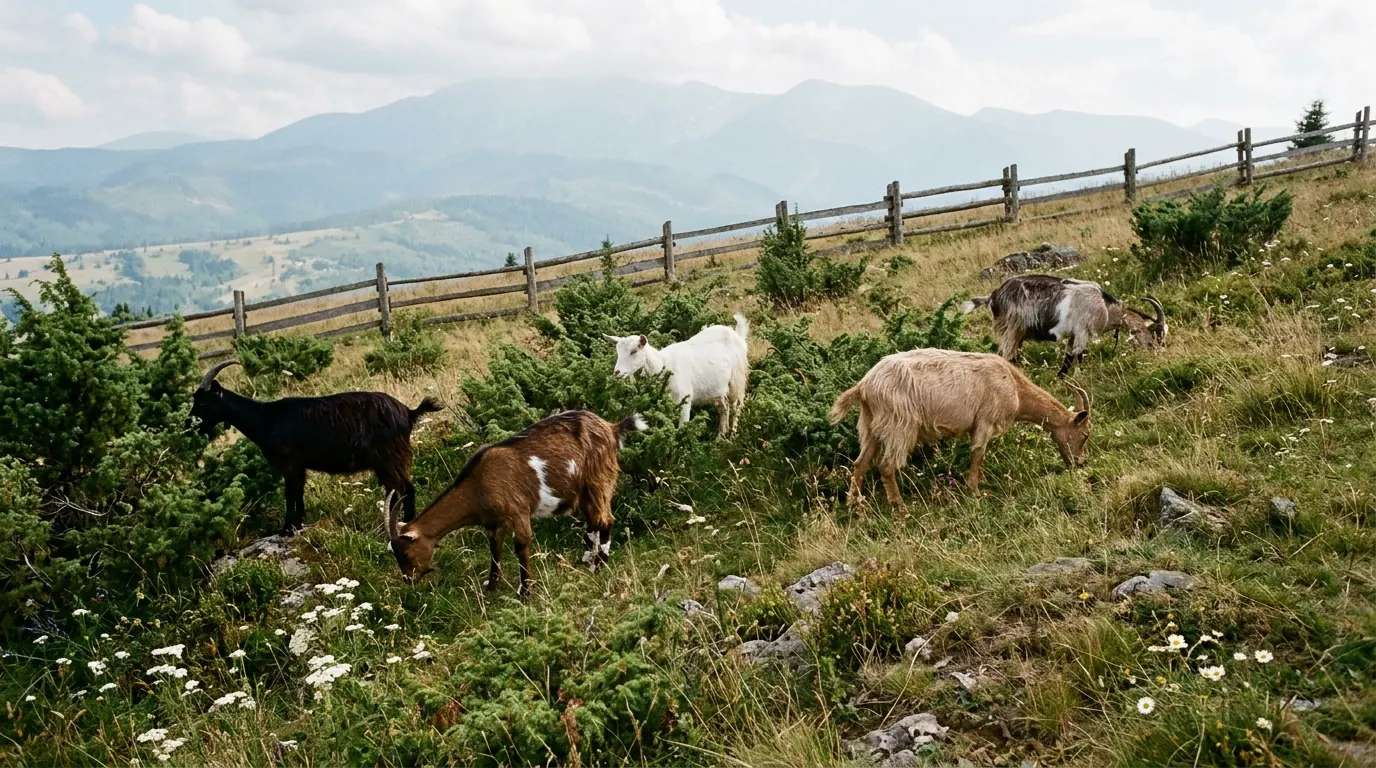
Is goat farming profitable? It depends on three numbers: how much milk a goat gives in a year, how much you get for it and who buys it, and what the goat costs to keep, including your own work. Without a sales plan, even a good milker loses money, because the milk must be collected, cooled and sold every day. For a general overview, see Goat farming: where to start, what it costs and whether it pays.
Why we give no prices
Prices of goat milk, breeding goats, feed and cheese change from year to year and differ between regions and sales channels. So we explain how the calculation works and where to find current figures: offers from local buyers, feed price lists from suppliers and your own bills from recent months. Put them into the formula below and check the result before you buy your first animals.
What makes up the cost of keeping goats
Fixed costs
Fixed costs include the building, fencing, milking equipment and herd registration. We describe the building in Goat house: space, ventilation, equipment and fences and electric fencing in Fencing for goats. Goats beat weak fencing easily, so saving on the fence ends in damage on neighbors' land and escapes. Add water, electricity for cooling milk and building insurance. You pay these whether the herd has ten goats or forty, so herd size strongly changes the cost per goat.
Variable costs: feed
Feed depends on yield. According to the 2007 INRA table, cited by IZ PIB (Poland's National Research Institute of Animal Production) in its article on goat feeding, a dry goat of 50 kg eats 0.69 kg of dry matter a day. A dairy goat of the same weight giving 2 kg of milk a day eats 1.59 kg, and at 4 kg of milk a day 2.49 kg of dry matter. Doubling the milk means clearly higher feed use, not only more milk. We cover rations in Feeding dairy goats.
Pasture lowers feed cost
The same IZ PIB data show the value of pasture: on 10 May the dry matter of the sward has 0.97 JPM (feed units for milk production) per kilogram, and on 26 June only 0.70 JPM. Young grass is much more valuable than overgrown grass. Well-managed pasture replaces part of the concentrate, but it needs fencing, rotation and observation, because goats pick plants selectively. In your calculation, count the cost of land and labor for pasture instead of treating it as zero.
Where income comes from
Milk and milk products
Milk income is the goat's yield multiplied by the price you get in your chosen sales channel. Milk sold to a wholesale buyer fetches a lower price per unit than cheese and products sold directly, but needs no cheesemaking of your own. Processing raises income, but adds costs for equipment and time, and the need to meet veterinary requirements. Check the rules for selling milk and products with the county veterinary inspectorate before you buy the herd, not after. We cover milking hygiene in Milking goats.
Yield depends on breed
Milk yield differs greatly between breeds. For example, IZ PIB reports that Carpathian goats, covered by a genetic resources protection program, give on average 350 kg of milk per lactation, the best goat 498 kg, with on average 2.9% protein and 3.11% fat. This is a local breed, not bred for high output. Improved dairy breeds usually give more, as we describe in the articles on the Saanen goat and the Toggenburg goat. Choose a breed for your sales channel: for milk to be processed, composition matters as well as quantity.
Kids
A goat also earns from her offspring. For Carpathian goats IZ PIB gives fertility of 95% and prolificacy of 158%, meaning on average a little over one and a half kids per goat that kids. Bucklings from dairy lines are hard to sell at a higher price, so plan their sale early. Young breeding goats from good pedigrees are worth more, but need entry in herd books and assessments. We describe mating and kidding dates in Heat and mating of goats.
Subsidies and requirements that affect the result
Payments for sheep and goats raise income, but come with conditions, including registration and keeping a minimum number of animals. Check current rates, deadlines and requirements with ARiMR (Poland's Agency for Restructuring and Modernisation of Agriculture); we give an overview in Subsidies for sheep and goats. Do not build your profitability on subsidies alone: their rules change from year to year. Every goat must be tagged and the herd registered, as we describe in Registering goats with ARiMR. The legal position as of 23.11.2026 should be checked with ARiMR and the Veterinary Inspection (Inspekcja Weterynaryjna), because detailed requirements differ with herd size.
How to work out profitability for your own herd
The per-goat formula
Take the yearly income from one goat: milk multiplied by price, plus kids, plus subsidies per head. Subtract the yearly cost of her feed, bedding, treatment, worming and her share of fixed costs. The result is the margin before pay for your own work. Then divide it by the hours you spend on the goat in a year: milking twice a day, feeding, cleaning, kidding. Only then compare the result with another job. For the cost of buying goats, see How much a dairy goat costs.
Herd size
In a small herd your own labor is the biggest cost, so goat keeping can pay as a supplement to income from processing and direct sales. A larger herd allows more mechanization, but also brings higher risk of disease and treatment costs. Grow the herd step by step and compare your figures with your assumptions after each year. Watch health too: we describe goat diseases, symptoms and prevention in Goat diseases.
What lowers profitability
Health and parasites
Internal parasites lower yield and raise treatment costs. Plan worming with a vet, who chooses the medicine and dose and gives the withdrawal period for milk. Milk from the withdrawal period cannot be sold, so every treatment also means lost income. Record treatments and withdrawal dates as you go. We describe the rules in Worming goats.
Milk quality and no market
A high somatic cell count in milk signals a problem with udder health and can cut you off from a buyer. IZ PIB describes somatic cells in goat milk as an important quality indicator. The second risk is having no buyer: goats give milk through the whole lactation and you cannot pause it. So agree a contract or sales plan before the first mating.
Breeding sector data
IZ PIB points out that after subsidies for breeding ended after 2007, the number of herds covered by performance recording fell from 96 herds in 2005 to 13 in 2010 and 2015. This means goat breeding is poorly organized in Poland, and when you buy breeding animals you have fewer offers and less data on their yield. Plan more time to choose your goats.
Frequently asked questions
Is goat farming profitable?add
It pays when you have secured sales of milk or products and you count feed costs and your own labor. Without a buyer, or when you buy expensive animals without a plan, the result can be negative. Work out the margin on one goat before you buy a herd.
How much milk does a goat give in a year?add
It depends on breed and feeding. For example, IZ PIB gives an average of 350 kg of milk per lactation for the Carpathian breed, and the best goat gave 498 kg. Improved dairy breeds give more, but need better feed.
How much does it cost to keep a dairy goat?add
The biggest cost is feed: according to the 2007 INRA table, a goat of 50 kg giving 4 kg of milk a day eats 2.49 kg of dry matter, and a dry goat 0.69 kg. Add bedding, treatment and a share of building costs. Work out the amount from your own feed prices.
Are there subsidies for goats?add
Yes, there are payments for sheep and goats, but they have conditions on registration and number of animals. Check current rules with ARiMR. Do not base your profitability calculation on subsidies alone.
Can I sell goat milk after treating the goat?add
Only after the withdrawal period given by the vet for the medicine used. The vet always chooses the medicine and dose. Record the treatment date and the end of the withdrawal period.
How many goats should I start with?add
Start with a small herd that you can milk and handle yourself, and enlarge it after the first full year of records. A small scale lets you test sales and yield before you spend more on a building and animals.
Sources & resources
- linkIZ PIB (Wiadomości Zootechniczne) — Basic issues in goat feeding
- linkIZ PIB (Wiadomości Zootechniczne) — Current problems of dairy goat breeding in Poland
- linkIZ PIB (Wiadomości Zootechniczne) — Current state of breeding and the genetic resources protection program for Carpathian goats
- linkIZ PIB (Wiadomości Zootechniczne) — Somatic cells in goat milk
- linkARiMR — gov.pl/web/arimr
Prepared by: DlaFerm Team based on data from the sources listed · Publisher: INSTA-TECH sp. z o.o.
Keep treatments and withdrawal periods in one place
The <a href="/ewidencja-leczenia-i-karencja-lekow">Treatment and withdrawal</a> module in DlaFerm helps you track treatment dates and the end of withdrawal periods, which matters for your result when you sell milk. Create a free farm account or get in touch.
Phone
+48 796 258 151