How much does a dairy goat cost, and what to check before you buy
The price of a dairy goat depends on breed, age, the dam's milk yield and breeding papers. We give no amounts, because they differ between regions and breeders. We explain what makes up the price, how to compare offers and what to check before you pay.
verifiedFrom the team that has organised work on poultry farms for years.
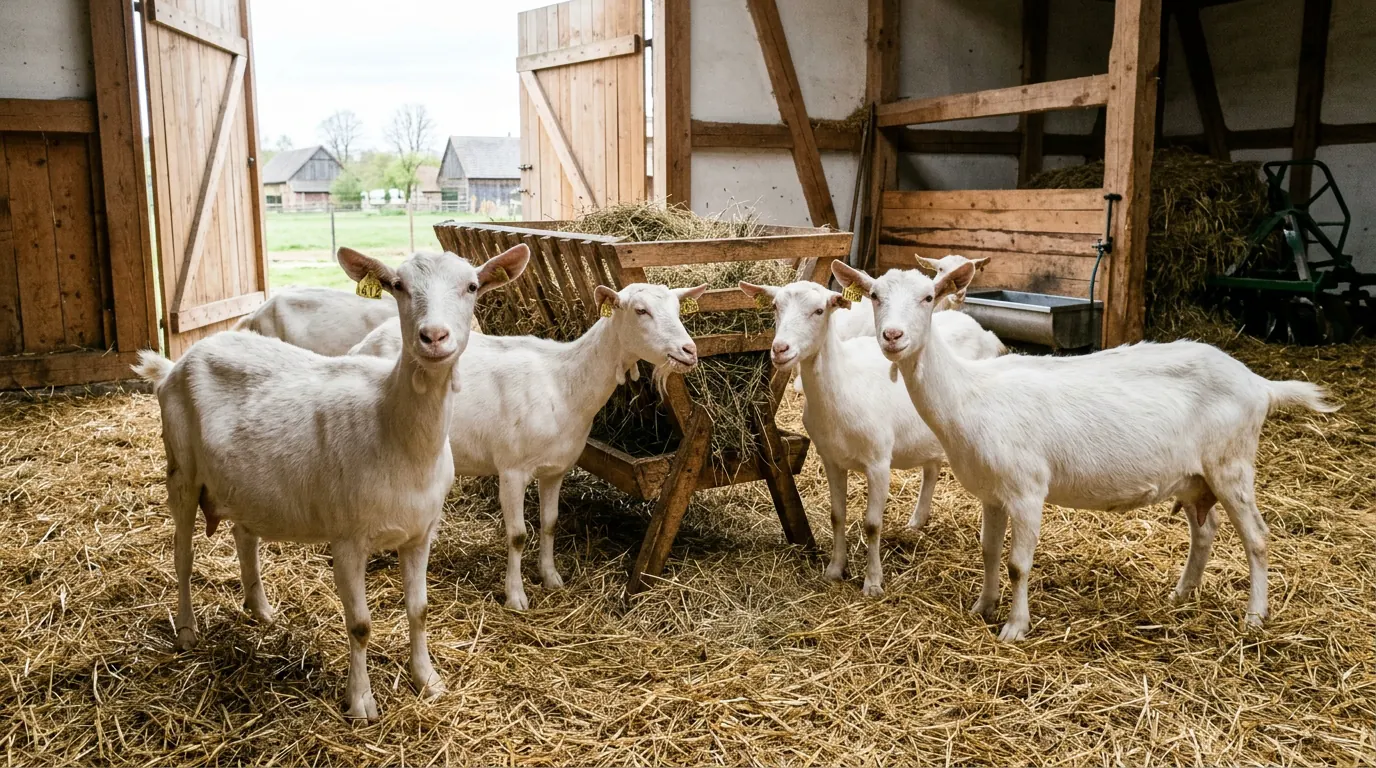
There is no single price for a dairy goat. Ads from the same town can differ a lot, because one offer is a kid with no papers and another is a goat after her first kidding, entered in a herd book. You find the current price by calling several breeders and comparing animals of similar age, breed and origin. We deliberately give no amounts, because they change from season to season.
The purchase price is only the start of your spending. A goat needs a roofed shelter, fencing, winter roughage and milking equipment. Before you buy, read how to work out the profitability of dairy goat keeping and the guide on how to start keeping goats. That way you know what it really costs to start with a goat, not just what the goat costs.
What sets the price of a goat
Age and production stage
A kid is the cheapest, but you must wait for her first kidding and the start of lactation. A goat after her first kidding costs more, because her yield and temperament are already visible. Animals in full lactation with proven milk yield cost the most. For a pregnant goat, you can judge her by how her dam or siblings did in the herd. For dates and the course of pregnancy, see goat pregnancy and preparing for kidding.
Breed, pedigree and the dam's yield
Breed affects the price, but papers matter most. An animal entered in a herd book, with a known dam yield, costs more than a goat with no recorded ancestry. Breeds such as the Saanen or the Toggenburg have an established dairy reputation. Demand for rare native breeds, for example the Carpathian goat, also matters a lot. According to IZ PIB (National Research Institute of Animal Production, 2019), it is kept in 17 herds holding 205 goats and 26 breeding bucks. With such a small population, breeders set the prices, not the market.
Region and season
Prices rise in spring, when kids are born and breeders want to top up their herds. In autumn some owners sell animals before winter so they do not have to buy feed. Differences between voivodeships (Polish provinces) come from the number of breeders nearby and the cost of getting there. Ask for prices in several places and add transport separately, because a long trip raises the cost and stresses the animal.
Which dairy goat to buy
Dairy breeds to choose from
In Poland people most often choose the Polish improved White or Colored goat or the Alpine goat. For an overview of the rest, see goat breeds: dairy, meat and fiber. Pick the breed for your needs: for home-made cheese less milk is enough, while for selling you need higher-yielding animals. We describe milk amounts and composition in the article on goat milk.
A native breed as an option
Carpathian goats are well adapted to harsh conditions. IZ PIB (2019) reports that the breed's average milk yield is 350 kg, and the best goat gave 498 kg of milk, on average with 2.9% protein and 3.11% fat. Fertility averaged 95% and prolificacy 158%. That is less than in high-yielding breeds, but the breed suits small farms in mountain areas. We give details in the article on the Carpathian goat.
What to look for when buying
Appearance and health of the animal
A healthy goat has a shiny coat, clean eyes and nose, and good body condition, with a rump that is neither emaciated nor fat. Check the hooves, the udder and the way she moves. The udder should be symmetrical, soft after milking, with no lumps or thickening. Ask to see milk test results, including the somatic cell count, because this value shows the health of the udder. For how somatic cells affect goat milk, see the IZ PIB publication from 2014. Also ask about deworming and vaccinations.
See the dam and the herd
Ask to see the dam or other goats from the same herd. You will see their build, their udders and their behavior during milking. Ask how much milk goats in this herd give and how they are fed. Check whether the herd has a separate place for new animals and whether the breeder shows records of disease. Goats from backyards, with unknown origin, are cheaper but carry more risk. We describe a plan for buying an animal from an unknown herd in the box below.
Papers and notifications when buying a goat
What to ask the seller for
Ask for the movement document, a certificate of the herd's health status and, if the goat has a pedigree, a certificate or herd book entry. The seller should give the herd (premises) number and the animal's identification details. A template of the sheep and goat registration book is provided by the County Veterinary Inspectorate in Pruszków (Powiatowy Inspektorat Weterynarii); you can use it to see what data you need to keep.
Registration and identification
The rules for registering and identifying goats change, so ask the county office of ARiMR (Poland's Agency for Restructuring and Modernisation of Agriculture) and the county veterinarian about current requirements. In practice inspectors expect every animal to be identified and entered in the herd registration book. You can check the legal state as of 23.11.2026 on the websites of the Chief Veterinary Inspectorate (Główny Inspektorat Weterynarii) and ARiMR. Do not rely only on the seller's assurances.
Costs beyond the purchase price
Feed and pasture
According to the INRA table from 2007 (IZ PIB), a dry goat weighing 50 kg eats about 0.69 kg of dry matter a day. A dairy goat of the same weight giving 2 kg of milk a day needs 1.59 kg of dry matter, and at 4 kg of milk already 2.49 kg. Pasture value drops through the season: on 10 May the dry matter has 0.97 JPM per kg, and on 26 June only 0.70. We describe rations in detail in the article on feeding dairy goats.
Building, equipment and care
Besides feed, count fencing, shelter, milking, milk storage, tests and veterinary care. The American guide from Penn State Extension lists investments in animals, buildings and milking equipment separately, and shows that milking and milk storage equipment is one of the biggest items. Do not carry those amounts over to Polish conditions, but use the same breakdown in your own budget. Also record treatments and medication, and remember that the vet always chooses the medicine and its dose.
Frequently asked questions
How much does a dairy goat cost?add
The price depends on breed, age, the dam's yield and papers. We give no amounts, because they differ between breeders and seasons. The best approach is to call several sellers and compare animals with similar parameters.
Is a goat without a pedigree cheaper?add
Usually yes, but you know neither the dam's yield nor the herd's health history. A goat without papers may milk well, but she is harder to sell and her breeding value is harder to judge. For a production herd it pays to know where the animal comes from.
When is the best time to buy a goat?add
Spring offers the widest choice, because kids are born and breeders top up their herds. In autumn some owners sell animals before winter. If you buy a pregnant goat, ask about the kidding date and prepare a place in advance.
How many goats should I buy to start with?add
Goats are herd animals, so do not keep just one. Start with two or a few animals and match the number to your building, feed and time for milking. We cover cost planning in the article on profitability of goat keeping.
What should I check before buying a goat?add
Look at the udder, hooves, body condition and coat, and ask about milk tests, deworming and vaccinations. Ask for the movement document and the animal's identification details. Also ask about the health status of the herd.
Is a Carpathian goat more expensive than other breeds?add
The breed is rare: according to IZ PIB (2019) it is kept in 17 herds, so breeders set prices directly. Check the price with them or with breeders' associations. The breed's milk yield is lower than in high-yielding breeds, which is worth factoring into your plan.
Sources & resources
- linkIZ PIB (Wiadomości Zootechniczne) — Current state of breeding and the genetic resources conservation program for Carpathian goats
- linkIZ PIB (Wiadomości Zootechniczne) — Basics of goat feeding
- linkIZ PIB (Wiadomości Zootechniczne) — Somatic cells in goat milk
- linkPIW Pruszków (Veterinary Inspection) — Sheep/goat registration book (template)
- linkPenn State Extension — Agricultural Alternatives: Dairy Goat Production
Prepared by: DlaFerm Team based on data from the sources listed · Publisher: INSTA-TECH sp. z o.o.
New animals on your farm? Record entries and treatments
When you bring in animals from outside, DlaFerm.pl helps you keep an entry and exit log with QR codes, treatment records with withdrawal periods, and a biosecurity plan generator. These are general modules, with no features made only for goats. Create a free farm account or get in touch.
Phone
+48 796 258 151