Miniature goats: Cameroon and Nigerian Dwarf
Miniature goats are two separate breeds from West Africa: the Cameroon, stocky and sociable, and the Nigerian Dwarf, smaller and milk-oriented. Both are small, but they carry the same registration and health duties as full-size goats. We cover the differences, the requirements and the costs of keeping them.
verifiedFrom the team that has organised work on poultry farms for years.
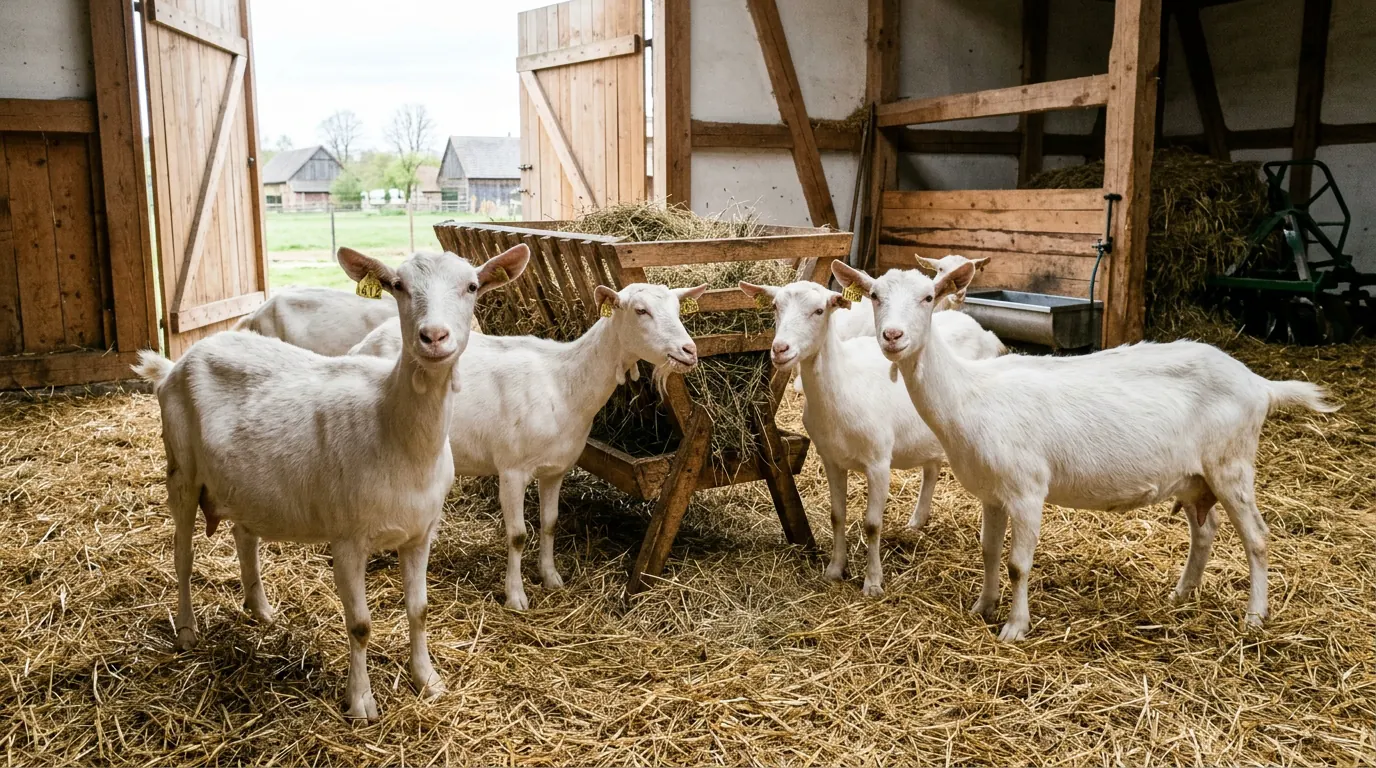
"Miniature goats" covers two breeds: the Cameroon goat (Cameroon dwarf) and the Nigerian Dwarf goat. Both come from West Africa and both are much smaller than dairy goats such as the Saanen or the Alpine. The Cameroon has a stocky, barrel-shaped body and short legs. The Nigerian Dwarf is slimmer and built like a small dairy goat.
A small goat is still a farm animal
A smaller size changes neither the rules nor the animal's needs. A dwarf goat needs a dry shelter, constant access to water, roughage and the company of other goats. It is also subject to registration and veterinary duties. We describe these below. For the general rules of starting a herd, read Goat keeping: where to start.
Who miniature goats are for
Dwarf goats end up on agritourism farms, on small plots and with keepers who want a small amount of milk. They will not replace a dairy or meat herd. If you want high milk output, choose a dairy breed. If you are looking for a native breed of light build, check the Carpathian goat.
Cameroon and Nigerian Dwarf goats: the differences
Cameroon goat
The Cameroon goat is compact and heavily muscled, with short legs and a broad chest. It comes in many colors, from solid to patched. It is sociable, tames easily and copes well in a small group. It is kept mainly as a companion animal, for shows and on agritourism farms. It gives little milk, and so little meat that fattening it does not pay.
Nigerian Dwarf goat
The Nigerian Dwarf is more graceful and longer in the body than the Cameroon, with proportionally thinner legs. Its strength is milk use: the milk of this breed is described as rich and sweetish, and the amount is small but enough for a family. Check the exact yield with the specific breeder, because it differs between lines. For general data on milk composition and properties, see Goat milk.
Which to choose
Choose the Cameroon if you want companion animals and do not count on milk. Choose the Nigerian Dwarf if you want a small amount of milk from a small herd. Do not buy goats by eye: ask the seller for pedigree documents and check that the animal is entered in the register. Crosses of the two breeds also turn up in practice, so ask exactly what the animal descends from.
Pen, fencing and company
Shelter
A dwarf goat needs a dry, wind-sheltered space with bedding. Drafts and damp hurt it more than low temperatures in a dry pen. The simplest layout is a roofed shed with raised sleeping platforms, because goats like to climb and rest higher up. Each goat should have access to a feeder and a drinker, and a hard-surfaced area next to the building is enough for a yard.
Fencing
Small size does not mean weak jumping. Dwarf goats go under, through and over a fence if they have something to climb. The mesh should be tight and firmly fixed at the bottom. Keep crates, pallets and woodpiles away from the fence, because they work as steps. Predators, including dogs, can threaten small goats, so shut the animals in a building at night.
Goats live in groups
A goat kept alone gets stressed and calls loudly. Always keep at least two animals. Sheep and goat welfare is covered in a May 2024 guide from WODR Poznań (the Wielkopolska agricultural advisory center). When you pick a group, think about rank in the herd: young and weaker animals need a place the older ones cannot reach.
What to feed miniature goats
Pasture and hay
According to IZ PIB (Poland's National Research Institute of Animal Production), pasture is the best feed for goats: easily digestible and rich in nutrients. Goats pick plants selectively, so watch how much is left uneaten. INRA data from 2007 show that the value of pasture changes through the season. Young grass from 10 May contained 17% dry matter and 114 g of BTJN protein per kg of dry matter. Grass from 26 June had 61 g of that protein. In winter give good hay and make sure it is not moldy. We cover year-round feeding in What goats eat.
How much feed a small goat needs
The INRA tables refer to goats weighing 50 kg, and dwarf goats are much lighter, so their needs are lower. For orientation: a 50 kg goat not in lactation eats about 1.25 kg of dry matter a day, about 1.90 kg at 2 kg of milk a day, and about 2.54 kg at 4 kg of milk. Do not feed a dwarf goat by these figures. Set the ration for the specific animal with a vet or an adviser from an agricultural advisory center, because overweight goats get sick easily.
What to avoid
Do not give wet, sour or moldy feed. Introduce feed changes gradually, over several days. Dwarf goats tend to put on weight, so limit concentrates and kitchen scraps. Provide constant access to clean water and a mineral lick made for goats. Do not give sheep feed without checking the composition, because its copper content can be wrong for goats.
Registration, health and withdrawal periods
Registering the herd
Poland's rules on animal identification and registration cover goats regardless of size or purpose. In practice the goat keeper reports the herd to ARiMR (Agency for Restructuring and Modernisation of Agriculture), tags the animals and keeps a registration book. A template of the sheep and goat book is published by the District Veterinary Inspectorate in Pruszków (part of the Inspekcja Weterynaryjna, the Veterinary Inspection). For the current legal state (as of 23.11.2026) and the exact reporting deadlines, check with ARiMR and your district veterinary inspectorate.
Health and treatment
Dwarf goats need regular checks of hooves, internal parasites and general condition. A vet sets the worming and vaccination plan and chooses the drug and dose. Remember the withdrawal period: after a drug is given, the milk and meat are not fit for consumption for the time stated on the leaflet or by the vet. Record every treatment with the date and the product name. You can keep the records in the Treatment and withdrawal period module.
Biosecurity in a small herd
A small herd does not mean lower disease risk. Keep new goats apart for several weeks before joining them to the herd. Limit strangers' access to the pen and disinfect footwear. When you sell animals, keep a visitor list, for example in the QR entry log. You can build your own protection plan in the biosecurity plan generator.
Kidding, kids and the cost of buying
Pregnancy and kidding
Pregnancy in a goat lasts about five months, dwarf breeds included. Miniature goats usually give birth to one or several kids. Prepare a dry, clean kidding pen. We describe the birth in Goat pregnancy and Goat kidding. In a difficult birth call a vet, because small goats have narrow birth canals.
How much a miniature goat costs
The breeder sets the price, and it depends on breed, age, sex, color, origin and whether the animal has documents. We give no specific amounts, because they differ between regions and change from season to season. Check adverts and ask several breeders. On top of the animal's price add the cost of the pen, hay, fencing and veterinary care. We explain how to judge a price in How much a goat costs.
What to look for when buying
The animal should have a clean, smooth coat, bright eyes, a dry nose and an even gait. Look at the hooves and check that the goat does not limp. Ask for documents, the register entry and information on worming. Buy goats at least in pairs, ideally from one breeder, so they have company from the start.
Frequently asked questions
What is the difference between a Cameroon goat and a Nigerian Dwarf goat?add
The Cameroon is stocky, with short legs, and serves mainly as a companion animal. The Nigerian Dwarf is slimmer and has milk use. Both come from West Africa and both are smaller than dairy goats.
Do dwarf goats give milk?add
Yes, especially the Nigerian Dwarf, but only a small amount. Check the exact yield with the breeder, because it depends on line, age and feeding. When you treat a goat, remember the milk withdrawal period.
Do you have to register miniature goats in Poland?add
Yes, Poland's rules on animal identification and registration cover goats whatever their size. Check herd reporting, tagging and the registration book with ARiMR and your district veterinary inspectorate. Verify the legal state on the day of purchase.
How many dwarf goats should you keep?add
At least two, because a goat kept alone gets stressed and loses condition. Goats are herd animals. It is best to buy two females, or a castrated male with a female.
What do you feed miniature goats?add
The base is pasture in summer and good hay in winter, plus water and a mineral lick. Dose concentrates carefully, because dwarf goats put on weight easily. Set the ration with a vet or an adviser.
How much does a miniature goat cost?add
The price depends on breed, age, origin and documents. Ask several breeders and compare adverts. On top of the price add the cost of the pen, fencing, feed and the vet.
Sources & resources
- linkIZ PIB (Wiadomości Zootechniczne): Basic issues in goat feeding
- linkIZ PIB (Wiadomości Zootechniczne): The effect of grassland in organic goat keeping on the quality of products
- linkWODR Poznań: Poradnik Gospodarski, May 2024 (Welfare issues in sheep and goat keeping)
- linkPIW Pruszków (Veterinary Inspection): Sheep/goat registration book (template)
- linkARiMR: gov.pl/web/arimr
Prepared by: DlaFerm Team based on data from the sources listed · Publisher: INSTA-TECH sp. z o.o.
Keeping goats alongside other animals? Start with the entry log and withdrawal periods
DlaFerm.pl has no separate goat module, but the general modules also help with a small herd: the QR entry log, treatment records with withdrawal periods and the biosecurity plan generator. Create a free farm account or get in touch.
Phone
+48 796 258 151