Beef cattle breeds: Limousine, Charolaise, Angus, Hereford and more compared
Beef cows are breeds developed to raise calves for meat, not for milk. In Poland, bulls of 13 breeds, from Angus to Wagyu, go through official evaluation. We compare the most common breeds by breeding maturity, heifer weight, longevity and polled status.
verifiedFrom the team that has organised work on poultry farms for years.
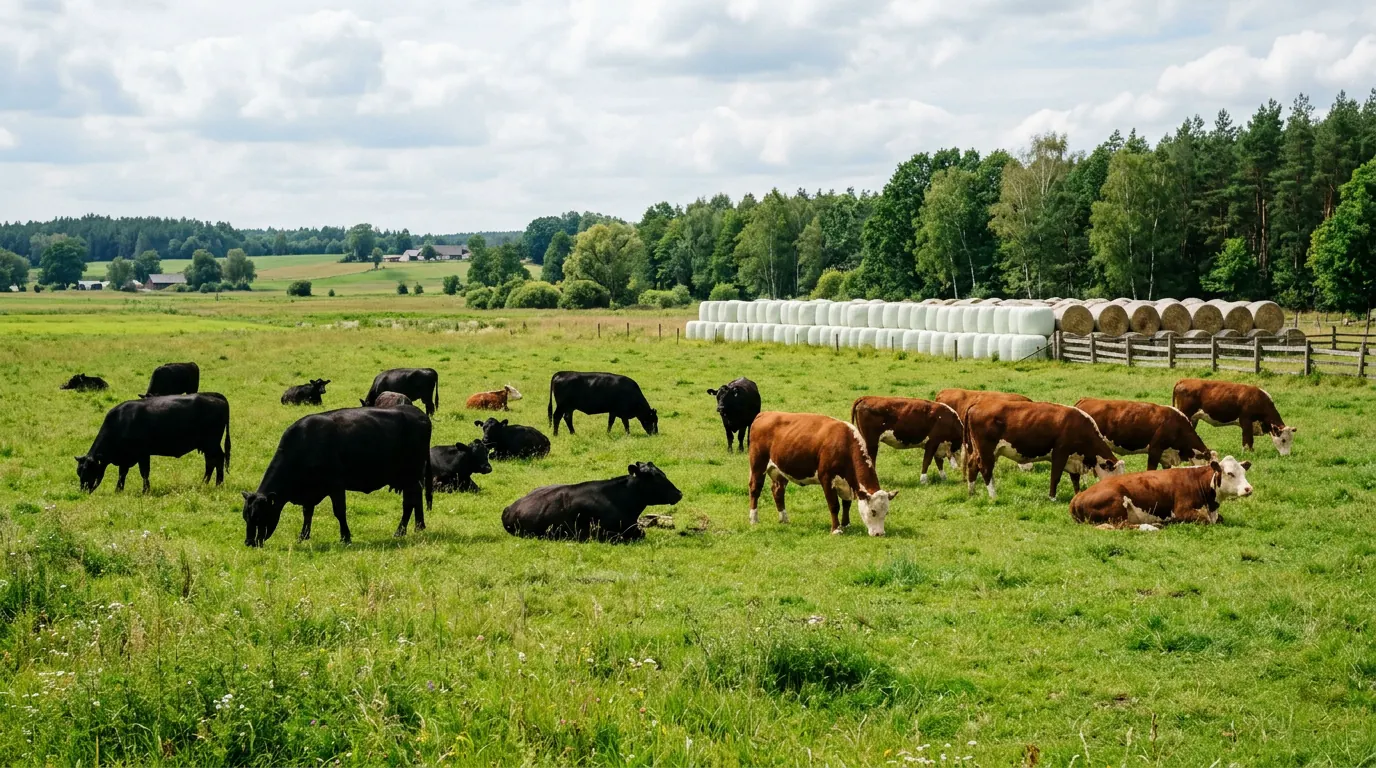
A beef breed is one where cows raise calves at their side, and calf growth and muscling matter more than milk. In Poland you will most often meet Limousine, Charolaise, Angus, Hereford and Simmental. Breeds differ in size, speed of maturing, how long cows stay productive and whether they have horns. These traits decide which breed suits your herd.
Cow breed and production goal
The question "which cow breed" only makes sense once you know your goal. One breed fits a suckler herd on pasture, another fits crossing with dairy cows for fattening. For a comparison with dairy breeds, see dairy and dual-purpose cattle breeds. Below we list beef breeds by the traits that matter in a suckler herd.
The most popular beef cattle breeds in Poland
Which breeds are evaluated
Since 2007 the Polish Association of Beef Cattle Breeders and Producers, together with IZ PIB, has evaluated the productive and breeding value of beef bulls. According to IZ PIB (Wiadomości Zootechniczne 2018), the evaluation covers Black and Red Angus, Blonde d'Aquitaine, Charolaise, Galloway, Hereford, Highland, Limousine, Piemontese, Salers, Simmental, Wagyu and Welsh Black. These bulls are used for natural mating in beef herds and for artificial insemination of dairy cows in commercial crossbreeding.
Limousine, Charolaise and Simmental
Limousine, Charolaise and Simmental are the breeds chosen most often for beef herds and crossbreeding. You will find detailed profiles on the pages for Limousine and Charolaise. Charolaise is a large-frame breed, so heifers need longer rearing before first breeding. Limousine matures earlier. For exact bull and cow weights, check the breed descriptions from the breeders' association and from the regional agricultural advisory center (ODR), because weights depend on bloodline and feeding.
Angus and Hereford
Angus and Hereford are smaller-framed breeds that mature earlier and cope well on pasture. There is a separate profile on the Hereford page. According to IZ PIB, Hereford and Angus cows stayed in production longest of the compared breeds, and Limousine and Charolaise cows the shortest.
Other breeds: from Galloway to Chianina
Breeds for pasture and harder land
For pasture-based and extensive systems, farmers turn to hardy, undemanding breeds. We describe them separately: Galloway, Dexter and Salers. Galloway and Salers are on the list of breeds in the IZ PIB bull evaluation. Before choosing, check whether a breeder near you can sell animals directly, without middlemen.
Large-frame continental breeds
Large-frame breeds include Piemontese, Chianina, Blonde d'Aquitaine and Belgian Blue. WMODR Olsztyn (the Warmia-Masuria agricultural advisory center) lists Piemontese among breeds that should be bred later. According to EFSA, Chianina and other native Italian breeds are usually horned. Profiles of other breeds are on the pages for Parthenaise and Gelbvieh.
Rare breeds
We cover rare and exotic breeds such as White Park, Santa Gertrudis and Dutch Belted in the article on rare cattle breeds. For tropical traits, see also the page on Zebu. These animals are usually bought for small herds and direct sales.
Heifer breeding weight and sexual maturity
When a heifer is ready
According to a WMODR Olsztyn leaflet, in beef breeds sexual maturity comes when a heifer reaches about 2/3 of the adult cow's body weight for that breed. Heifers of large-frame breeds such as Charolaise and Piemontese, and poorly developed heifers, should be bred later. Smaller, earlier-maturing breeds such as Limousine, Hereford and Angus can be bred earlier with good feeding.
Optimal weights of bred heifers
WMODR Olsztyn states that the optimal body weight of bred Angus and Hereford heifers is about 360–380 kg, and 400–420 kg for Charolaise, Simmental, Limousine and Salers. Heifers should be well grown so older cows do not dominate them, especially after calving. Heifers bred too early give birth to smaller and often less vigorous calves.
Bulls
Young bulls reach full breeding maturity at 18–24 months. With moderate use, they can start breeding at 15 months. The full breeding cycle is described in the WMODR Olsztyn leaflet "Reproduction in beef cattle herds".
Cow longevity and polled breeds
How long cows stay in production
According to IZ PIB (Grodzki et al., Wiadomości Zootechniczne 2015), cows of selected beef breeds in Poland stay in production a long time, comparable to Limousine and Charolaise in France. Among the beef breeds, Hereford and Angus cows were used longest and Limousine and Charolaise the shortest. Simmental cows had the highest share calving for the sixth time or more. Cows of this breed also most often passed the 10th calving (3.4%).
Polled breeds
EFSA reports that Angus is a fully polled breed, and polled animals also occur in Limousine, Charolaise, Hereford and Blonde d'Aquitaine. Breeds such as Chianina and Romagnola are usually horned. The growing share of polled animals comes from genotyping bulls, and in semen catalogs you can pick a bull homozygous for the polled gene. For you, that means less risk of injury and less dehorning.
Commercial and grading-up crossbreeding
Commercial crossbreeding
Simple commercial crossbreeding means mating a cow, for example of the Polish Holstein-Friesian breed, with a beef bull such as Charolaise. According to IZ PIB (Wójcik, Czubska), this gives an F1 generation with very good fattening and individual traits. All calves from such crossing go to fattening. Ask your ODR which beef bulls they recommend for inseminating dairy cows in your region.
Grading-up crossbreeding
In grading-up, you breed each new generation of heifers to a beef bull, for example Limousine. According to IZ PIB, in the fourth year you get R4 offspring with over 90% beef blood. The method lets you replace a dairy herd with a beef herd step by step, without buying a whole herd. Record every animal and run the herd with a farm management program.
How to choose a breed for your farm
Questions before you buy
Before buying animals, answer four questions: how much pasture you have, what housing you have for winter, whether you will sell calves for fattening or as live cattle, and whether you have access to a vet and breeding services. A large-frame breed needs better feeding and longer heifer rearing. Smaller breeds tolerate leaner conditions. For an income calculation for beef at different intensity levels, see the ODR Lubań publication.
Where to buy animals
Buy from breeders with performance evaluation and pedigrees. Poland's ARiMR (Agency for Restructuring and Modernisation of Agriculture) keeps the animal register, and for details of rules and identification ask the county Veterinary Inspection (Inspekcja Weterynaryjna) office. When buying, check the health status of the source herd, because diseases such as lumpy skin disease need special vigilance. A pig keeper can use the app for pig farmers.
Frequently asked questions
What is the best beef cattle breed?add
There is no single best breed. Angus and Hereford mature earlier and stay in production long, while Charolaise and Limousine give heavy muscling. Choose by pasture, conditions and production goal.
What are beef cows?add
They are cows of breeds kept to produce calves for meat, such as Limousine, Charolaise, Angus or Hereford. They raise calves at their side and are not milked.
Which cattle breeds are polled?add
According to EFSA, Angus is fully polled. Polled animals also occur in Limousine, Charolaise, Hereford and Blonde d'Aquitaine. Chianina and Romagnola are usually horned.
How much should a heifer weigh at first breeding?add
WMODR Olsztyn gives about 360–380 kg for Angus and Hereford and 400–420 kg for Charolaise, Simmental, Limousine and Salers. As a rule, it is about 2/3 of the adult cow's weight for that breed.
At what age can a bull be used for breeding?add
Young bulls reach full maturity at 18–24 months. With moderate use, they can start at 15 months.
Can I turn a dairy herd into a beef herd?add
Yes, through grading-up crossbreeding. According to IZ PIB, in the fourth year you get offspring with over 90% beef blood, for example using a Limousine bull.
Sources & resources
- linkIZ PIB — WZ — Current state and prospects of beef cattle farming and breeding in Poland (H. Grodzki et al.), WZ LIII(2015)2:77–87
- linkIZ PIB — WZ — New methods of evaluating the productive and breeding value of beef cattle (Z. Choroszy et al.), WZ LVI(2018)3:17–23
- linkIZ PIB — WZ — Breed selection and breeding work in organic beef herds (P. Wójcik, A. Czubska)
- linkWMODR Olsztyn (gov.pl) — Reproduction in beef cattle herds (leaflet)
- linkEFSA AHAW Panel — Welfare of beef cattle (EFSA Journal 23:9518)
Prepared by: DlaFerm Team based on data from the sources listed · Publisher: INSTA-TECH sp. z o.o.
Run your herd in one place with the DlaFerm farm management program
The farm management module keeps your animal data, records and documents in one place. Create a free farm account in DlaFerm or get in touch.
Phone
+48 796 258 151