Salers cattle breed: traits, breeding and finishing
Salers is a French beef breed with a sturdy frame that copes well with grazing. We explain where it comes from, how it works in a suckler herd and what to watch when finishing. We give only figures from institute publications and the ARiMR list (Poland's Agency for Restructuring and Modernisation of Agriculture).
verifiedFrom the team that has organised work on poultry farms for years.
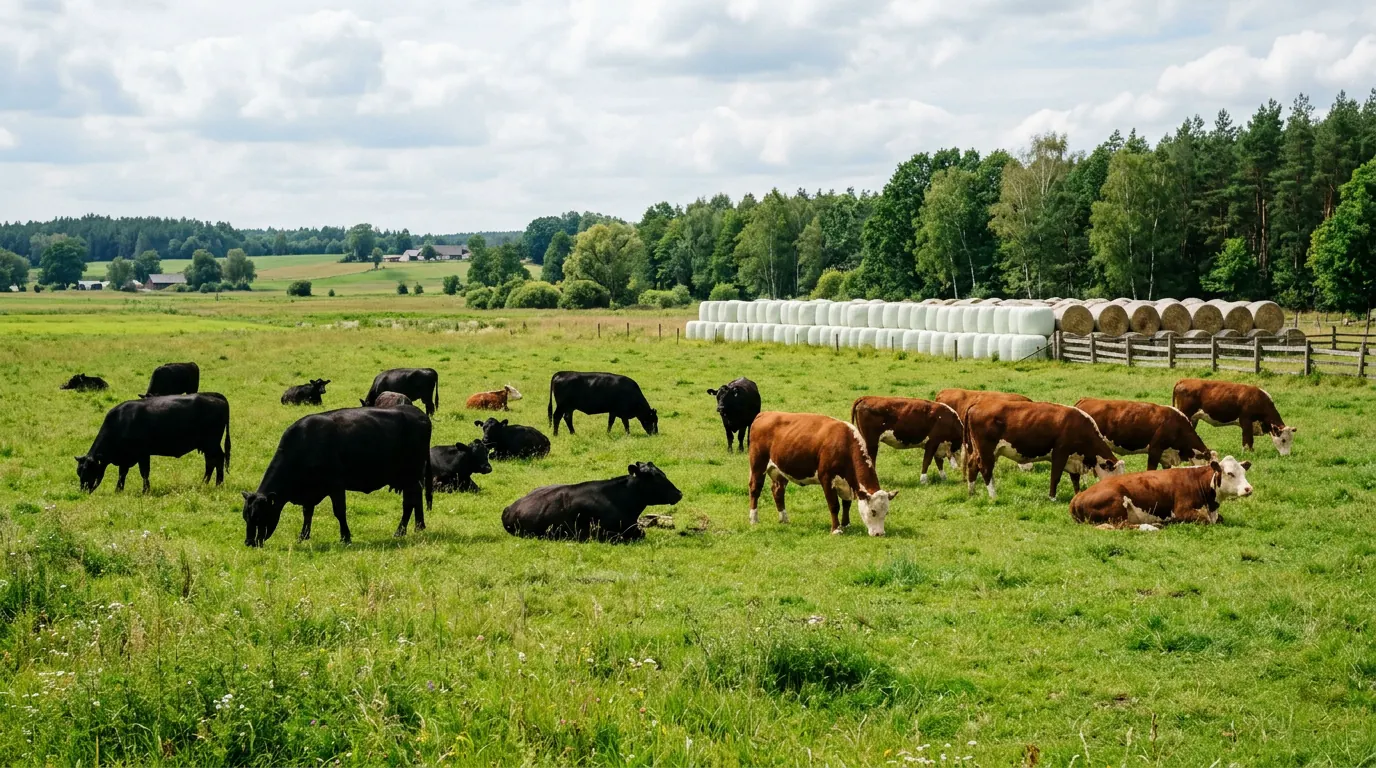
Salers (letter code SL in the ARiMR list) is a beef breed of French origin. Keepers value its compact, strong build, good condition on grass and calm cows that raise their own calves at pasture. The breed has a small population in Poland, so before you buy a bull or heifers, check the animals' pedigree and performance records.
Who this breed is for
Salers works best in a suckler herd kept on pasture, not in intensive indoor finishing. If you want fast gain on a high share of concentrate feed, compare Salers with other breeds. The calculators for farmers help you work out whether rearing your own calves and selling live cattle pays. There is no universal answer, because the result depends on feed prices, access to pasture and the live-weight price on the day you sell.
Where Salers comes from and what it looks like
Origin and population in Poland
The breed is named after the town of Salers in the Auvergne region, in the Massif Central mountains of France. Animals have long been kept there on mountain pastures. Like most beef breeds in Poland, Salers arrived through imports. According to IZ PIB (the National Research Institute of Animal Production), Wiadomości Zootechniczne, 2015, the 14 beef breeds together, Salers included, make up a small group of about 17.5 thousand purebred cows. The trend is slowly rising, but the choice of bulls and heifers stays limited, so plan your purchase well ahead.
Appearance and build
Salers is a medium-sized animal with a compact, strong frame and a red coat. Typical features are lyre-shaped horns curving forward and up, a dark nose and dark hooves. When buying, compare animals with the breed standard and with the description in the farm animal breed atlas on the ZPE platform (Poland's Integrated Educational Platform). Judge leg structure, the cows' udders and overall condition, because these decide how long animals last in a grazing herd.
Reproduction and breeding work in a Salers herd
Suckler cows and calves
Salers is most often kept in a suckler herd, meaning cows kept with their calves at pasture. For many months the calves live on their mother's milk and grass, and this largely decides their gain. Breeding work covers choosing the bull and checking age at first calving and calving intervals. Plan calving dates ahead in stocking and cycle planning and keep herd records in the farm management software.
Terminal crossbreeding
Many herds use terminal crossbreeding, meaning cows are bred to a bull of another beef breed. In an IZ PIB publication from 2011 (Wiadomości Zootechniczne), young bulls from different breed combinations reached a dressing percentage of 56.87% to 62.52% of body weight, and meat output reached up to 128.3% of the control group. Salers was not included in that comparison, so you must not carry these figures over to Salers without your own data. The general lesson is still practical: the choice of sire changes the carcass result, so keep your own records of gains and slaughter results.
Performance assessment
A 2018 IZ PIB paper describes new methods of assessing the performance and breeding value of beef cattle. Assessment run by the breeders' association lets you compare bulls and cows on gains and on the results of their offspring. When buying, ask the seller for the parents' assessment results and for the pedigree in the herd book. For a small herd, this is the cheapest way to avoid buying a bull blind.
Finishing Salers cattle, from weaning to the abattoir
Feed and pasture
Salers makes good use of pasture and roughage. When finishing heifers or steers, what matters most is an energy and protein ration matched to the animal's age and weight. In practice, feeding usually decides gain more than breed does. The OODR Łosiów leaflet on feeding beef cattle (a regional agricultural advisory center) sets out the details. Have a feeding adviser or a vet set the exact ration and diet, and record every change in your herd records.
Dressing percentage and slaughter age
Dressing percentage depends on the animal's age and category. In IZ PIB studies of beef-breed young bulls aged 12 and 15 months, dressing percentage ranged from 56.87% to 62.52% of body weight, depending on breed combination. There are no separate results for Salers, so work them out from your own weighings before slaughter and from abattoir records. Compare results between batches, not only against general published data.
Treatment and withdrawal periods
Any treatment of animals meant for slaughter needs a vet's decision, and the vet chooses the medicine and dose. You are responsible for recording every administration and for keeping the withdrawal period stated on the product leaflet. Do not work out withdrawal periods from memory. Keep the log in the treatment and withdrawal records module, so you have every date to hand before animals go to the abattoir.
Welfare and disease in a Salers herd
Calf rearing and transport
EFSA publishes opinions on the welfare of beef cattle, calves and animals in transport. Council Directive 2008/119/EC sets minimum standards for the protection of calves and applies across the European Union. When rearing beef calves, keep bedding dry and make sure they have water and proper ventilation. Practical rearing rules are in the KPODR Minikowo guide, written by authors from SGGW (Warsaw University of Life Sciences). For transport, plan short routes and proper breaks, especially in heat and in winter.
Lumpy skin disease (LSD)
Lumpy skin disease (LSD) is an infectious disease that must be reported officially. If you suspect symptoms, call your vet and the county vet (powiatowy lekarz weterynarii) at once. The PODR Szepietowo leaflet (Z. Marciniak) describes the symptoms and what to do. Rules and notices on the disease can change, so check current information on the website of the Chief Veterinary Inspectorate (Główny Inspektorat Weterynarii). Do not try to treat animals yourself without a vet's decision.
Profitability and paperwork for a Salers herd
Live cattle prices and profitability
Beef live-weight prices depend on the market, the animal's category, its weight and slaughter results. Quotes change weekly, so we do not list them here. Check current prices with buyers and in trade listings, and compare feed and pasture costs with your own data. A publication from ODR Lubań (a regional agricultural advisory center) shows a sample income calculation for beef live-weight production at different intensity levels, and you can use it as a model. For your own sums, the calculator for farmers will help.
Breed in your records and the rules
You mark an animal's breed in your records with the ARiMR code. For Salers this is SL, according to the list of letter codes for marking cattle breeds. Rules on identifying and registering cattle can change, so before entering an animal, check the current legal acts in ISAP, Poland's online legal acts database. The legal state this description rests on is 22.11.2026. Confirm statutory requirements and reporting deadlines with ARiMR or with the county vet.
Frequently asked questions
What is the Salers cattle breed?add
Salers is a French beef breed with a red coat and a strong, compact build. In Poland it is kept mainly in suckler herds on pasture. Its population in the country is small.
What is the Salers breed code in ARiMR?add
In the ARiMR list of letter codes for marking cattle breeds, Salers has the code SL. You use this code to mark animals in your herd records.
Is Salers suitable for indoor finishing?add
The breed suits a suckler herd on pasture best. For indoor finishing, the result depends on feeding, slaughter age and feed quality. Compare your own results with a calculation before you decide.
How much does a Salers bull or heifer cost?add
The price depends on the animal's pedigree, its parents' assessment results, age and weight. Agree the exact amount directly with the breeder or the breeders' association. We give no prices, because they change with the market.
How do I check the performance of a Salers bull?add
Ask the seller for performance assessment results, the pedigree in the herd book and data on the offspring's gains. It is worth comparing the breeders' association assessment with your own assessment of the animal on site.
Can you crossbreed Salers with other breeds?add
Many herds use terminal crossbreeding. The carcass result depends on the choice of sire, and we have no separate data for Salers. Keep your own records of gains and slaughter results to judge the effect.
Sources & resources
- linkARiMR — List of letter codes for marking cattle breeds
- linkIZ PIB — WZ — Current state and prospects of beef cattle farming and breeding in Poland (H. Grodzki et al.), WZ LIII(2015)2:77–87
- linkIZ PIB — WZ — 60 years of IZ work on beef cattle (J. Trela et al.), WZ XLIX(2011)4:11–56
- linkIZ PIB — WZ — New methods of assessing the performance and breeding value of beef cattle (Z. Choroszy et al.), WZ LVI(2018)3:17–23
- linkZPE / MEiN (Integrated Educational Platform) — Farm animal breeds, interactive atlas (e-material ROL.11)
Prepared by: DlaFerm Team based on data from the sources listed · Publisher: INSTA-TECH sp. z o.o.
Do you keep beef cattle alongside poultry?
The treatment and withdrawal module in DlaFerm keeps drug administrations and withdrawal dates in one place. Create a free farm account and see how it works in practice.
Phone
+48 796 258 151