Blonde d'Aquitaine cattle: traits, breeding and fattening
Blonde d'Aquitaine is a French beef breed. Farmers keep it in purebred herds and use it as the sire in commercial crossbreeding. In studies by IZ PIB (Poland's National Research Institute of Animal Production), crossbreds with this breed gave more meat than control groups. We describe the breed's traits, the fattening results and what to check when you choose animals.
verifiedFrom the team that has organised work on poultry farms for years.
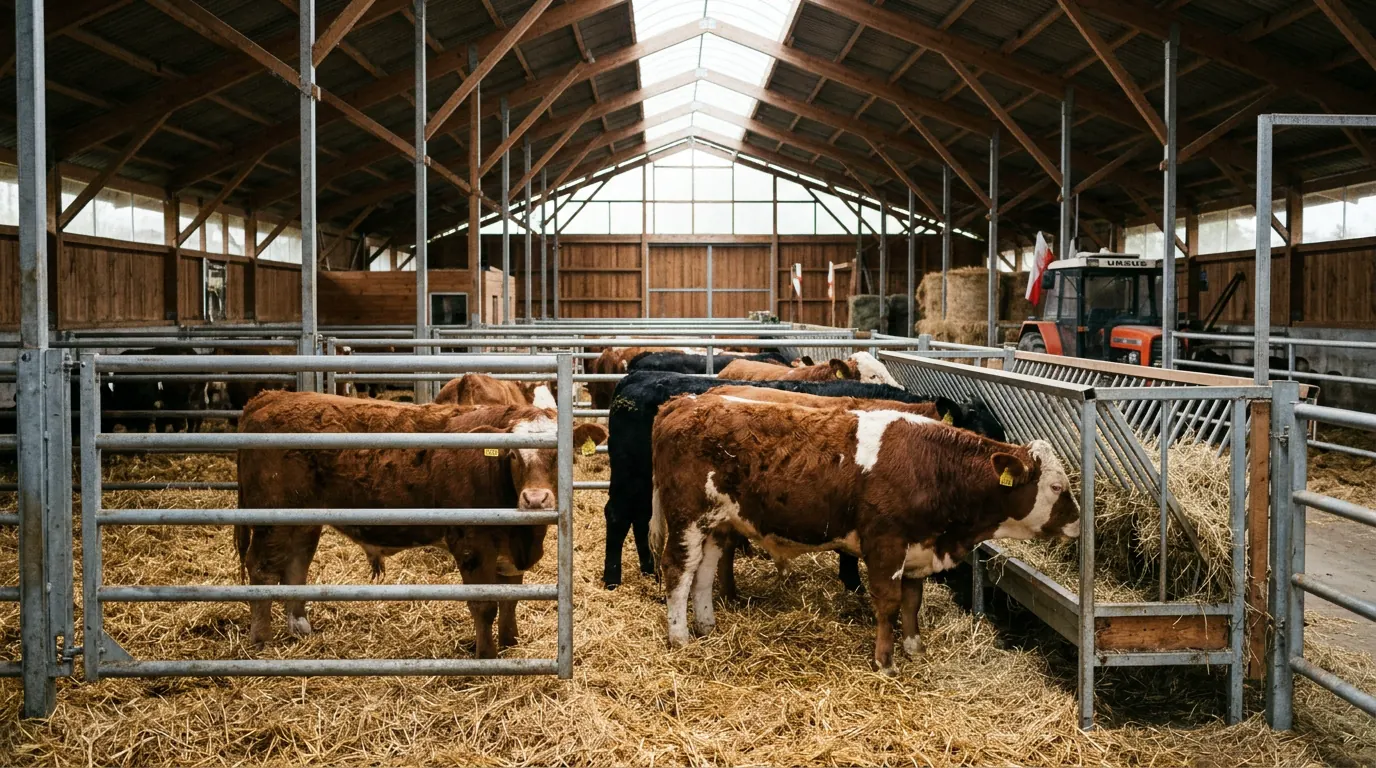
Blonde d'Aquitaine is a beef breed from France, kept mainly to produce beef cattle for slaughter. In Poland you meet it in two roles: as a purebred in suckler cow herds, and as the sire of crossbreds out of Black-and-White cows. The second role matters a lot in Poland, because crossbreds give carcasses with higher meat production than control animals. Below we describe results from IZ PIB and Teagasc-style research on rearing and fattening, and what to watch for.
Who this breed suits
The breed suits a farmer who wants to sell live cattle or carcasses with good meat yield and has access to roughage and pasture. On a small farm, a few animals can improve the muscling of young stock without rebuilding the whole herd. When you buy, check the pedigree and the animal's performance evaluation results, not only its looks. In Poland, breeding value evaluation of beef cattle is run by the Polish Association of Beef Cattle Breeders and Producers (PZHiPBM), and its results are the basis for comparing bulls and cows.
Growth and fattening results
Body weight and gains
In studies under organic conditions, Blonde d'Aquitaine animals weighed 36 kg (bulls) and 33 kg (heifers) at birth. At 15 months, bulls reached 493 kg and heifers 418 kg. Daily gain up to 15 months was 1014 g and 855 g respectively, according to data compiled by IZ PIB (Wójcik and Czubska). These figures show the breed grows well on roughage, but the result depends on feeding and on whether young animals have pasture. Compare your own weighings with these values instead of treating them as a guarantee.
Slaughter yield
The IZ PIB manual (Trela et al., 2011) gives fattening and post-slaughter results for crossbreds out of Black-and-White cows and beef breed bulls. Bulls crossed with Blonde d'Aquitaine and fattened to 12 months had a slaughter yield of 60.40%, against 57.54% in the control group. Meat production compared with the control group was 111.9% at 12 months and 116.5% at 15 months. In heifers, meat production was 112.1% and 115.2%. The data come from one study, so use them as a reference point for your own fattening.
Crossbreeding and breeding work
Role in commercial crossbreeding
Most often, Blonde d'Aquitaine is used as the sire of calves out of Black-and-White cows. Data compiled by IZ PIB (Choroszy et al., 2018) show the number of crossbred females with this breed was 111 thousand head in 2007 and 102 thousand head in 2016, with swings in between. In crossbreeding, what counts most is how the offspring grow and how well calving goes. Before you pick a bull, compare the results of his progeny with those of other sires in the same herd.
Calving ease in selection
According to the EFSA review on beef cattle welfare (2025), in France breeds such as Blonde d'Aquitaine are selected on combined indexes that include calving ease, calf weaning weight, and skeletal and muscle development. EFSA notes that many selection programs indirectly select maternal traits by looking at calf gains and weaning weight. For you this means a simple rule: when you buy a bull, check the calving ease index together with the birth weight of calves, because both decide how safe calving is.
Pasture and feeding in fattening
Pasture in extensive fattening
Research on extensive fattening shows that grassland can produce good-quality beef cattle. Adding one or two grazing seasons to fattening lowers growth rate, but the cost of each unit of gain is clearly lower (Wójcik and Czubska, IZ PIB). For a farm with its own meadows, this is one of the key choices in the feeding plan. Before you decide, work out how many kilograms of gain you want in a given time and compare that with the feed base you have.
Feeding suckler cows and calves
Suckler cows and calves have different needs from animals being fattened. The UK's AHDB Beef & Lamb manual (Beef BRP Manual 5) describes feeding suckler cows and calves to improve rearing results, not just body weight at one moment. Cow condition before calving and feed quality during lactation affect calf development. Set the ration with your vet or a feeding adviser, and record changes in feeding and their effect on gains.
Welfare, health and rules
Welfare of calves and of cattle in transport
EFSA has published opinions on the welfare of calves, beef cattle and animals in transport. The shared principles are a dry bed, enough space, less stress during moving and loading, and regular checks of condition. Minimum standards for calf protection are set by Council Directive 2008/119/EC, transposed into Polish law. Check the legal status in ISAP (Poland's online legal acts database) before any change to your housing system, as of 22.11.2026.
Disease and treatment
Lumpy skin disease (LSD) is a contagious disease that must be reported and calls for close work with your vet and the county veterinary officer (powiatowy lekarz weterynarii). For every treatment, vaccination and medicine, record the date, the product and the withdrawal period. The vet always chooses the medicine and the dose. The easiest way to keep treatment records is a register that reminds you when animals can go to slaughter. The treatment and withdrawal period register in DlaFerm helps you keep this in order.
What the fattening result depends on
Intensity and income
Sample farm income calculations for beef production, prepared by ODR Lubań (PODR, an agricultural advisory center), show that the result depends on the intensity of fattening, not on the breed alone. Higher intensity raises feed cost but shortens the fattening time. Each farm should calculate its own option, with its own costs and purchase prices. Market prices for cattle change over time, so check current quotes at market centers and with buyers instead of taking them from this page. Ready tools help you compare several options: calculators for farmers.
Data from your farm
Fattening pays better when you know each animal's daily gain, how much feed it ate and how fast it was sold. Without these data it is hard to tell whether a change of breed, feed or bull worked. Record weight at birth, at weaning and at later weighings. You can bring animal identification data into the system through integrations: the integration with IRZplus (ARiMR's online animal register) and sensors cuts retyping in your records.
Frequently asked questions
Is Blonde d'Aquitaine suitable for purebred breeding?add
Yes. The breed is kept in purebred herds, and its breeding value is evaluated in programs run in Poland. In purebred breeding, watch calving ease and calf weaning weight. Base your choice of bull on evaluation results, not on looks alone.
How much do Blonde d'Aquitaine cattle weigh?add
In studies compiled by IZ PIB under organic conditions, bulls weighed 493 kg at 15 months and heifers 418 kg. The result depends on feeding, pasture and weighing day. Use these values as a reference point for your own data.
Does Blonde d'Aquitaine give a better slaughter yield than Black-and-White cattle?add
In the IZ PIB study (Trela et al., 2011), crossbreds with this breed had a higher slaughter yield and more meat production than the control group of purebred Black-and-White cows. The data come from one experiment, so do not apply them directly to every farm. A comparison in your own herd gives the surest answer.
How do I choose a Blonde d'Aquitaine bull for my herd?add
Check the pedigree, the performance evaluation results and the calving ease index. Look at the birth weight of calves, because it drives the risk of a hard calving. Always combine the purchase with a health check by your vet.
Can Blonde d'Aquitaine cattle be kept on pasture?add
Yes. IZ PIB studies show extensive fattening based on grassland can give good-quality beef cattle. Grazing seasons lower growth rate but usually lower the cost of each unit of gain. Set the feeding plan with an adviser or your vet.
What rules apply to the welfare of calves of this breed?add
Minimum standards for calf protection are set by Council Directive 2008/119/EC, transposed into Polish law. Check the legal status in ISAP as of 22.11.2026. If in doubt, ask the county veterinary officer.
Sources & resources
- linkIZ PIB — WZ — 60 years of IZ work on beef cattle (J. Trela et al.), WZ XLIX(2011)4:11–56
- linkIZ PIB — WZ — Breed selection and breeding work in beef herds under organic conditions (P. Wójcik, A. Czubska)
- linkIZ PIB — WZ — New methods of evaluating performance and breeding value of beef breeds (Z. Choroszy et al.), WZ LVI(2018)3:17–23
- linkEFSA AHAW Panel — Welfare of beef cattle (EFSA Journal 23:9518)
- linkAHDB Beef & Lamb (UK) — Beef BRP Manual 5: Feeding suckler cows and calves for Better Returns
Prepared by: DlaFerm Team based on data from the sources listed · Publisher: INSTA-TECH sp. z o.o.
Do you run a beef herd and want treatments and withdrawal periods in one place?
The treatment and withdrawal register in DlaFerm tracks when animals can leave the farm and logs every treatment. Create a free farm account and see how it works in your herd.
Phone
+48 796 258 151