Charolais cattle: breed, bull weight, crossing
Charolais is a French beef breed, coded CH in the ARiMR breed list (ARiMR is Poland's Agency for Restructuring and Modernisation of Agriculture). Calves grow well, and crosses with this breed improve carcass yield. Below are figures from IZ PIB (Poland's Institute of Animal Science) and Teagasc, plus breeding rules.
verifiedFrom the team that has organised work on poultry farms for years.
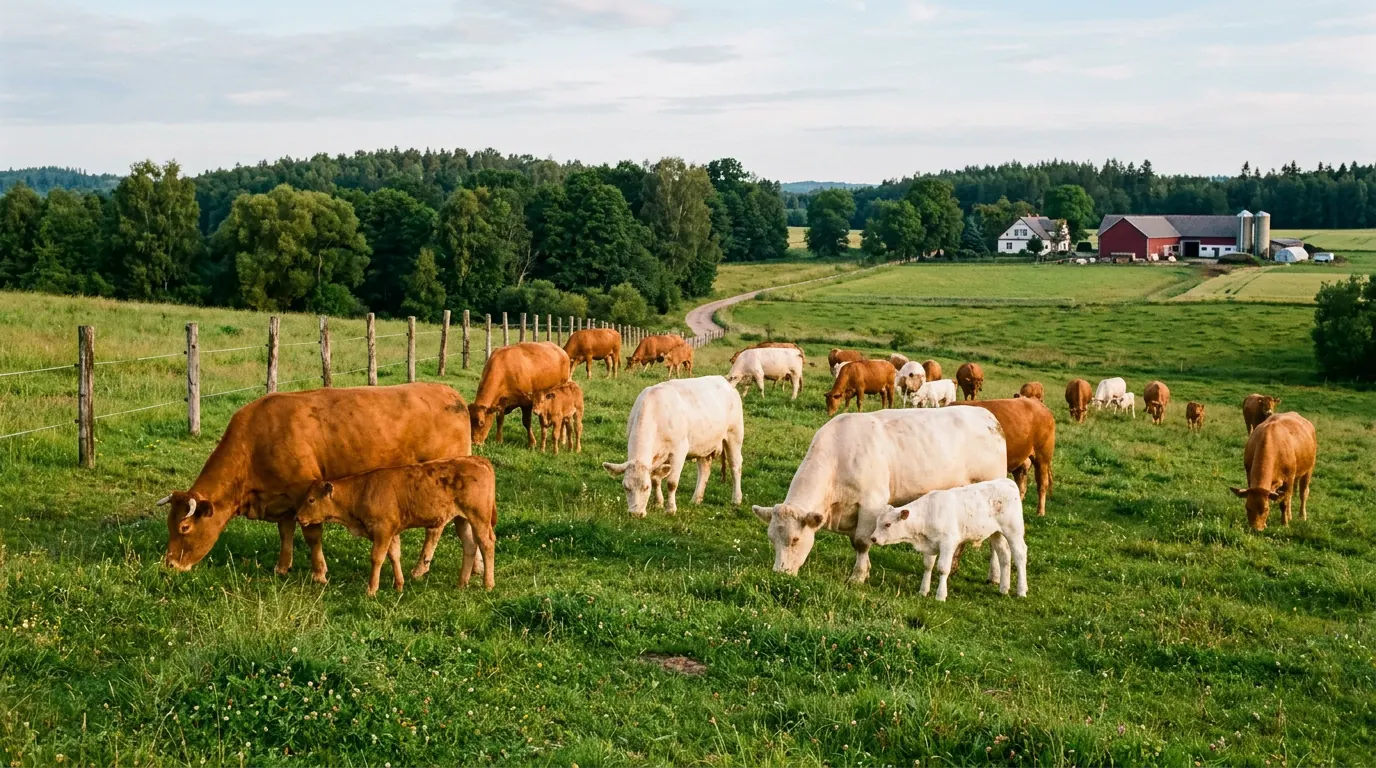
Charolais is a beef breed of French origin, coded CH in the ARiMR list. Farmers often choose it for commercial crossing because calves grow quickly and adult bulls are large. Below you will find the weight of bulls and heifers, carcass yield data for crossbreds and practical breeding rules, with references to IZ PIB and Teagasc.
Code CH and coat color
In Polish breeding documents we record the breed with the code CH, following the ARiMR list of letter codes. Charolais cows and bulls have a light cream-white or wheat coat, and the skin around the eyes and nose is dark. These traits help you judge an animal at purchase, but pedigree decides whether it is purebred, not looks. When buying, ask the seller for pedigree documents and check that the data in the animal's passport matches the database entry.
Where the breed comes from and how to recognize it
A French breed from the Charolles region
Charolais comes from central France, around Charolles, where it was long kept as both a work and beef animal. The breed later spread to many countries and is now one of the main beef breeds in Europe. In Poland, herds often rely on imported bulls and their offspring, as IZ PIB writes in its review of beef cattle farming. So when you choose your first animals, look at the herd book entry and the performance of the parents, not only at looks.
Marks in documents
In the ARiMR list we record Charolais with the code CH. Crosses with beef breeds get the code MM, and crosses without beef breeds get MS. Matching the code to the documents is the basis for selling animals, so check it whenever cattle join the herd. Record the breed from day one, because later corrections in documents take time.
Bull weight and calf growth rate
Weight of bull and heifer calves at day 210
According to IZ PIB data from 2015, Charolais bull calves aged 210 days averaged 280.2 kg body weight and a daily gain of 1115 g. Heifers of the same age weighed 259.6 kg on average, with a daily gain of 1057 g. For comparison, Limousin bull calves reached 274.7 kg and 1095 g. These figures come from recorded herds, so the result on your farm depends on feeding, the dam's breed and the season. Weigh at the same intervals and use these numbers as a reference point. We describe weighing a flock in a separate article on weighing.
Breeding bull at 14 months
The Teagasc Beef Manual gives target bull weights at 14 months: 430 kg for Charolais X crosses, 420 kg for Limousin X and 400 kg for Simmental X. Buy a bull at least two months before the breeding season and feed him moderately after purchase. For heifers the advice is different: they should reach 85–90% of mature cow weight at first calving, and good feeding from birth is needed for that. You can build a schedule of placements and calving dates in the placement planning module.
Charolais crossing in commercial production
Carcass yield of crossbreds
A 2011 IZ PIB study compared offspring of crosses with Charolais bulls against a control group. At 15 months, control bull calves had a carcass yield of 59.01% and Charolais crosses 60.52%. In heifers the results were close: 59.98% in the control group and 60.17% in crosses. At 12 months, Charolais crosses gave 58.16% against 57.54% in the control group. The result shows that Charolais improves carcass yield, though not always by much, and that slaughter age is worth watching.
How to plan crossing
Commercial crossing means calves go to rearing or slaughter while the dams stay in the herd. First set your goal: fast gain, carcass yield or easy calving. Choose the bull on pedigree data and breeding value results, not looks alone. IZ PIB described new methods of this evaluation in papers from 2018 and 2019. Record every mating and every birth, because only such data lets you judge how well the crossing worked over the following years.
Bull, heifers and cow longevity
Assessing bull fertility
The best test of a bull's fertility is the number of cows he gets in calf in a season. Teagasc advises checking the bull regularly during mating and pregnancy-testing the first cows about 30–40 days after mating. Record matings with the date and test result. In a larger herd you track the breeding cycle in the records, which lets you spot repeat heats without delay.
Age at first calving and cow lifespan
According to IZ PIB (2015), in the studied Charolais cow herd 19.0% were first-calvers and 0.8% lasted more than 10 calvings. Most cows stay in the herd for several calvings, and late maturing of heifers shortens this period. Teagasc stresses that the later a heifer reaches puberty, the longer the period without heat after her first calf. Poor feeding slows growth and delays maturity, so heifers need good feed from birth.
Calf rearing and prevention in a Charolais herd
Rearing beef calves
The KPODR Minikowo guide, prepared by authors from SGGW (Warsaw University of Life Sciences), describes rearing beef calves from the first days: colostrum, a dry bed, checking gains and feeding in later months. Directive 2008/119/EC sets minimum standards for protecting calves in the European Union. You can check current Polish rules in the Internetowy System Aktów Prawnych (Poland's online legal database); legal state as of 22.11.2026. Record every case of disease and every treatment, because this is the basis of herd inspections.
Infectious diseases and withdrawal period
PODR Szepietowo (a regional agricultural advisory center) describes lumpy skin disease (LSD) in a leaflet. Report any suspicion of the disease to your vet immediately. A vet always chooses the medicine and dose. For animals going to slaughter a withdrawal period applies, meaning the time from the last dose to slaughter; its length is given on the product leaflet and by your vet. Keep a register of doses and the calculated withdrawal period so you never send an animal with medicine still in its body. You keep these records in the treatment and withdrawal module.
Charolais herd records in DlaFerm.pl
Connecting to IRZplus
DlaFerm.pl has a module for integrations with IRZplus and sensors. IRZplus is ARiMR's online animal register. With it, herd records can match the IRZplus database without retyping the same data many times. Before you work on live records, check in the module which data is sent and how it looks in the database.
Team work with the herd
If several people work with the cattle, a shared staff app lets them enter events in the same place. Entries go to one record, so the manager sees what is done and what is waiting. The calving plan shows ahead of time when to expect births in the season, and cycle planning helps you arrange matings so calves are born in planned batches.
Frequently asked questions
How much does a Charolais bull weigh at 14 months?add
The Teagasc Beef Manual gives a target weight of 430 kg for bulls marked Charolais X at 14 months of age. The weight of an adult bull depends on age, feeding and pedigree. The surest way to check it is regular weighing, with results written in your records.
What slaughter age gives the best carcass yield in Charolais crosses?add
In a 2011 IZ PIB study, bull calves from Charolais crosses had a carcass yield of 58.16% at 12 months and 60.52% at 15 months. The result depends on rearing conditions, so decide slaughter age after analyzing your own herd and feed costs.
How much does a Charolais bull cost?add
The price depends on pedigree, age, performance evaluation and whether you buy a breeding or a commercial animal. Market prices change, so we give no amounts. You can get current guidance from breeders, the breed club and agricultural advisory centers.
How do I check that an animal is purebred Charolais?add
Check the pedigree documents and the breed code in the ARiMR list, which is CH. Compare the data in the animal's passport with the database entry. If in doubt, ask a vet or an advisor from an agricultural advisory center.
Must I report suspected lumpy skin disease?add
Yes, report any suspicion of the disease to your vet immediately. The PODR Szepietowo leaflet describes the symptoms and procedure. The vet decides on next steps and treatment.
How long is the withdrawal period after a medicine in cattle?add
The length depends on the product and is given on the leaflet and by your vet. Record the date of the last dose and the calculated end of the withdrawal period. Check this entry before sending an animal to slaughter.
Sources & resources
- linkARiMR — List of letter codes for cattle breeds
- linkIZ PIB — WZ — Current state and prospects for farming and breeding of beef cattle in Poland (H. Grodzki et al.), WZ LIII(2015)2:77–87
- linkIZ PIB — WZ — 60 years of IZ work on beef cattle (J. Trela et al.), WZ XLIX(2011)4:11–56
- linkTeagasc — Teagasc Beef Manual — Section 4: Breeding
- linkPODR Szepietowo — Lumpy skin disease (LSD) — leaflet (Z. Marciniak)
Prepared by: DlaFerm Team based on data from the sources listed · Publisher: INSTA-TECH sp. z o.o.
Do you keep a Charolais herd with crossing?
The integrations module for IRZplus and sensors in DlaFerm.pl helps you keep herd records in one place. Create a free farm account or get in touch, and we will show you how it works with beef cattle.
Phone
+48 796 258 151