Parthenaise cattle: traits, breeding and finishing
Parthenaise is a French beef breed with a pale coat and dark mucous membranes. Farmers use it in purebred herds and in commercial crossbreeding. Below we cover the breed's traits, breeding practice and feeding for finishing.
verifiedFrom the team that has organised work on poultry farms for years.
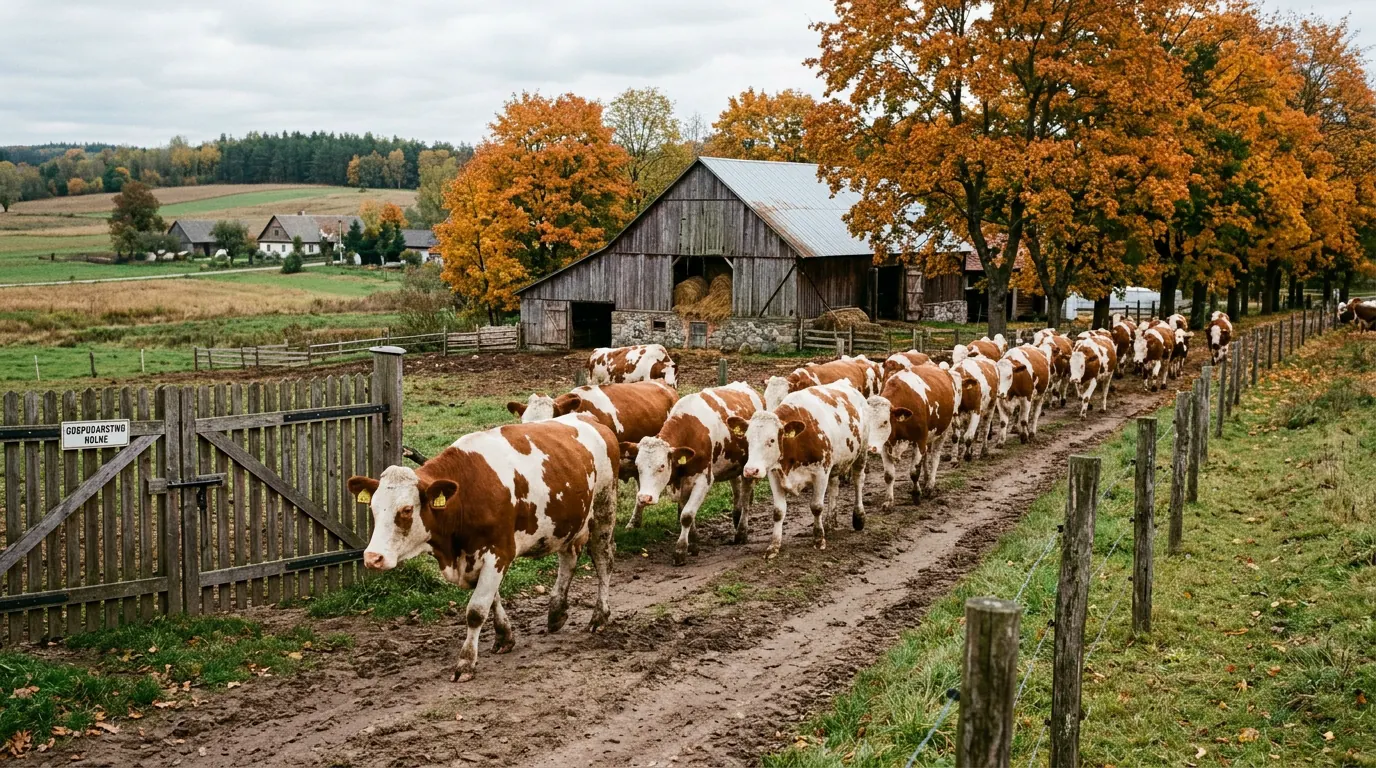
Parthenaise is a beef breed from western France. In Poland farmers keep it in suckler herds and for finishing. How well it suits you depends on your aim: purebred breeding, or crossing with dairy cows or with suckler cows of other breeds. The breed is on the list of breed letter codes kept by Poland's ARiMR (Agency for Restructuring and Modernisation of Agriculture), so you register animals according to that list. For the wider picture, see our guide to beef cattle breeds, finishing and profitability.
Who this breed suits
Parthenaise suits farms that sell finished beef cattle or weaned calves and want a simple system. The breed gives well-muscled carcasses with moderate feed demands. Before you buy, decide whether you need a bull for natural service or heifers to replace cows in the herd. That decides which traits of the parents you check in the papers.
Breed traits you can spot in the herd
Coat and identifying marks
Parthenaise has a pale coat, most often white or greyish. Dark mucous membranes and dark hooves are typical and help you tell the animals from other pale breeds. When you assess a herd, check that the coat color is uniform across the group, because crossbreds from other breeds often differ in shade. Confirm an animal's ancestry with pedigree documents, not by its looks.
Body build
Parthenaise animals have a heavy, meaty build with a well-developed rump and back. When you buy, assess the legs, because they decide how long cows last in the herd. Cows that work on rough ground or on a paddock need strong joints and healthy hooves. Good conformation also makes mating and calving easier.
Slaughter yield and carcass quality
Results from IZ PIB
According to IZ PIB (Poland's National Research Institute of Animal Production; Trela et al., WZ 2011), young bulls finished up to 15 months of age gave a higher slaughter yield when the sire was a beef bull. Crossbreds from black-and-white cows and Piemontese bulls reached a 61.98% slaughter yield, against 57.81% in the control group. The table covers crossing with beef breeds in general, not Parthenaise alone. Apply the conclusions to Parthenaise with care, and rely on your own herd's results. For comparison, see Piemontese.
How to calculate the result in practice
Slaughter yield is the ratio of carcass weight to live weight before slaughter. Compare it within the same age group and on the same feeding system, because age at slaughter changes the result. Record live and carcass weights for every animal, and keep the data in records from which you can pull averages easily. That shows whether a change of bull or finishing method brings a real improvement.
Reproduction and breeding work in a suckler herd
Mating and calving interval
In beef herds cows usually calve once a year, and the calving interval is one of the key indicators of profitability. According to Teagasc (Beef Manual, Section 4: Breeding), you should monitor gestation length and time to rebreeding in every breeding season. For Parthenaise, record mating and calving dates so you can work out the real interval for each cow. Send animals that regularly drop out of the cycle to a vet for assessment.
Choosing a bull and heifers
When you choose a bull, look at ease of calving and calf birth weight, because the safety of your cows depends on them. Pick replacement heifers from calves with good growth and sound conformation. In its breeding section Teagasc advises assessing the performance of offspring, not just the looks of the parents. Record the results of every calf, so after a few years you can see which lines work. Compare with Limousine or Hereford if you are still choosing.
Feeding cows and finishing young cattle
Feeding basics
Roughage is the basis of beef cattle feeding: pasture, silage and hay. IZ PIB material (Bilik et al., WZ 2014) shows that where concentrates are restricted, the quality of roughage and its share in year-round feeding decide finishing performance. Set rations and their composition with a feeding adviser, matched to the age and weight of the animals. Record feed use in each group, so you can work out the cost of a kilogram of gain.
Finishing and daily gain
In finishing, daily gain and the moment you end the finishing period matter most. Finishing too long raises cost, and too short gives lighter carcasses. According to a sample calculation by ODR Lubań (podr.pl, a publication on beef production), the result depends on feeding intensity, so compare options using your own data. For every batch, note the starting weight, days on feed and final weight.
Prevention and duties with beef cattle
Diseases reported to the county vet
Lumpy skin disease (LSD) is an infectious disease that you must report. A PODR Szepietowo leaflet (Z. Marciniak) describes the symptoms and procedures. If you suspect it, contact your vet at once and do not move animals without the vet's decision. Full lists of diseases and reporting rules are available from the Chief Veterinary Inspectorate (Główny Inspektorat Weterynarii).
Welfare and treatment
EFSA, in its opinions on beef cattle welfare (AHAW Panel), describes animals' needs for feed, space and calf care. A vet always chooses the medicine and dose. After every treatment, record the date given, the product name and the end of the withdrawal period, because selling an animal before it ends is prohibited. Keep treatment records in one place, so you do not mix up dates. In DlaFerm.pl you can do this in the treatment and withdrawal period module.
Registration, documents and costs
Registration and documents
Every animal should have identification documents and an entry in the database run by ARiMR. Check that the breed code in the documents matches the ARiMR list of letter codes. Update animal movements at once, because registration backlogs make selling harder. You can keep this in order in herd records software, and integrations with IRZplus, ARiMR's online animal register, help with registration. Our guide to rules and documents for beef cattle keepers covers the rest.
Costs and profitability
The prices of animals, feed and veterinary services change, so we give no amounts. Check current livestock market prices and feed prices in your region. To compare results, use calculators for farmers and enter your own data from the last year. Good cost records let you work out the cost of a kilogram of gain and the break-even point for each batch.
Frequently asked questions
What makes Parthenaise cattle stand out?add
The breed has a pale coat, most often white or greyish, with dark mucous membranes and hooves. It is a beef breed with a heavy build. When you buy, check pedigree documents, because looks alone do not prove a pure breed.
Is Parthenaise good for crossbreeding?add
Yes, farmers use the breed in commercial crossbreeding with cows of other breeds. IZ PIB research shows that crossing with beef breeds raises slaughter yield. Still, test the results for your own herd in your own records.
How do you assess the slaughter yield of cattle?add
Slaughter yield is the ratio of carcass weight to live weight before slaughter. Compare it within the same age group and on the same feeding. Record weights for every animal to see the real difference between groups.
What matters most in feeding beef cattle?add
Roughage is the basis: pasture, silage and hay. According to IZ PIB, the quality of this feed decides the feeding efficiency of cows and young cattle. A feeding adviser sets rations to suit the age and weight of the animals.
How do you treat cattle and count the withdrawal period?add
A vet always chooses the medicine and dose. After every treatment, record the date given, the product name and the end of the withdrawal period. Do not sell the animal before the withdrawal period ends.
What should you report if you suspect lumpy skin disease?add
Report lumpy skin disease to your vet and to the county vet. Do not move animals until a decision is made. A PODR Szepietowo leaflet describes the symptoms and procedures.
Sources & resources
- linkARiMR — List of letter codes for marking cattle breeds
- linkIZ PIB — WZ — 60 years of IZ work on beef cattle (J. Trela et al.), WZ XLIX(2011)4:11–56
- linkIZ PIB — WZ — Feeding beef cattle in organic production (K. Bilik et al.)
- linkTeagasc — Teagasc Beef Manual — Section 4: Breeding
- linkPODR Szepietowo — Lumpy skin disease (LSD) in cattle — leaflet (Z. Marciniak)
Prepared by: DlaFerm Team based on data from the sources listed · Publisher: INSTA-TECH sp. z o.o.
Do you run a suckler herd or finish beef cattle?
In DlaFerm.pl you keep treatment and withdrawal period records for every animal and check the dates before you sell. Create a free farm account and start with one group of cattle.
Phone
+48 796 258 151