Beef cattle: breeds, finishing and profit
Beef farming has two stages: suckler cows rear calves, and young cattle are finished for slaughter. The result depends on the breed or cross, the cost and quality of feed, and on keeping health records and paperwork in order. We draw on data from IZ PIB (Poland's National Research Institute of Animal Production), ODR (agricultural advisory centers), Teagasc and EFSA. Medicines and doses are always chosen by a vet.
verifiedFrom the team that has organised work on poultry farms for years.
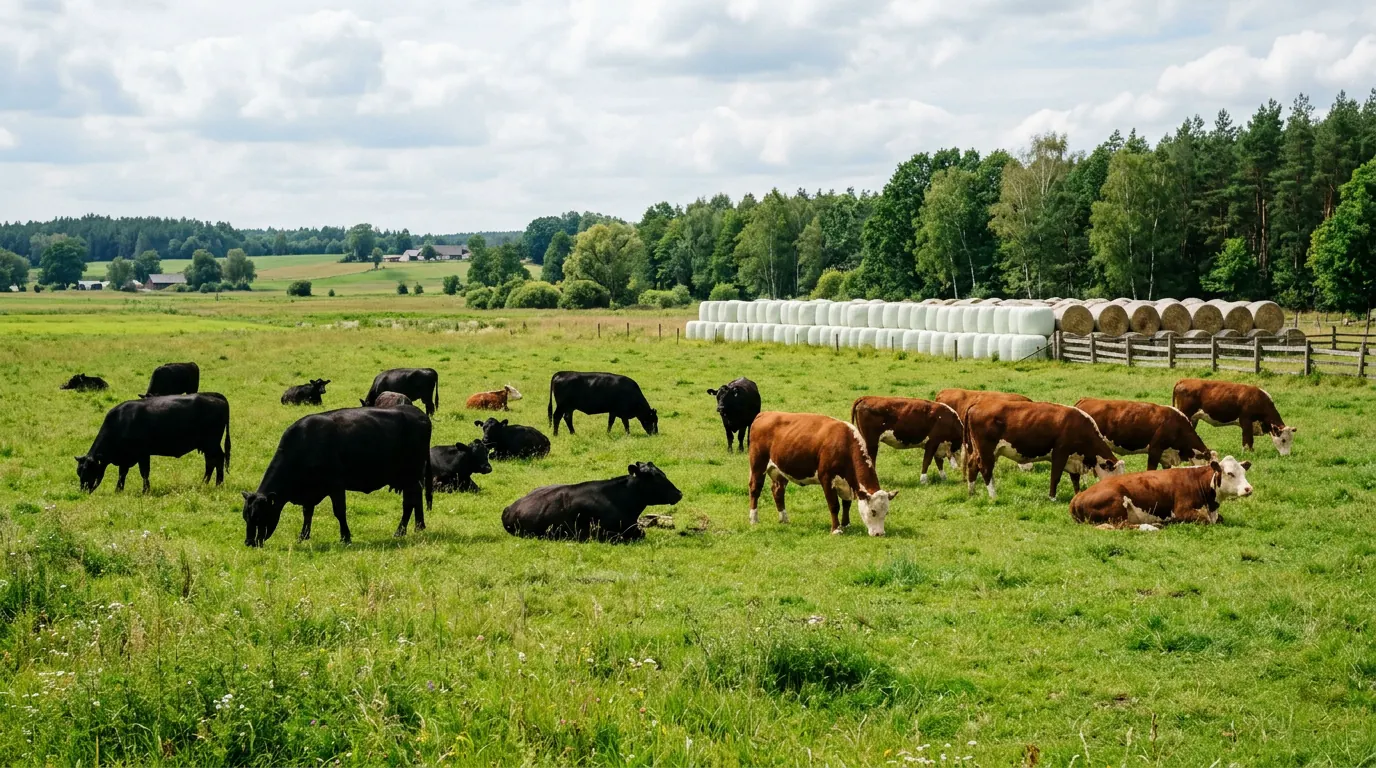
You usually keep beef cattle in one of two ways: with suckler cows that rear calves until weaning, or by finishing young cattle bought in. Both rest on three factors: the breed or cross, feed quality, and the costs you must work out before the first animal arrives. Below we cover each one, based on publications from IZ PIB, ODR and Teagasc, with the legal state as of 22.11.2026.
Where to start
Before you buy animals, check three numbers: how much feed you can grow on your own land, what rearing and selling cost, and what market you have nearby. Without them it is hard to say whether finishing will pay. You can track feed use and animal numbers with feed silo monitoring, and keep herd data in one place before you compare results from later batches. Always rerun the numbers at current prices, because live weight and feed prices change every week.
Beef breeds and crossbreeding
Purebreds and crosses
According to a 2011 IZ PIB publication (J. Trela et al.), beef cattle differ in weight and build. For example, Piemontese, a medium-frame Italian breed, has cows weighing 500–600 kg at a withers height of about 140 cm, and adult bulls of 700–900 kg. Calves weigh 37–42 kg at birth, and calving in this breed is easy. Beef breeds are also widely used in commercial crossing with dairy cows. Which breed you pick depends on whether ease of calving, growth rate or carcass yield matters most. See our guides to Piemontese and other rare cattle breeds.
Suckler cows and calves
IZ PIB's feeding example (K. Bilik et al.) uses a medium-frame suckler cow of about 500 kg body weight that calves in February and rears the calf to 250 kg, with 80% of the ration coming from green forage. Set your calving plan around pasture availability and feed stocks. Details on rearing and reproduction are in the KPODR instructions and WMODR leaflets (regional agricultural advisory centers). Minimum calf welfare standards come from Council Directive 2008/119/EC. More in our guide to the suckler cow system.
Finishing cattle: growth rate and feeding
Young cattle for finishing
The IZ PIB example covers young finishing cattle of beef breeds or beef-by-dairy crosses, weighing 200–350 kg. These animals gain 160 kg in 180 days, with green pasture forage making up 80% of the ration. The result shows that finishing speed depends mainly on grassland quality. On poorer pasture you must add concentrate, which raises the cost of each kilogram of gain. Check gains on a scale, not just by eye. More in our guide to cattle finishing.
Protein in the concentrate
The Teagasc cattle feeding manual (Section 6) gives crude protein needs for concentrate mixes. With silage at 10% crude protein, finishing cattle (heifers and steers) need 14% protein in the mix, and with silage at 14% they need 11–12%. Growing young bulls on 10% protein silage need 18%. These values come from an Irish manual, so do not apply them directly to Polish feeds. Set the ration with a feed adviser and your vet.
Finishing profitability: what drives the result
Feed cost
In a sample calculation from ODR Lubań (a PODR publication), feed made up 71.0% of direct costs when finishing crossbreds and 65.1% for purebred beef cattle. The biggest items were maize silage, rapeseed meal and grass silage. A change in feed price or grassland yield moves the result more than the cost of a single vet visit. Check feed and purchase prices directly with suppliers and local buyers.
Subsidies and calf value
In the same calculation, income also depends on the value of the calf entering finishing and on cattle subsidies. Check current subsidy terms with Poland's ARiMR (Agency for Restructuring and Modernisation of Agriculture), and the rules in the Internetowy System Aktów Prawnych (Poland's online legal database). Direct surplus differs for crossbreds and purebreds, so work out your direction on your own data, not someone else's table. Remember that the example is illustrative only.
Herd health and welfare
Lumpy skin disease
Lumpy skin disease (LSD) is an infectious disease, and its symptoms are described in a leaflet from PODR Szepietowo (Z. Marciniak). If you suspect skin lesions, report it to your vet, who will decide the next steps. Until a decision is made, limit animal movements. Current disease information is published by the Główny Inspektorat Weterynarii (Chief Veterinary Inspectorate) on gov.pl. Do not wait for symptoms to clear up on their own.
Treatment and withdrawal periods
Your vet always chooses the medicine and dose. What matters to you is the withdrawal period, the time after which meat can go to market. Record every treatment, the animal's number and the withdrawal end date in the treatment and withdrawal module. Rules for keeping disease out can be set up in the biosecurity plan generator, which helps organize entry to the barn and animal handling.
Herd registration and sales
Data in IRZ
Cattle must be registered in Poland's IRZ (Animal Identification and Registration System). Records of animals, movements and slaughter are the basis for subsidies and sales. You can sync the data through the IRZplus integration (IRZplus is ARiMR's online animal register), which saves you entering the same information twice. Check every month that your herd count matches the register.
Invoices for live cattle
When you sell live cattle you issue invoices that must follow current rules. The KSeF invoicing module covers invoicing in KSeF, Poland's national e-invoicing system. Check the legal state in the Internetowy System Aktów Prawnych, because invoicing rules change from time to time. Always confirm the details with your accountant.
Frequently asked questions
What is the best beef cattle breed for finishing?add
There is no single best breed. The choice depends on your goal: ease of calving, growth rate, carcass yield and the cost of buying calves. Compare IZ PIB data for a given breed with the conditions on your farm.
How much feed do finishing cattle need?add
Needs depend on body weight, daily gain and feed quality, so we give no universal ration. Start from analyses of your pasture and silage and the advice of a feed adviser. Match the concentrate to the stage of finishing, especially the protein level.
Is finishing beef cattle profitable?add
The result depends on feed cost, calf and live weight prices, and subsidies. In the ODR Lubań example, feed was the largest cost item. Work out the direct surplus on your own data, not on someone else's calculation.
How long does it take to finish young cattle?add
According to IZ PIB, young cattle weighing 200–350 kg gain 160 kg in 180 days, with green forage making up 80% of the ration. Speed depends on pasture quality and feeding, so check gains on a scale.
What should I do if I suspect lumpy skin disease?add
Report it to your vet straight away and do not wait for improvement. Limit animal movements until the vet decides. The rules for action are set by the Veterinary Inspection (Inspekcja Weterynaryjna).
How long is the withdrawal period after a medicine?add
The withdrawal period comes from the product leaflet and your vet's decision, so we give no number here. Record the treatment date and the withdrawal end date for each animal before it goes to slaughter.
Sources & resources
- linkIZ PIB — Wiadomości Zootechniczne — Breeding work in beef cattle herds (Z. Choroszy et al.), WZ L(2012)1:11–20
- linkIZ PIB — WZ — 60 years of IZ research on beef cattle (J. Trela et al.), WZ XLIX(2011)4:11–56
- linkIZ PIB — WZ — Feeding beef cattle in organic systems (K. Bilik et al.)
- linkODR Lubań (PODR publication) — Sample farm income calculation for beef production (different intensity levels)
- linkTeagasc — Teagasc Beef Manual — Section 6: Nutrition
Prepared by: DlaFerm Team based on data from the sources listed · Publisher: INSTA-TECH sp. z o.o.
Do you run a beef herd and want your data in one place?
The IRZplus and sensor integrations module helps keep your herd data consistent without double entry. Create a free farm account at DlaFerm.pl or get in touch, and we will show you how it works in practice.
Phone
+48 796 258 151