Belgian Blue: a double-muscled beef breed
Belgian Blue (Belgijska biało-błękitna in Polish) is a beef breed known for its heavy muscling and high carcass yield. The same trait makes breeding harder, because calvings often need a vet. Here is what to check before you bring cows of this breed into your herd.
verifiedFrom the team that has organised work on poultry farms for years.
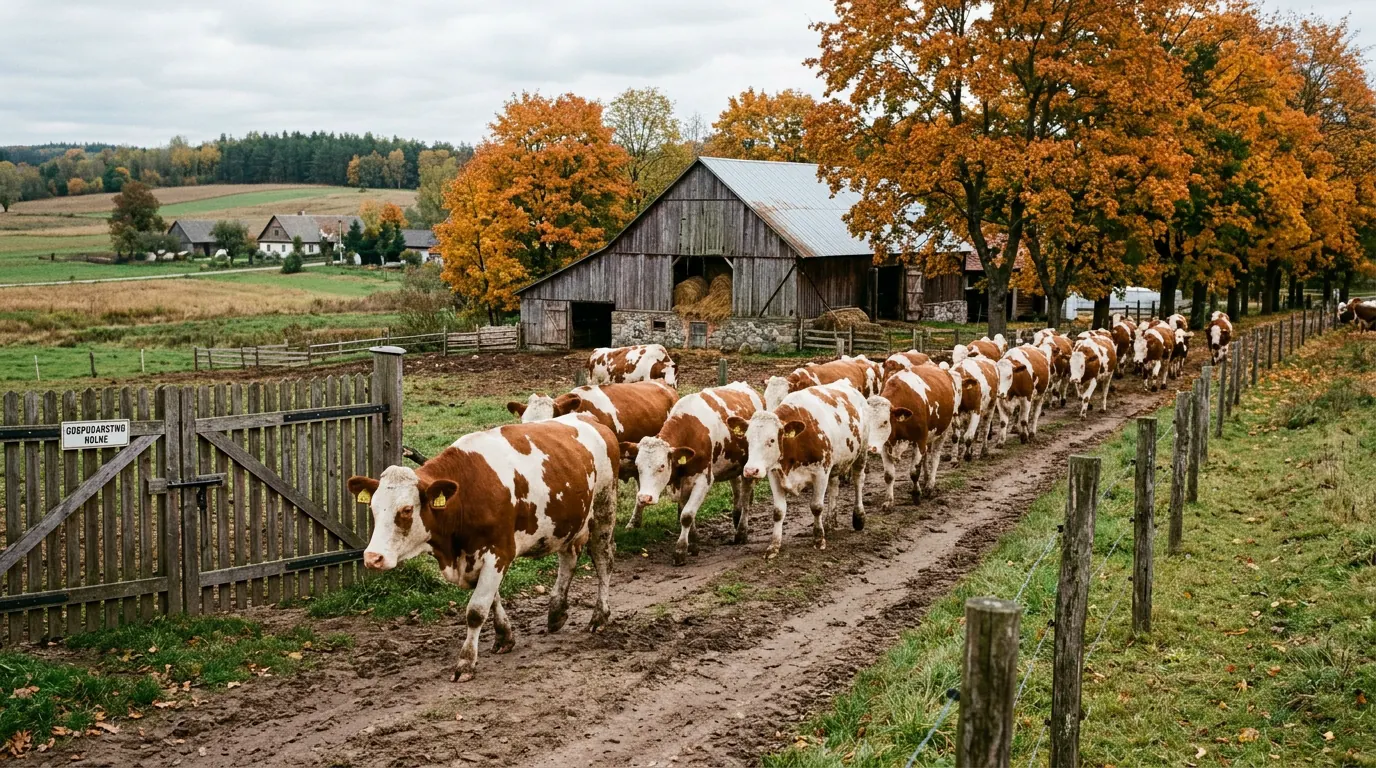
Belgian Blue cows are beef suckler cows, kept mainly to raise calves for slaughter or for further fattening. The breed has its typical build because of double muscling (caused by a mutation in a gene that controls muscle growth). So when you choose cows for the herd, looks are not enough. Calving history and the cow's ability to raise calves matter too.
Why this breed needs records, not just a purchase
Cows of this breed are often bought without a close look at their value in the herd. For each cow, you should know her age at first calving, how earlier calvings went, and the calf's weight at birth and at weaning. Data from the Institute of Animal Production (Instytut Zootechniki PIB) shows how the crossbred female beef population changed: according to table 2 in the 2018 WZ paper (PZHiPBM data from 2016, the Polish Association of Beef Cattle Breeders and Producers), it fell from 11,333 thousand head in 2007 to 4,272 thousand head in 2016. With changes like these, every animal in the herd counts for more, so keep records in a system, not just in your head. For other breeds, see Limousine or Hereford.
Looks and performance of Belgian Blue cows
Build and muscling
A Belgian Blue cow has a broad rump, a deep chest and clearly marked hindquarters. The coat is white or blue-white with darker patches, and the pattern differs from animal to animal. An adult cow is heavy, so with poor condition or no exercise her legs are easily overloaded. When you select, pick dams with sound legs and a sound udder, because that decides whether a cow lasts through many lactations in the herd.
What to measure
In Polish practice, the performance and breeding value of beef cattle is assessed from recording data, and the methods are described in IZ PIB publications from 2018. For you, the most important figures are calf birth weight, gain to weaning and the dam's productive life. Record these for every cow from her first calving. Only an unbroken series of results shows whether the herd is heading in the right direction.
Calving and breeding of Belgian Blue cows
Why calvings can be hard
Heavily muscled calves and a narrow pelvis in some dams mean calving often needs help. Caesarean section is more common in this breed than in others, so keep your vet's number at hand during calving. Do not use calving tools without training. Record how each calving went: time from the first signs, calf weight and whether assistance was needed.
Heifers and age at first service
The Teagasc beef manual (Teagasc is Ireland's agriculture and food development authority) points out that at first service the heifer's weight and development count, not age alone. A heifer that is too young or too small more often has trouble at her first calving. An IZ PIB paper on the Glinna farm (ZD Kołbacz) gives heifer weights before conception, but they relate to a different herd structure, so we do not apply them to Belgian Blue. Set the breeding date with your vet and from the heifer's recorded weight.
Planning calving by season
Fixing calving to a chosen period lets you plan labor for births and feed for cows with calves. The cycle planning module helps you spread the herd cycle so that too many calvings do not fall in one week. Match the timing to pasture availability and stocking, not only to what is convenient for you. If you are weighing a suckler system, read about suckler cows.
Feed and paddocks for beef cows
Paddock quality sets stocking rate
An IZ PIB publication on feeding beef cattle in organic systems (K. Bilik et al., WZ 2014) shows that stocking rate per hectare depends on paddock quality. On a very good paddock you can keep clearly more cows with calves than on a poor one. Dry matter yield and nitrogen fertilization also differ clearly between paddock classes. The table assumes a medium-frame beef cow (about 500 kg body weight) calving in February and rearing a calf to 250 kg. Work out your yield from your own meadow and do not copy values from the table.
Water, salt and ration changes
Water and mineral salt must be available all the time. Choose mineral supplements to match the analysis of your own forage, and agree doses and ingredients with your vet or a nutrition adviser. Avoid sudden feed changes, because they cause digestive upsets in cows and calves. Record every change in ration composition in the system, so that when a health problem appears you know what changed. A farm management program helps with feed planning.
Rearing calves and finishing Belgian Blue cattle
Calves from birth
A Belgian Blue calf is usually born heavy, which raises the risk of a difficult birth. The first hours decide immunity, so colostrum must be given quickly, and you should discuss its amount and quality with your vet. Council Directive 2008/119/EC sets minimum standards for the protection of calves in the EU, and in Poland it is implemented through national rules. Check the current wording of the rules in ISAP (Poland's legal acts database), legal state as of 22.11.2026, because requirements may change. For paperwork, see the rules and documents for beef cattle keepers.
Finishing and economic result
The result of finishing depends on feeding, age at the start of finishing and feed cost. Advisory publications with income calculations for beef production show how the result changes at different intensity levels. We give no amounts here, because live cattle prices change every week. Check quotes at the buyer and compare them with your own feed costs, not with last season's price.
Welfare, disease and withdrawal periods
Welfare at pasture and in the barn
The EFSA opinion on beef cattle welfare (EFSA is the European Food Safety Authority) points to access to shade and shelter at pasture, and to winter conditions. Cows need a dry lying area and constant access to water, also at low temperatures. Provide a covered spot in the paddock and watch the condition of hooves and skin. Log outside visitors to the herd in the farm visitor log, because it is part of biosecurity.
Disease, withdrawal periods and treatments
Lumpy skin disease (LSD) is an infectious disease. If you suspect it, report it to your vet and do not treat on your own. Your vet chooses medicines and vaccinations, and you check withdrawal period rules in the product's documentation. Record every treatment with the date and batch number, so before you sell milk or animals you know when the withdrawal period ends. The Teagasc cattle health manual describes how to keep such records. In DlaFerm you do this in the treatment and withdrawal module.
Beef cow records in DlaFerm
Cow and calf records
Record every cow from her first calving: number, calving date, calf weight, how calving went and weaning. Performance recording data is easier to analyze when it is organized in one system. It lets you compare dams and decide on herd replacement from facts, not impressions.
IRZplus integration
IRZplus is ARiMR's online animal register (ARiMR is Poland's Agency for Restructuring and Modernisation of Agriculture), the national database for animal identification and registration. Reporting duties depend on species and type of production, so ask your adviser which ones apply to your farm. The integration module helps you avoid retyping the same data in several places.
Frequently asked questions
How is a Belgian Blue cow different from other beef breeds?add
A Belgian Blue cow has clearly heavier muscling, especially in the hindquarters and rump. This gives a good carcass yield, but when you select dams you need to look at leg structure and how calvings go.
Do Belgian Blue cows have difficult births?add
Births can be hard, because calves are large and some dams have a narrow pelvis. At every calving keep your vet's number at hand and record how the birth went. Your vet decides on assistance and Caesarean section.
How much does a Belgian Blue cow cost?add
The price depends on age, origin, health, and whether you buy a heifer, a cow with a calf or an animal with documented pedigree. Prices change over time, so check current offers from breeders and in regional ads.
Can Belgian Blue cows be kept on pasture?add
Yes, but they need shade and shelter, a dry lying area and water in winter too. Match pasture stocking to paddock quality, not to its area. Check yield from your own meadow.
What records do you need to keep for beef cattle?add
You must keep animal records in line with the rules on cattle identification and registration, plus records of treatments and withdrawal periods. Check the scope of duties in ISAP and with the county vet (powiatowy lekarz weterynarii). For convenience, record everything in one system.
When should you call the vet for a cow with a calf?add
Call the vet when calving takes longer than usual, the calf is in an unusual position or the cow shows signs of illness. Do not wait for improvement, because delay raises the risk for dam and calf. Record the time of the call.
Sources & resources
- linkIZ PIB — WZ — New methods of assessing the performance and breeding value of beef cattle (Z. Choroszy et al.), WZ LVI(2018)3:17–23
- linkIZ PIB — WZ — Feeding beef cattle in organic systems (K. Bilik et al.)
- linkTeagasc — Teagasc Beef Manual — Section 4: Breeding
- linkTeagasc (Ireland) — Teagasc Beef Manual — Section 7: Animal Health
- linkEFSA AHAW Panel — Welfare of beef cattle (EFSA Journal 23:9518)
- linkEU / Publications Office of the EU — Council Directive 2008/119/EC laying down minimum standards for the protection of calves
Prepared by: DlaFerm Team based on data from the sources listed · Publisher: INSTA-TECH sp. z o.o.
Do you run a beef cow herd?
Create a free farm account in DlaFerm.pl and record calvings and treatments in the treatment and withdrawal module. You can check the scope of IRZplus integration in the integrations module.
Phone
+48 796 258 151