Zebu cattle breed: traits, breeding, fattening
Zebu is a group of Bos indicus cattle, known for the hump and good heat tolerance. They are rare in Poland, and the data from IZ PIB (Poland's National Research Institute of Animal Production) mostly cover European breeds. We explain what is known about zebu traits, what crossbreeding data show, and how to run breeding and fattening when some data are missing.
verifiedFrom the team that has organised work on poultry farms for years.
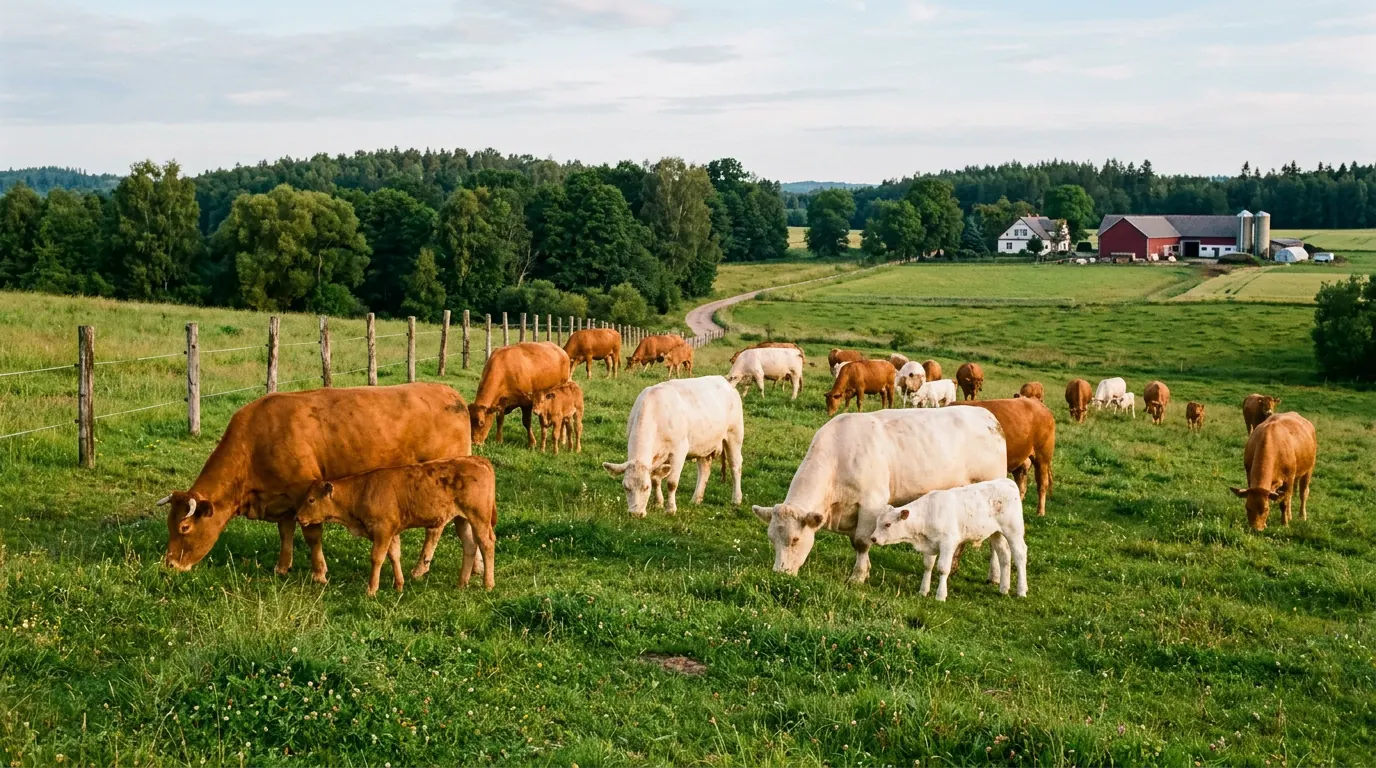
Zebu is a group of cattle breeds of the species Bos indicus. You recognize them by the hump on the back and good tolerance of high temperatures. They are a rarity in Poland: zebu do not appear in the IZ PIB beef cattle summaries, which are dominated by European breeds. So we describe zebu with care: what is known in general, what data on crossing beef breeds show, and where to look for specific numbers.
Why this question keeps coming back
Keepers usually ask about zebu for one of two reasons: they want animals that cope with heat, or they look for a breed to raise for beef in harder pasture conditions. Before you invest, compare the traits of the breed with data from Polish and European studies. Most studies cover European breeds, so below we separate what we know in general from what is still unknown.
What sets zebu apart
Hump and build
The typical zebu trait is a hump on the back, made of fat and muscle tissue around the withers. The animals usually have looser skin and clear folds on the neck. This build comes from the origin of the species, which developed in a warmer climate than European beef breeds. In practice it means a different outline in the paddock and a different conformation assessment than for Limousine or Charolaise.
Heat tolerance
The main advantage of zebu described in the literature is better tolerance of high temperatures and strong sun. Zebu usually cope with heat better than many European breeds, but that does not mean they do not need shade and water. When you assess the herd in hot weather, one rule applies: animals must have access to shade, fresh water and a well-ventilated place.
What is known and what is not
The IZ PIB summaries on beef cattle in Poland mainly describe Limousine, Charolaise, Hereford and Simmental. Zebu do not appear in them. The 2025 EFSA (European Food Safety Authority) review on the welfare of beef cattle in hot weather explicitly excluded zebu in its search strategy. So take performance data for zebu from a specific breeder or the breed register, not from tables for European breeds.
What data on crossing beef breeds show
Crosses out of dairy cows
A 2011 IZ PIB study (J. Trela et al.) compared young bulls and heifers from Polish Holstein-Friesian (black-and-white) cows crossed with beef breeds, fattened to 12 and 15 months of age. Dressing percentage of control-group bulls was 57.54% at 12 months and 57.81% at 15 months. Crosses with Piemontese reached 60.18% and 61.98%. The choice of sire breed clearly changes dressing percentage.
Meat production relative to the control group
The same study gives meat production relative to the control group. For Piemontese bulls it was 121.5% at 12 months and 133.7% at 15 months. For Limousin crosses it was 109.5% and 118.7%. When you plan fattening, then, daily gain is not the only factor: the age at which you finish matters too, because the gap between 12 and 15 months can be large.
What this means for zebu
If you consider zebu as a parent in a cross, measure dressing percentage, carcass weight and slaughter age in your own herd and compare them with a control group. Without your own records you cannot tell whether the cross pays. Keep records from the first calf, for example in a farm management program.
Breeding work and reproduction
Choosing animals
A 2018 IZ PIB paper (Z. Choroszy et al.) describes new methods of assessing the performance and breeding value of beef cattle. When you pick a bull and cows, rely on assessment results, not only on how the animal looks. Also establish whether the animals are purebred or crossbred, because the interpretation of results depends on it.
Reproduction and calves
The Teagasc Beef Manual (Section 4: Breeding) treats reproduction in beef herds as one of the main drivers of economic result, because the number of weaned calves decides income. Record calving dates and causes of losses. For calf rearing, the minimum standards of Council Directive 2008/119/EC apply. Check the details of national rules in ISAP (Poland's legal acts database), because the legal state as of 22.11.2026 may change.
Records in practice
Set a calving calendar for your farm, a way to identify animals and a way to record data. When crossing with zebu, some keepers want to combine heat tolerance with beef yield. Make that decision with a breeding adviser, because data on such crosses in Poland are rare. Keep reproduction records in one place, for example in a farm management program. For the rules and paperwork, see regulations and documents for beef cattle keepers.
Fattening zebu and crosses
Roughage
According to K. Bilik et al. (IZ PIB, 2014), in organic farming the main factor in the feeding efficiency of cows and young fattening cattle is the quality of roughage and maximizing its share all year round, because the use of concentrates is limited. This finding concerns organic farming, but it shows the principle well: good hay and silage lower the cost of fattening.
Intensity and slaughter age
The research described in the same paper covered the effect of feeding intensity in the finishing period and the type of roughage on slaughter traits and the dietetic value of meat. Put slaughter age, daily gain and carcass weight in one sheet. You can do a first calculation in the calculators for keepers, and plan the fattening cycle in the stocking and cycle planning module.
How to read the numbers
Dressing percentage differs between groups depending on the sire breed and age, as the 2011 IZ PIB tables show. Do not carry these numbers over to zebu one to one. Use them as a reference for one question: how much meat do your animals give on the same feed and at the same age?
Heat, welfare and herd health
Heat stress
EFSA, in its 2025 opinion on the welfare of beef cattle, analyzed heat stress in housing systems. The review covered fattening cattle and suckler cows, but zebu were excluded from the search. The practical takeaway: for every breed, provide shade, water and ventilation, and in hot weather watch how the animals behave, especially on pasture without a roof.
Health and treatment
A vet who knows your herd always chooses the medicine and dose. Record every treatment, the batch number and the date the withdrawal period ends. A treatment register makes checks before slaughter easier, and treatment and withdrawal records help you keep to the dates.
Frequently asked questions
Are zebu suitable for farming in Poland?add
Zebu are a rare breed in Poland, so there is no database as broad as for European breeds. Before you decide, compare the climate needs and costs with the conditions on your farm. If in doubt, talk to a breeding adviser or a vet.
Do zebu tolerate heat better than European beef breeds?add
The literature describes zebu as tolerating high temperatures better, which relates to skin structure and the hump. There are no specific comparisons for zebu, because the EFSA review excluded zebu from its search. Watch the animals in hot weather and give them shade and water.
What is the dressing percentage of beef cattle?add
According to IZ PIB in 2011, dressing percentage depended on the sire breed and slaughter age. For control-group bulls it was 57.54% at 12 months, and for Piemontese crosses 60.18%. For zebu you need to collect data in your own herd.
Do I have to keep treatment records for cattle?add
Yes, every treatment should be recorded together with the date the withdrawal period ends. A vet chooses the medicine and dose. Records make checks before slaughter easier and help you avoid withdrawal period mistakes.
How do I check whether fattening zebu pays?add
Start with feed costs, slaughter age and carcass weight from your own data. Purchase prices change often, so check current quotes with a local buyer and in market publications, not in fixed tables. Calculators help you put the result together.
Can zebu be crossed with beef breeds?add
Crossing is common in beef cattle, and the 2011 IZ PIB data show that the choice of sire breed changes dressing percentage. Before you decide, set your goal: meat, heat resistance or both. Agree the crossing plan with an adviser.
Sources & resources
- linkIZ PIB — WZ — New methods of assessing the performance and breeding value of beef cattle (Z. Choroszy et al.), WZ LVI(2018)3:17–23
- linkIZ PIB — WZ — 60 years of IZ work on beef cattle (J. Trela et al.), WZ XLIX(2011)4:11–56
- linkIZ PIB — WZ — Feeding beef cattle in organic farming (K. Bilik et al.)
- linkEFSA AHAW Panel — Welfare of beef cattle (EFSA Journal 23:9518)
- linkTeagasc — Teagasc Beef Manual — Section 4: Breeding
- linkEU / Publications Office of the EU — Council Directive 2008/119/EC laying down minimum standards for the protection of calves
Prepared by: DlaFerm Team based on data from the sources listed · Publisher: INSTA-TECH sp. z o.o.
Do you keep beef cattle with zebu or crosses?
The DlaFerm farm management program lets you record calvings, treatments and fattening results in one place. Create a free farm account and see how it works in practice.
Phone
+48 796 258 151