Texas longhorn: the cattle with the longest horns
The Texas longhorn is a North American beef breed known for very long horns. In the register of Poland's ARiMR (Agency for Restructuring and Modernisation of Agriculture) it has the letter code "LO". We cover origin, beef traits, pasture needs and the trouble horns cause in a herd.
verifiedFrom the team that has organised work on poultry farms for years.
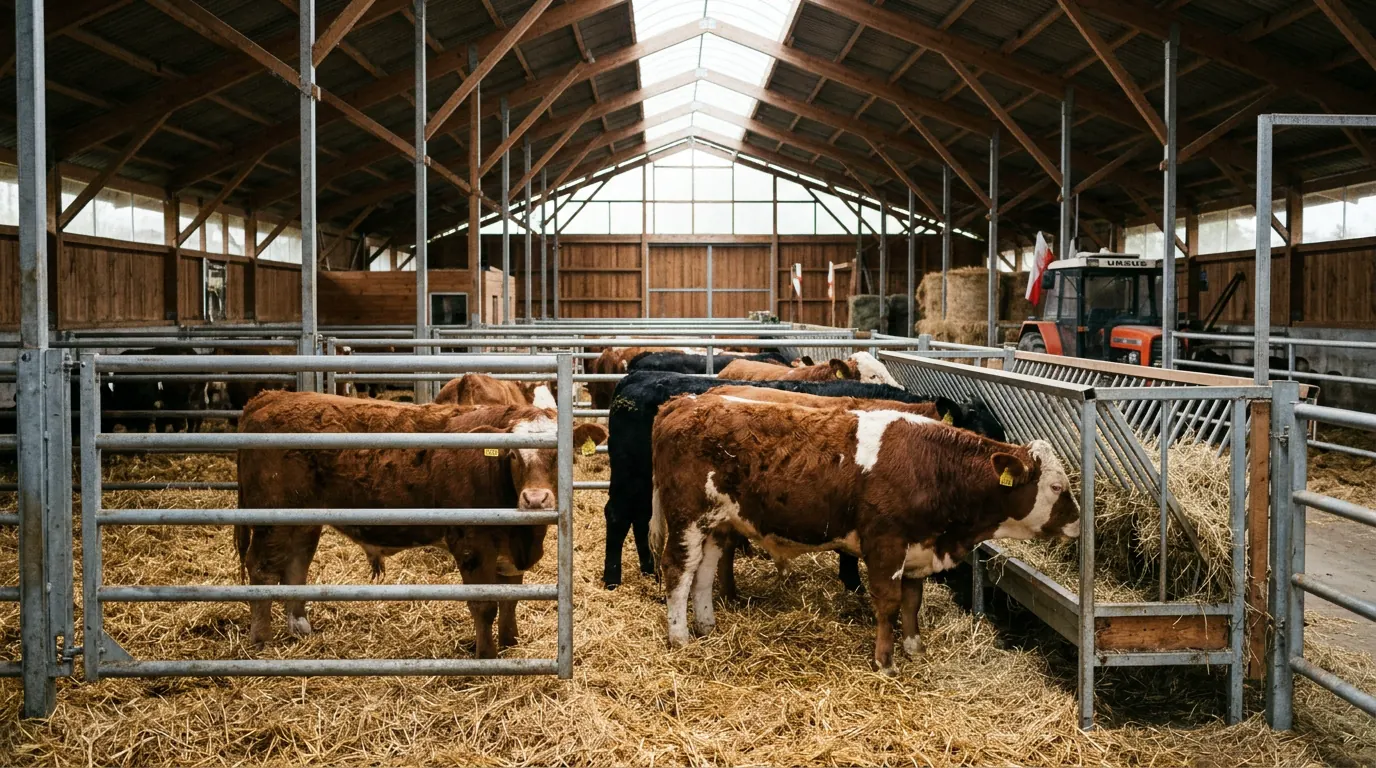
The Texas longhorn is a beef breed you recognize by its horns: the spread is measured in meters, not centimeters. It descends from cattle the Spanish brought to the Americas. For centuries those animals ran wild and selected themselves in the harsh conditions of Texas. Today it is a small breed, kept on pasture, in show herds and by keepers who value hardy animals. In the catalog of cattle breeds in Poland you will find it under the code "LO" (longhorn) in the ARiMR list.
How the longhorn differs from other horned breeds
Other breeds in our catalog also carry big horns: the Watusi from Africa, the Scottish Highland and the recreated aurochs, the Heck cattle. On a longhorn the horns grow sideways and slightly upward, and their shape can vary even within one herd. Coat colors vary widely too, from solid colors to patches and speckles. This variety comes from the lack of a single fixed standard in the early years of the breed.
Where the Texas cattle came from
Descendants of Spanish cattle
The ancestors of longhorns reached the Americas on the ships of Spanish settlers. Some animals escaped or were left behind and lived for several centuries without human care. The ones that survived coped well with heat, drought, poor feed and predators. This natural selection produced a hardy, independent breed. Only in the 20th century did breeders begin to organize the breed, keep herd books and select animals to a standard.
Horns: the record-setting trademark
Horns helped the old cattle defend themselves against wolves and other predators, and helped bulls fight for the herd. For a modern keeper they are both a decoration and a handling burden. Horns grow throughout life, so older animals have the biggest ones. The spread differs between animals and lines, so we give no single "norm" here. When you buy, measure the actual animal and write the result in its record.
Beef, calving and longevity
Beef production
The longhorn is a beef breed, but not a top-performing one. The animals have average body weight and grow more slowly than continental breeds such as Gelbvieh. In return the meat is lean, and finishing on pasture usually does not need a high share of concentrate feed. Enter exact body weights and gains in your own records and compare them with the table in how much a cow and a bull weigh. We cover profitability in the article on beef cattle.
Easy calving and durable cows
Keepers value longhorns for relatively easy calving and long working lives of the cows. Teagasc, Ireland's agricultural advisory body, lists moderate size and easy calving among the desirable traits of a suckler cow, and for bulls also a short gestation and good temperament. Longhorns meet these criteria more often than large, late-maturing breeds. That does not mean you can skip supervision: report first-calf heifer calvings and any trouble with a calf to your vet.
Crossbreeding
Longhorns are sometimes used in crossbreeding to pass on hardiness and easy calving. Teagasc advises choosing bulls for crossbreeding to suit your production system and market requirements, because there is no single breeding policy for everyone. Before you buy a bull, find out whether crossbred calves will find a buyer in your region.
Requirements for pasture-based keeping
Pasture and stocking
A longhorn copes well on poorer grassland, but that does not excuse you from watching the sward. The UK's AHDB gives sward heights for suckler cows early in the season, from turnout to May: 10–14 cm before the herd goes in and 5–6 cm after it leaves under rotational grazing. From June to July the values are 12–15 cm before and 7–8 cm after grazing. These are guidelines for beef breeds in Britain, so adjust them to your soil and climate.
Stocking data from a Polish institute
The Institute of Animal Science PIB (Instytut Zootechniki PIB), in a paper on feeding beef cattle in organic systems, gives stocking rates that depend on paddock quality. For a medium-frame suckler cow (about 500 kg) with calf, it shows 5.1 head/ha on a very good paddock, 3.9 head/ha on an average one and 2.2 head/ha on a poor one. Approximate dry matter intake of such a cow is 14 kg per day. A longhorn is usually lighter than the cow described, so it needs less feed, but do not simply copy these values. Calculate them for your own herd.
Health and insects
On open pasture cattle suffer from insects, and in high temperatures shade is lacking. We describe this in the article on horse flies and warble flies in cattle. If you treat an animal, your vet chooses the medicine and dose, and you must observe the withdrawal period before slaughter or before selling milk.
Horns in the herd, at the feed barrier and in transport
Space at the feed barrier and in the race
Long horns take up a lot of room. An animal with a wide spread will not fit a typical feed barrier or an alley built for polled breeds. Plan wider openings and exits and more space at the feed barrier so that weaker animals are not pushed aside. When handling, enter the pen slowly and remember that an animal turning its head can hit you with a horn even without meaning to attack.
Transport and welfare
During loading and transport, horns raise the risk of injury to animals and handlers. The EFSA opinion on the welfare of cattle during transport describes such hazards for all breeds. For horned cattle we also recommend smaller groups and more space per animal. Ask the haulier whether they have experience with horned breeds, and agree on the job well ahead.
The longhorn in Polish records and when you buy
Breed code and documents
In the ARiMR list the breed has the code "LO" (longhorn), next to codes such as "HI" for Highland or "GV" for Gelbvieh. When you register animals and file reports in IRZplus (ARiMR's online animal register), give the correct breed code. Crosses with beef breeds are reported with the code "MM" (crosses with beef breeds). You can keep data on the herd, assessments and health events using the IRZplus integrations in DlaFerm.
Prices and availability
We give no prices for longhorns, because they depend on age, sex, pedigree, horn spread and region, and the market for the breed is narrow. We describe general pricing rules in the article on how much a cow, bull and calf cost. When you buy, ask for pedigree documents, check the ear tags and ask the breeder about the herd history and treatments. For comparison, also look at dual-purpose breeds such as Shorthorn and mountain breeds such as Pinzgauer.
Frequently asked questions
Is the Texas longhorn a beef breed?add
Yes, the longhorn is kept mainly for beef. The meat is lean, and the animals grow more slowly than continental breeds. Many herds are also kept for looks and for shows.
What is the longhorn's breed code in the ARiMR register?add
In the ARiMR list of letter codes for cattle breeds, the longhorn has the code "LO". Crosses with beef breeds are marked "MM". If in doubt, check the current list on the ARiMR website.
Is the longhorn suited to a cool, temperate climate like Poland's?add
The breed copes well with pasture and poorer feed, but in winter it needs a dry place and access to bulky feed. Conditions depend on the region, so before you buy, talk to a breeder who keeps longhorns in a similar climate.
Do longhorns calve without problems?add
The breed is known for easy calving, but that is no guarantee. Supervise every calving and call a vet if there is trouble.
How much does a longhorn cow cost?add
The price depends on age, sex, pedigree and horn size, and the market for this breed is small. Ask several breeders directly and compare offers together with the pedigree documents.
Are longhorn horns dangerous?add
Horns can injure other animals and handlers even when the cattle are calm. Plan wider passages, more space at the feed barrier and calm handling in small groups.
Sources & resources
- linkARiMR: List of letter codes for cattle breeds
- linkIZ PIB (WZ): Feeding beef cattle in organic systems (K. Bilik et al.)
- linkAHDB Beef & Lamb (UK): Beef BRP Manual 5: Feeding suckler cows and calves for Better Returns
- linkTeagasc: Teagasc Beef Manual, Section 4: Breeding
- linkEFSA AHAW Panel: Welfare of cattle during transport (EFSA Journal 20(9):7442)
Prepared by: DlaFerm Team based on data from the sources listed · Publisher: INSTA-TECH sp. z o.o.
Keeping a rare breed and need to stay on top of reporting?
The IRZplus integrations in DlaFerm help you keep herd data in one place, together with treatment and withdrawal records. Create a free farm account or get in touch.
Phone
+48 796 258 151