Shorthorn cattle: a dual-purpose breed
The Shorthorn (breed code SH) is an old British breed used for both beef and milk. It is rare in Poland, but as a sire of crossbreds it is known from beef finishing programs in Ireland. We cover what sets it apart, how to record it in your documents and what it suits.
verifiedFrom the team that has organised work on poultry farms for years.
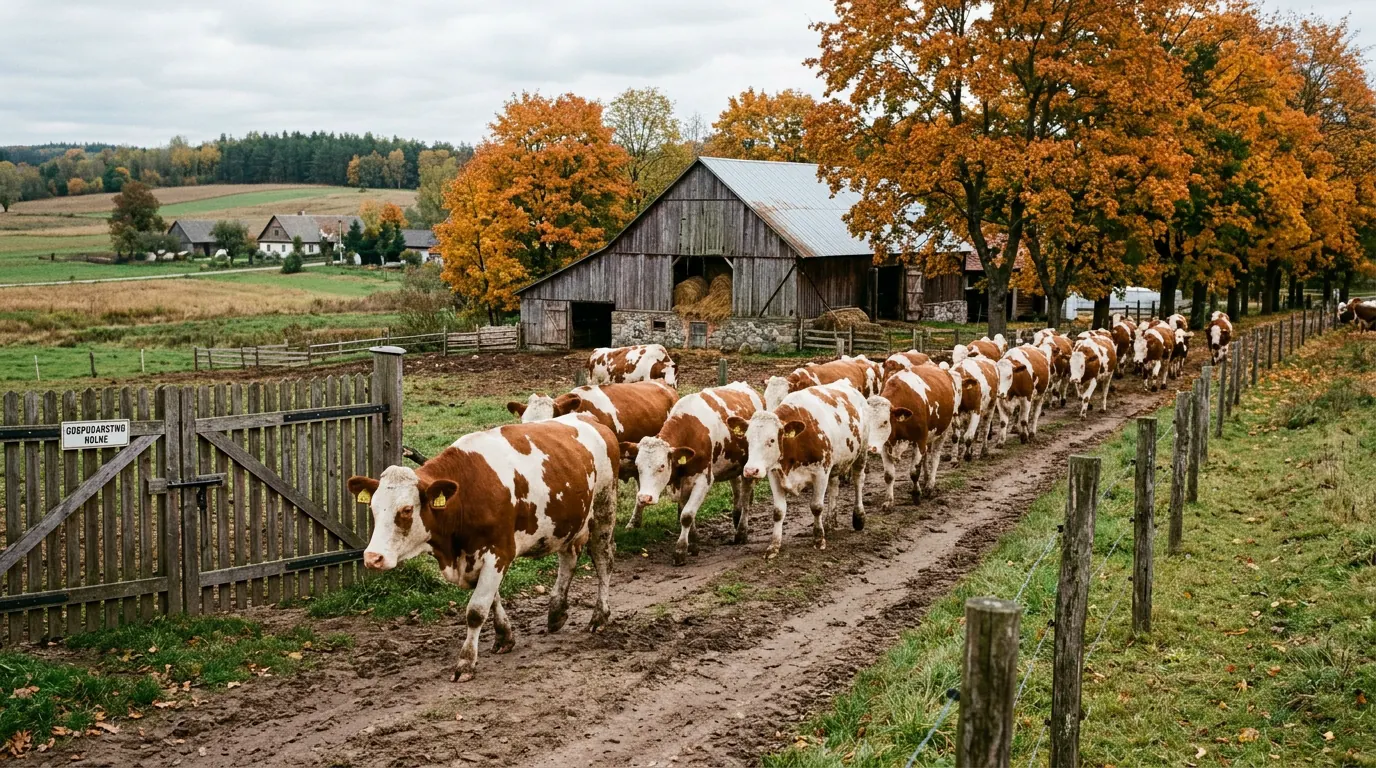
The Shorthorn is a dual-purpose breed: it gives both meat and milk. It comes from Great Britain, and the name set it apart from the long-horned British breeds such as the Texas Longhorn. In Polish beef herds the Shorthorn plays no big role, but it appears in breed lists and in crossing programs abroad.
How to record a Shorthorn in your documents
The list of letter codes for cattle breeds published by ARiMR (Poland's Agency for Restructuring and Modernisation of Agriculture) gives the Shorthorn the code "SH". You enter the code when you report the animal's breed, so check the current version of the list on the ARiMR website before you report. For crosses with beef breeds the list has separate codes. A calf from a Shorthorn bull and a cow of another breed is recorded under the rules in that list, not with the code "SH".
What a dual-purpose breed is
Beef and milk use
Dual-purpose breeds do not match specialized breeds in either direction. A Shorthorn cow gives less milk than a dairy breed such as the Jersey, and a less muscled calf than a beef breed such as the Limousine. In return you get an all-round animal: the cow raises her own calf on her milk, and her offspring suit finishing for beef. For a general overview of such breeds and a comparison with beef breeds, see our article on dairy and dual-purpose cattle breeds.
Who chooses this cattle
Dual-purpose breeds usually go to farms that do not want to bet only on milk or only on beef. They fit grassland, where pasture and roughage are the base of the diet. The Pinzgauer, a mountain dual-purpose breed, follows a similar logic. If you plan to sell calves for finishing, a dual-purpose breed makes sense only when you have a proven market for such animals.
Shorthorn as a sire of beef crossbreds
Target weight of a bull at 14 months
The Teagasc Beef Manual from Ireland gives target bodyweights for bulls at 14 months by sire breed. For crosses involving Aberdeen Angus, Hereford and Shorthorn it is 370 kg. For Simmental it is 400 kg, for Limousine 420 kg and for Charolaise 430 kg. So the Shorthorn sits in the earlier-maturing group with the Angus and the Hereford, while continental breeds such as the Charolaise reach higher weights at the same age.
Earlier maturing, smaller frame
British breeds, the Shorthorn included, usually have a smaller frame and fatten faster than large continental breeds. In practice they reach slaughter maturity at a lower bodyweight. This matters when you plan finishing on pasture, where you cannot always supply the ration a large breed needs. Details on breeding and choosing a bull are in leaflets from agricultural advisory centers, and you should treat the Teagasc data as a reference for Irish conditions.
Bull and heifers in a crossing program
Teagasc recommends buying the bull at least two months before the planned start of the breeding season and keeping him on a moderate level of feeding. Check the first served cows for returns to heat, and do a pregnancy scan 30–40 days after service. Heifers should reach 85–90% of mature weight by first calving, which lowers the risk of difficult births and shortens the time to the next heat.
Shorthorn against beef breeds in Poland
Herd structure
According to the Institute of Animal Science, National Research Institute (IZ PIB; Wiadomości Zootechniczne 2018, PZHiPBM data from 2016), Limousine dominates the purebred beef population with 70% of cows. Next come Charolaise (12%), Hereford (6%) and Simmental (6%). The Shorthorn does not appear in these statistics as a separate item, which confirms its marginal role in Polish herds.
What this means for buying
A small population means harder access to breeding animals and proven lines. Before you buy, ask for the pedigree and check whether you can find another breeder nearby to swap bulls with. If you want an easier breed to source, consider the Polish Red or other breeds from our catalog, such as the Gelbvieh or the Ayrshire.
Pasture and stocking rate
How many animals per hectare
British breeds use pasture well, so it pays to know your stocking rate. According to an IZ PIB study on feeding beef cattle in organic systems, a paddock of very good quality with fertilization carries 7.5 head/ha of young fattening cattle weighing 200–350 kg, or 5.1 head/ha of cows with calves. On an average paddock the figures are 5.8 and 3.9 head/ha, and on a poor one 3.3 and 2.2 head/ha. The data assume a cow of about 500 kg, 80% forage utilization and organic conditions, so treat them as a rough guide for your own farm.
Dry matter intake
The same study gives approximate dry matter intake: 5.9 kg per day for young fattening cattle and 8.7 kg for a cow with a calf. From this you can work out how much roughage you must provide for the grazing season. Work out indoor-season rations with an advisor from your agricultural advisory center.
Frequently asked questions
Is the Shorthorn a beef or a dairy breed?add
The Shorthorn is a dual-purpose breed, used for both beef and milk. Neither direction matches the specialized breeds, though.
What breed code does the Shorthorn have at ARiMR?add
In the ARiMR list of letter codes for cattle breeds, the Shorthorn has the code "SH". Check the current version of the list before you report.
Where does the Shorthorn come from?add
The breed comes from Great Britain. The name means short-horned and sets it apart from the long-horned British breeds.
What weight do crossbreds from a Shorthorn bull reach?add
Teagasc gives a target weight of 370 kg at 14 months for crosses involving the Shorthorn. Aberdeen Angus and Hereford have the same, and Limousine 420 kg.
Is the Shorthorn popular in Poland?add
No. In IZ PIB statistics from 2016, Limousine dominates among purebred beef cows (70%), and the Shorthorn is not listed separately.
Which breed should I choose instead of a Shorthorn?add
It depends on your goal. For finishing on pasture consider the Hereford or the Galloway, and for a mix of beef and milk the Pinzgauer or the Polish Red.
Sources & resources
- linkARiMR — List of letter codes for cattle breeds
- linkIZ PIB — WZ — New methods of assessing the performance and breeding value of beef cattle (Z. Choroszy et al.), WZ LVI(2018)3:17–23
- linkTeagasc — Teagasc Beef Manual — Section 4: Breeding
- linkIZ PIB — WZ — Feeding beef cattle in organic farming (K. Bilik et al.)
Prepared by: DlaFerm Team based on data from the sources listed · Publisher: INSTA-TECH sp. z o.o.
Do you run a cattle herd and want your records in order?
The Integrations with IRZplus (ARiMR's online animal register) and sensors module in DlaFerm helps you keep animal data and reports in one place. Create a free farm account or get in touch.
Phone
+48 796 258 151