Jersey cow: a small dairy breed
Jersey is a dairy breed, not a beef breed. These small, light cows give milk high in fat and protein. On a beef farm they work as mothers of crossbred calves, and their value depends on the bull you pick. We explain how to do it in practice.
verifiedFrom the team that has organised work on poultry farms for years.
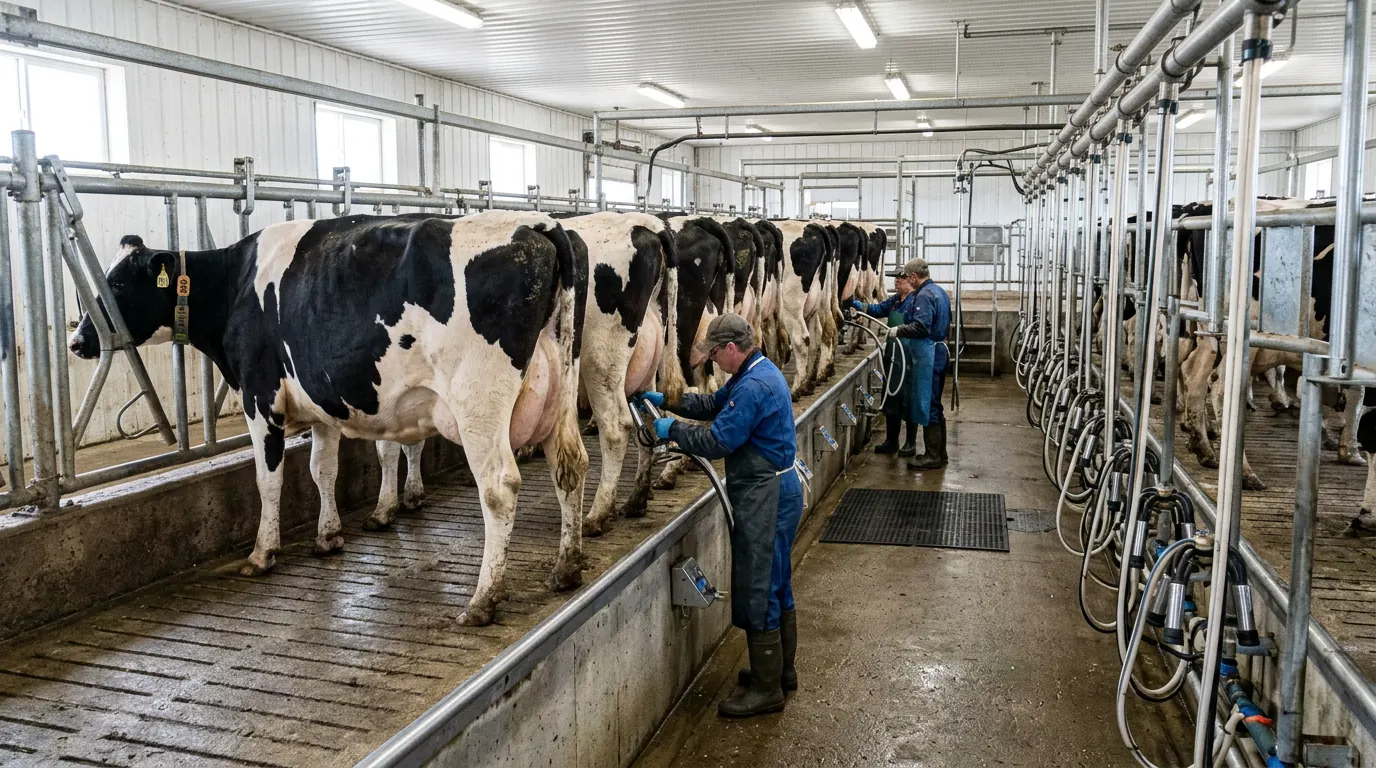
Jersey is a small dairy breed from the island of Jersey in the English Channel. The cows are light and short compared with Holstein-Friesians. Their milk is high in fat and protein. Jersey is not a beef breed. Its role in beef production is to be the mother of crossbreds: calves from a beef bull can reach a high fattening value.
Jersey in a beef system
Most often a jersey joins a beef herd as the mother of crossbred calves. IZ PIB (Poland's National Research Institute of Animal Production) describes a displacement crossing model: females of the starting breed are mated to a beef bull, and each generation of heifers carries more beef blood. In the example, by year four of the program you get offspring with over 90% beef blood. The scheme is shown for Polish Holstein-Friesian cows, but the principle is the same for any dairy breed. For a comparison of dairy and beef breeds, see our overview of dairy and dual-purpose cattle breeds.
Jersey cow traits
Body weight and size
Jersey is one of the smallest dairy breeds. Cows and heifers weigh clearly less than Holstein-Friesians, and their height at the withers is low. Exact weights depend on the line, feeding and age. Our sources have no figures for this breed, so we give none. To see how your animals grow, weigh them regularly and record the results in one place.
Breeding and choice of sire
A small mother and a large bull risk a difficult birth. In its Beef Manual, Teagasc (the Irish agriculture and food development authority) lists desirable bull traits such as a relatively short gestation, easy calving, fast growth and good feed efficiency. With jersey these traits matter more than with larger mothers, because a sire that is too big can lead to a hard calving.
Growth of the offspring
According to IZ PIB data from 2015 (table 5), Limousine bulls standardized to 210 days averaged 274.7 kg body weight and 1095 g daily gain. Jersey is not in that table, so we do not compare it directly with these values. They do show the growth level you can aim for in crossbreeding.
Choosing a bull for jersey mothers
Crossing generations
Consistent crossing with a beef breed gradually reduces the share of the starting breed. In the IZ PIB model, R1 heifers have up to 50% beef blood, R2 up to 75%, R3 up to 87.5% and R4 up to 93.7%. You can also stop at simple terminal crossing, which gives the F1 generation. The choice depends on your breeding goal and on whether the heifers stay in the herd.
Late-maturing sires
Teagasc ran trials at its Grange center. They show that heifers from the dairy herd work better as suckler cows when the sire is a late-maturing continental breed rather than an early-maturing British breed. Limousine × Friesian crossbreds grew faster throughout life and had better carcass yield, giving leaner and heavier carcasses. The result concerns Friesian cows, but it shows well the direction of selection.
Carcass yield
In an IZ PIB summary from 2011, bulls from crossing with a Piemontese sire reached a carcass yield of 60.22% at 12 months, against 57.54% in the control group. Meat production reached 128.3% of the control group. The mothers in that study were not jersey, but the result shows what the choice of sire breed can give. Before you choose a bull, compare his data with the results in your own herd.
Calf rearing and fattening crossbreds
Calf rearing
The KPODR Minikowo guide to rearing beef calves (KPODR is a regional agricultural advisory center in Poland) covers feeding, weight gain checks and hygiene when feeding milk. Council Directive 2008/119/EC sets minimum standards for the protection of calves. Its rules apply on your farm whatever the mother's breed, so jersey crossbreds must be kept like any other calves. Legal state of this description: 22.11.2026.
Feeding mothers and calves
In its Beef BRP Manual 5, AHDB (the UK levy board for beef and lamb) describes how to feed suckler cows and calves to improve economic results. A leaflet from OODR Łosiów on feeding beef cattle shows the basic rules for dosing roughage and concentrates. For jersey it is especially important that the mother is in good condition before calving, because a small cow easily loses weight in lactation.
Fattening and gains
When fattening crossbreds, daily gain and carcass yield count. A publication from ODR Lubań (a Polish agricultural advisory center) calculates income from beef cattle production at different intensity levels. Cattle prices change every week, so we do not give them. Check quotes with buyers and agricultural chambers, and compare feed costs with the results of your own production.
Herd health and the keeper's duties
Records and identification
Every animal must be registered and tagged as the rules require. The integrations with IRZplus (ARiMR's online animal register) and sensors let you keep animal data in one place. When crossbreeding, record the sire, dam and calving date of every crossbred, because without these data it is hard to judge the results of your selection.
Treatment and withdrawal periods
A vet always chooses the medicine and dose. After every treatment, record the product name, the date given and the withdrawal period. A tool for treatment and withdrawal records helps you watch the date before an animal goes to slaughter or milk goes to the buyer.
Infectious diseases
Lumpy skin disease (LSD) is an infectious disease that you must report to a vet. If you suspect it, do not wait for changes in the herd and do not move animals. A leaflet from PODR Szepietowo (a regional agricultural advisory center) describes the symptoms and what to do. The EFSA (European Food Safety Authority) opinion on cattle transport gives the rules you follow when sending animals to slaughter.
Jersey in a small organic herd
Suckler cows on an organic farm
On the organic Glinna farm at ZD IZ PIB Kołbacz (an experimental station of the institute), suckler cows are used only for breeding and rearing calves. The offspring and crossbreds are fattened. The target herd size is 180 head, including 80 suckler cows. This model shows that a small mother can be part of a full cycle, from breeding to fattening, as long as the herd is well planned.
Frequently asked questions
Is a jersey cow suitable for beef production?add
Jersey is a dairy breed, so it is not a fattening breed. It works well as the mother of crossbreds when you cross it with a beef bull. The result depends on the choice of sire and on feeding conditions.
How much does a jersey cow weigh?add
We have no confirmed figures for this breed. Weight depends on the line, age and feeding. It is best to weigh your own animals regularly and record the results.
What bull should I use on jersey heifers?add
With small mothers, easy calving and a shorter gestation matter. Teagasc points out that late-maturing continental breeds work better than early-maturing British breeds. It is worth discussing the choice of bull with a vet or an adviser.
How much does a jersey heifer cost?add
The price depends on origin, age, performance records and current demand. Prices change often, so we give no amounts. Check offers from breeders and breed clubs.
What rules apply to calf rearing?add
Council Directive 2008/119/EC sets minimum standards for the protection of calves. The rules apply whatever the mother's breed. Legal state of this description is 22.11.2026; check current rules in ISAP, Poland's legal acts database.
Sources & resources
- linkIZ PIB — WZ — Breed selection and breeding work in beef herds under organic conditions (P. Wójcik, A. Czubska)
- linkIZ PIB — WZ — 60 years of IZ work on beef cattle (J. Trela et al.), WZ XLIX(2011)4:11–56
- linkIZ PIB — WZ — Current state and prospects of beef cattle farming and breeding in Poland (H. Grodzki et al.), WZ LIII(2015)2:77–87
- linkTeagasc — Teagasc Beef Manual — Section 4: Breeding
- linkAHDB Beef & Lamb (UK) — Beef BRP Manual 5: Feeding suckler cows and calves for Better Returns
Prepared by: DlaFerm Team based on data from the sources listed · Publisher: INSTA-TECH sp. z o.o.
Do you keep a herd of mothers and crossbreds?
The <a href="/integracje-irzplus-czujniki">IRZplus and sensor integrations</a> and the <a href="/ewidencja-leczenia-i-karencja-lekow">treatment and withdrawal records</a> help you keep herd data in one place. Create a free DlaFerm farm account or get in touch, and we will show you how it works in practice.
Phone
+48 796 258 151