Polish Red cattle (polska czerwona): traits, breeding, finishing
In the list of letter codes kept by Poland's ARiMR (Agency for Restructuring and Modernisation of Agriculture), Polish Red cattle carry the code RP and count as a breed separate from other red cattle. We explain how to identify an animal from its papers, how to manage breeding and calf rearing, and what drives finishing results. We give only figures from IZ PIB publications (Poland's National Research Institute of Animal Production) and the other sources listed at the end.
verifiedFrom the team that has organised work on poultry farms for years.
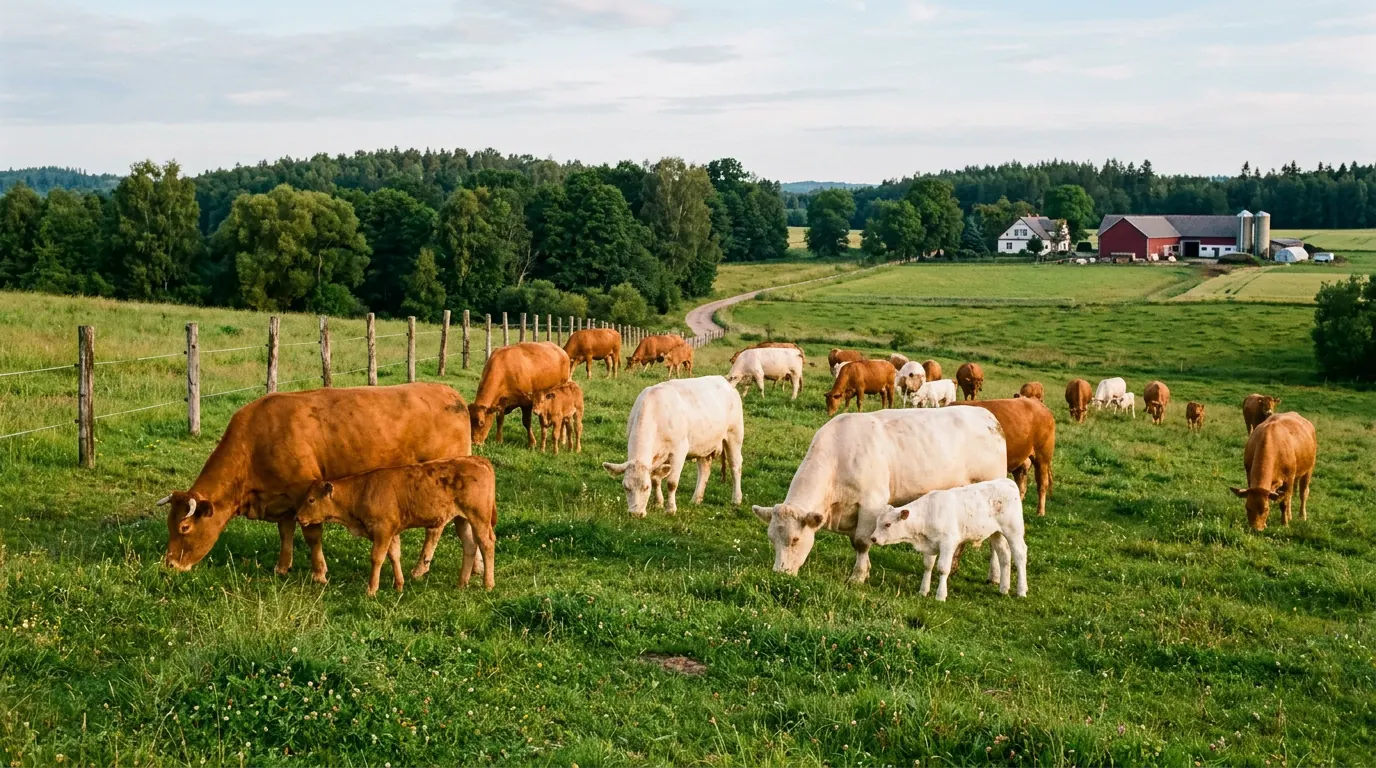
In the ARiMR list of letter codes, Polish Red cattle (polska czerwona, code RP) appear as a separate breed, not as generic "red cattle". For you as a keeper, this means the animal must be recorded as RP in its papers, in the herd register and at sale. Below we cover how the breed differs on paper, how to manage breeding and calf rearing, what drives finishing results and where to check the data. Farm management software makes it easier to record breed and origin.
A code in the list, not just a name
Next to RP, the ARiMR list has other codes for red cattle, including RE for "European red cattle (other varieties of the breed)" and ZR for "Polish Red-and-White" (polska czerwono-biała). Polish Red-and-White is a separate breed with its own code, so do not confuse it with RP. When you read a sale advert, ask for the code in the papers, not only the coat color. Color is only a hint. The breed is identified by pedigree and by the code in the register.
Breed traits and production type
Papers and performance assessment
Beef cattle breeding in Poland is assessed by, among others, the Polish Association of Beef Cattle Breeders and Producers (PZHiPBM), which also publishes results in summaries. What matters to you is that an animal with pedigree papers can be compared with other animals of the same breed. When buying, ask for the pedigree, data on the parents and the assessment result, if one exists. Without papers, treat the animal as a commercial animal, not a breeding animal.
Purebred or crossbred
IZ PIB summaries show that a large share of the female beef population is crossbred, and its numbers changed between 2007 and 2016. You choose crossing with beef breeds when the goal is faster gain or a set live weight. Base the decision on your goal: do you want purebred calves for further breeding, or live animals for finishing? When crossing, keep records on the sire and follow the requirements of the breeding program.
Before buying, check the animal's age and health, ear tags and identification documents, and conditions on the seller's farm. Compare the offer with the pedigree entries, because mismatches are a common reason for complaints. Talk to a vet about any doubts over herd health before transport.
Breeding, calving and calf rearing
Mating plan and calving dates
Record heat, mating and calving dates for every cow. Without these records it is hard to tell whether the herd calves in the planned period and which cows need watching. A leaflet from WMODR Olsztyn (an agricultural advisory center) on breeding in beef herds shows how such records tie into mating decisions. Plan your cycles in the placement planning module. Always consult a vet about difficult births and fertility problems.
Calf rearing
Calf rearing starts with first care after birth: a dry bed, colostrum and a check of condition. The KPODR Minikowo (an agricultural advisory center) guide on rearing beef calves describes these steps one by one. The binding calf protection standards come from Council Directive 2008/119/EC, and you can check the current national rules in ISAP (Poland's online legal acts database). Record every calf health event from day one.
Feeding cows and calves
Forage
Forage is the base of beef cow feeding: pasture, silage and hay. The Teagasc Beef Manual (section Nutrition) explains that forage quality decides how much concentrate you need to add. Before you build a ration, have your silage and hay tested in a laboratory. Feed by animal weight and production stage, not by eye. In storage, watch moisture, because losses are highest when silage is poorly made.
Dry period, pregnancy and lactation
A cow has different needs when dry and when in lactation. In late pregnancy, make sure she gets enough energy and protein. After calving, give her constant access to water and good forage. Cow condition at calving affects the birth and calf rearing. Set rations together with a nutrition adviser or a vet. Check feed stocks and silo levels in the feed silo monitoring module.
Finishing Polish Red cattle
Age at slaughter and dressing percentage
In IZ PIB studies on crossbreds out of Black-and-White cows and beef-breed bulls, the dressing percentage of young bulls finished up to 12 months of age was 57.54% in the control group and 60.18% in the group sired by a Piemontese bull. Finished up to 15 months, it was 57.81% and 61.98% respectively. The data come from a summary by J. Trela et al. in Wiadomości Zootechniczne (2011) and concern other breed combinations, not Polish Red. They do show that age at slaughter and choice of sire affect the result.
Gain and feed cost
Finishing profit depends on daily gain, feed used per kilogram of gain and the buying price of live animals. Buying prices change often, so we give no amounts. Check quotes with buyers and in market publications, and work out your result in the calculators for farmers. Note the weight at each weighing and the feed used in each batch, because without these data a calculation is guesswork.
Withdrawal period and treatment in finishing
Every medicine given to an animal has a withdrawal period, which decides when the meat may go to slaughter. A vet always chooses the medicine and dose, and you record the dates of treatment and the withdrawal period. Keep these records in the treatment and withdrawal module. Before sending a batch to slaughter, check the entries for each animal separately.
Herd health and reporting disease
Lumpy skin disease (LSD)
Lumpy skin disease (LSD) is an infectious disease described in a leaflet from PODR Szepietowo (an agricultural advisory center). If an animal has skin lesions, report it to a vet and do not wait for the signs to go away on their own. Do not give the animal any medicine yourself. Bring in new animals only after isolation and observation, and keep suspect animals apart.
Transport and welfare
EFSA opinions on the welfare of beef cattle, calves and transport point to the strain on animals at loading and on long journeys. For you this means calm handling, a prepared ramp and planning shorter trips. Write down your biosecurity rules in the biosecurity plan generator, and your register entries will show the history of the herd.
Frequently asked questions
What is the difference between the RP, RE and ZR breed codes?add
RP means Polish Red cattle in the ARiMR list. RE is European red cattle (other varieties of the breed), and ZR is Polish Red-and-White. Always check the code in the papers, not only the coat color.
How do you tell if an animal is purebred Polish Red?add
By its pedigree, identification documents and entry in the herd register. Coat color is not enough, because similarly colored animals can belong to other breeds. If in doubt, ask a breeders' association for confirmation.
How much do Polish Red cattle cost?add
The price depends on age, origin, pedigree and whether you buy a calf, a heifer or a cow. Amounts change over time, so check offers from breeders and breeders' associations, and current quotes from buyers.
When should beef cattle go to slaughter?add
It depends on body weight, condition and your production goal. IZ PIB data show that for finishing up to 12 and 15 months, dressing percentage differs with the origin of the animals. Agree the slaughter date with the buyer and check medicine withdrawal periods.
What should you do if you suspect lumpy skin disease?add
Report the suspicion to a vet at once and give the animal no medicine without their advice. Isolate suspect animals from the rest of the herd if you can. Record the date of the first signs in your register.
How do you keep records for a beef cattle herd?add
Record breeding, calving, calf rearing, feeding and treatment with dates and withdrawal periods. Having the data in one place makes it easier to check profitability and to answer inspectors' questions. DlaFerm.pl lets you keep these records in its farm management software.
Sources & resources
- linkARiMR — List of letter codes for cattle breeds
- linkIZ PIB — Livestock keeping and breeding over 70 years. Cattle Breeding Department, Sheep and Goat Breeding Department
- linkIZ PIB — WZ — 60 years of IZ work on beef cattle (J. Trela et al.), WZ XLIX(2011)4:11–56
- linkIZ PIB — WZ — New methods for assessing the performance and breeding value of beef breeds (Z. Choroszy et al.), WZ LVI(2018)3:17–23
- linkTeagasc — Teagasc Beef Manual — Section 6: Nutrition
- linkISAP — Poland's online database of legal acts, isap.sejm.gov.pl
Prepared by: DlaFerm Team based on data from the sources listed · Publisher: INSTA-TECH sp. z o.o.
Do you keep a beef herd and want breeding, treatment and withdrawal records in one place?
The farm management software in DlaFerm.pl lets you keep your herd records in one place. Create a free farm account and see how it works in practice.
Phone
+48 796 258 151