Pinzgauer cattle: a dual-purpose mountain breed
Pinzgauer is a breed from the Austrian Alps, kept for milk and beef. The animals are hardy, walk well on rough ground and cope on pasture. We describe the look, performance, needs and place of the breed in Polish farming.
verifiedFrom the team that has organised work on poultry farms for years.
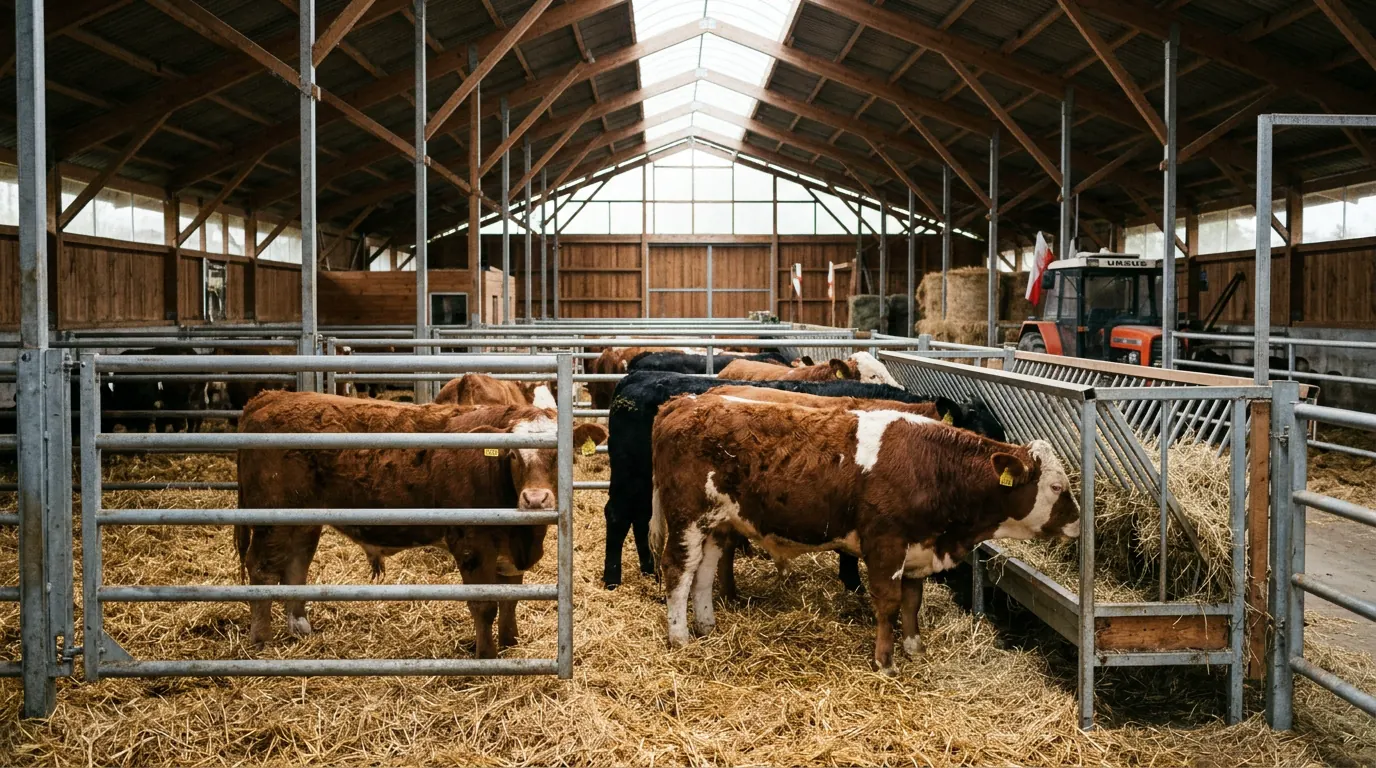
Pinzgauer is a dual-purpose cattle breed, kept for both milk and beef. It comes from the Pinzgau valley near Salzburg in Austria, a mountain region. It is rare in Poland, but it has its own code in the list of cattle breed codes kept by ARiMR (Poland's Agency for Restructuring and Modernisation of Agriculture): "PZ" (pinzgau). If you report an animal to the register, you must give the breed with this code.
Who this breed suits
Pinzgauer interests keepers who have pasture, meadows on poorer soils or rolling land, and want an animal less demanding than high-yielding Holsteins. It does not compete for the highest daily gain with beef breeds such as Limousin. Its strength is versatility: the cow gives milk for the calf or for processing, and fattened animals and culled cows give beef.
How to read this description
The breed is small in Poland, and results depend on the line and on farming conditions. Agree actual weights, yields and animal prices with the breeder you buy from, or with a breeders' association. You can compare other breeds in the breed catalog on DlaFerm.pl.
Where pinzgauer comes from
The Pinzgau valley in the Alps
The breed is named after the Pinzgau valley in the Austrian state of Salzburg. For centuries the cattle were kept on steep alpine pastures and grazed high in the mountains in summer. Selection by terrain and weather produced strong animals with good legs and hooves, resistant to cold and changeable weather. Simmental has a related Alpine origin. According to an IZ PIB monograph (Poland's National Research Institute of Animal Production), it descends from spotted mountain cattle of the Simme river valley in Switzerland and is now among the most popular breeds in the world.
The PZ code in registers
In the ARiMR list of letter codes, pinzgauer appears under the code "PZ" with the description "pinzgau". You will find it next to breeds such as "SM" (simental), "SL" (salers) and "GV" (gelbvieh). When you report to the animal register, enter the code from the current ARiMR list. Crosses with beef breeds and other cases have separate codes in the list, so check which one applies to your animal before reporting.
How to recognize a pinzgauer
Coat color and build
A pinzgauer has a dark, chestnut-brown body. A white band runs along the back and covers the belly and lower parts of the body, and the tail tip is sometimes white too. The head is usually dark. This sets the breed apart from Simmental, which has a body from light yellow to dark cherry and a white head. The frame is medium, the bone strong, and the legs lean and well set.
Look-alike breeds
From a distance a pinzgauer can be mistaken for other red or brown breeds, for example Polish Red or Salers. The pattern of white markings decides it: a band on the back and a white belly. When you buy, check the papers (pedigree and ear tags), not just the coat color.
Milk and beef performance
Milk and meat
Dual-purpose means the cow gives less milk than dedicated dairy breeds but more than beef breeds, and the carcass is well muscled. IZ PIB sources describe a similar pattern for Simmental: lower milk production than dairy breeds, but good fattening and slaughter performance and large, well-muscled carcasses without excess fat. Pinzgauer results depend on the line and conditions, so ask the breeder for the performance recording results of his herd.
Where it fits on a farm
The breed works where balance matters: a farm with its own forage and no heavy feeding of grain meal. For milk, compare it with dairy and dual-purpose breeds. For beef, check whether fattened crosses with a beef breed would give you a better result. Make that comparison with your own numbers: feed cost, gains and selling price.
Needs and management
Pasture and terrain
Animals shaped in the mountains cope well with grazing on uneven ground and with weather changes. Set stocking rates by pasture quality. According to IZ PIB data from organic farms, the permitted number of animals per hectare depends on paddock quality (very good, average, poor), on body weight and on fertilization, and dry matter yield falls as sward quality falls. On a poor paddock the stocking rate is clearly lower than on a very good one, so do not plan the herd by area alone.
Feeding
A dual-purpose cow needs more energy during lactation than a beef cow. Build the ration from forage: green fodder, haylage and hay, and add concentrates according to yield and body condition. Have the forage analyzed in a laboratory and set the ration with an adviser from an ODR (Poland's agricultural advisory center). Guides from OODR Łosiów and AHDB for suckler cows set out feeding rules for cows and calves in each phase of the cycle.
Calving and calf rearing
For calf rearing, follow the ODR guides and Directive 2008/119/EC on protecting calves. The calf should get colostrum in the first hours of life and needs a dry, warm place in the first weeks. When you buy young animals, not just calves, also check the health status of the herd they come from.
Registers, buying and profitability
Buying animals
You can buy pinzgauer from breeders who specialize in mountain breeds, often abroad. When you import from another EU country, check the health certificates and the requirements of the Veterinary Inspection (Inspekcja Weterynaryjna) on the GIW website (Poland's Chief Veterinary Inspectorate). Price depends on age, origin, herd book entry and herd health, so agree it directly with the breeder. Do not rely on an average from adverts.
Place in Polish statistics
In the 2016 PZHiPBM summary (Polish Association of Beef Cattle Breeders and Producers), quoted in "Wiadomości Zootechniczne", Limousin dominates the purebred beef population with 70% of cows, followed by Charolais (12%), Hereford (6%) and Simmental (6%). Pinzgauer is not singled out in this summary, which confirms that in Poland it is a niche breed. For you that means fewer animals for sale and fewer market reference points.
How to work out profitability
With a rare breed you work out profitability yourself, from your own costs and prices. Record calf gains, feed use, cow milk yield and treatment costs. A sample beef income calculation published by ODRs shows how the result changes at different intensity levels. Set your own data against such a model before you buy a herd.
Frequently asked questions
Where does the pinzgauer breed come from?add
Pinzgauer comes from the Pinzgau valley in the Austrian state of Salzburg. The breed was shaped in the mountains under harsh climate conditions, which explains its hardiness and good legs.
Is pinzgauer a dairy or a beef breed?add
It is a dual-purpose breed: it gives milk and beef. Milk yield is lower than in dedicated dairy breeds, and gains are lower than in specialized beef breeds such as Limousin. Its strengths are versatility and good use of pasture forage.
What breed code does pinzgauer have at ARiMR?add
In the ARiMR list of letter codes, pinzgauer has the code "PZ" (pinzgau). Always check the current list on the ARiMR website before reporting an animal to the register.
What does pinzgauer cattle look like?add
It has a dark, chestnut-brown body with a white band along the back and a white belly. The frame is medium and the bone strong. A dark head tells it apart from Simmental, which has a white head.
How much does a pinzgauer calf or cow cost?add
Prices depend on age, origin, herd book entry and herd health. For a rare breed there is no single price listing, so agree the price directly with the breeder or through a breeders' association.
Is pinzgauer suitable for organic farming?add
The breed copes well with pasture and extensive farming, so it can suit an organic farm. Set stocking rates by pasture quality and check feeding rules in IZ PIB materials on organic farming. Confirm certification details with your certification body.
Sources & resources
- linkARiMR — List of letter codes for cattle breeds
- linkIZ PIB — Farm animal keeping and breeding over 70 years. Cattle Breeding Department, Sheep and Goat Breeding Department
- linkIZ PIB — WZ — New methods of assessing the performance and breeding value of beef cattle (Z. Choroszy et al.), WZ LVI(2018)3:17–23
- linkIZ PIB — WZ — Feeding beef cattle in organic farming (K. Bilik et al.)
- linkZPE / MEiN (Integrated Educational Platform) — Farm animal breeds, interactive atlas (e-material ROL.11)
Prepared by: DlaFerm Team based on data from the sources listed · Publisher: INSTA-TECH sp. z o.o.
Do you keep a cattle herd and want your data in order?
The DlaFerm module for IRZplus (ARiMR's online animal register) and sensor integrations helps you keep animal data in one place. Create a free farm account or get in touch.
Phone
+48 796 258 151