Ayrshire cattle: the Scottish dairy breed
Ayrshire is a dairy breed from the county of Ayrshire in south-west Scotland. You can spot it by its red and white coat and lyre-shaped horns. We describe its traits, its needs and how it compares with other breeds.
verifiedFrom the team that has organised work on poultry farms for years.
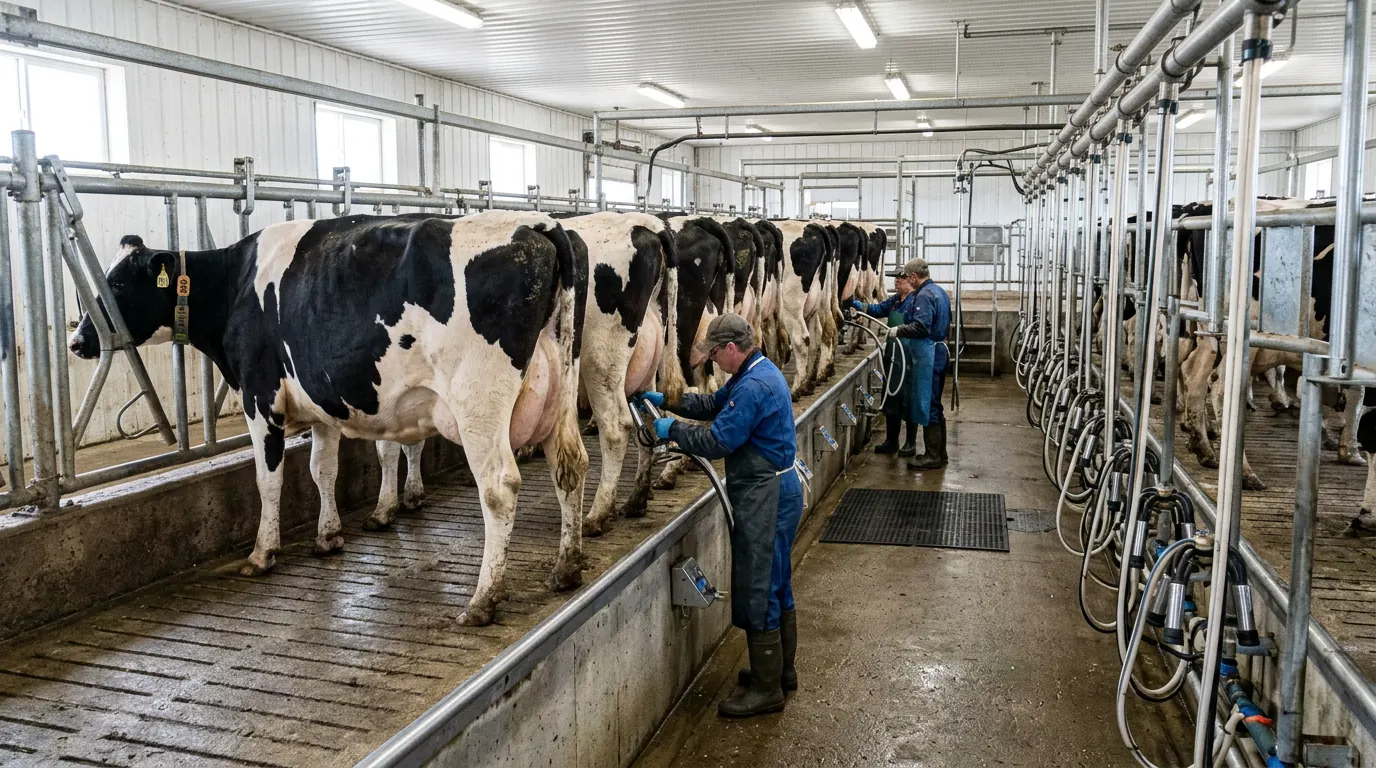
Ayrshire is a Scottish dairy breed, developed in the county of Ayrshire in south-west Scotland. It is a medium-sized cow, smaller and lighter than a typical Holstein-Friesian. Farmers value it for making good use of pasture, for its longevity and for coping with harsher conditions. In Poland's system for marking cattle breeds it has the letter code "AY", which you will find in the list published by ARiMR (Agency for Restructuring and Modernisation of Agriculture).
Who this breed suits
Ayrshire works where milk comes from grass rather than from a high-protein ration with lots of concentrate. It suits a farmer who has pasture and wants cows to stay in the herd for a long time. If you want record yield from each cow, compare it with other breeds in our guide to dairy and dual-purpose cattle breeds.
Yields and prices: where to get the data
We do not give specific milk yields or prices for calves and heifers. They depend on the breeding line, the country of origin, the season and performance evaluations. Take the figures you need for a purchase from the documents of the individual animal and from the breeding organization.
Where Ayrshire comes from and how to recognize it
Scottish roots
The breed was developed in Ayrshire, a region with a damp, cool climate and poorer soils than the lowlands of Europe. Selection favored cattle that tolerate rain, wind and modest pasture and still give milk. That is why farmers describe the breed as hardy, with lower feed demands than high-yielding cows. The breed was later exported to many countries with cooler climates.
Looks and coat
Ayrshire has a red and white coat: red, brown or mahogany patches on a white background, with sharp, clear edges. The horns are distinctive. They curve upward and outward in a lyre shape, as the breed standards describe them. In Poland some farmers dehorn according to herd management rules, but you will always see the horns in breed catalogs and photos. The udder is usually well attached and the teats even, which makes milking easier.
Size
This is a medium-sized breed. It is lighter than Holstein-Friesian and heavier than Jersey. Thanks to lower body weight, the cow damages the sward less on wet pastures, and the barn can be a little tighter. When planning stalls, still check the dimensions of the actual animals on site.
Milk and production traits of Ayrshire
Milk
Breed descriptions say Ayrshire gives milk with good composition, suitable for cheese and other dairy products. Yield is moderate, lower than the best Holstein-Friesian lines, but more even across the lactation. Take exact figures from the performance evaluation of the line and from the animal's documents, not from general tables. If you plan to sell milk to a dairy, ask whether it pays for protein and fat content.
Fertility and longevity
Ayrshire breeders stress easy calving, good mothering and cows that stay in the herd for many lactations. Longer use lowers the cost of replacing stock, because you buy or rear fewer replacement heifers. Remember that this is an opinion about the breed, not a guarantee for every animal. When buying, the history of the specific herd, the fertility record and udder health count.
Hardiness and hooves
The breed has a reputation for toughness. It tolerates cold and damp well, and the hooves have a favorable build, which lowers the risk of lameness on pasture. Still, check hooves, udder and body condition regularly, as with any breed. Treatment is always decided by a vet, who chooses the medicine and dose and gives the withdrawal period for milk and meat.
Pasture, feed and housing
Grazing system
Ayrshire does best in a system with a long grazing season and a good sward. Pasture lowers feed costs, and the cows get exercise that supports leg health. Pasture quality and stocking rate decide how much grass a cow eats. For beef cattle, IZ PIB (Poland's Institute of Animal Science, National Research Institute) gives approximate dry matter intake of about 14 kg per day for young fattening cattle. For dairy cows these figures depend on body weight and stage of lactation, so work out the ration with a feeding adviser.
Winter feeding
In winter you need good silage, hay and concentrate matched to the level of milk. A cow in good condition from the grazing season goes into winter more easily. Do not overfeed animals that give less milk, because fatness makes calving harder and lowers fertility. Score body condition several times a year and record it for each cow.
Barn and water
Barn requirements are the same as for other dairy breeds: dry, clean bedding, fresh water and comfortable cubicles. For Ayrshire-type cows, check the width of stalls and barriers, because smaller animals sometimes turn around in tight spots. Set the height of drinkers to suit the size of your cows.
Ayrshire in Poland and in herd records
Breed code in the register
In ARiMR's list of letter codes for marking cattle breeds, Ayrshire has the code "AY". The same list covers other dairy and beef breeds, for example "JE" for Jersey, "MO" for Montbeliarde and "SM" for Simmental. You must enter the correct breed code when you report an animal, so check it before registering an animal bought abroad. If in doubt, ask at your local ARiMR office. For tips on registers and systems, see our description of integrations with IRZplus, ARiMR's online animal register.
Scale of breeding
The breed is far less popular here than Holstein-Friesian. For comparison, in Poland's beef cattle evaluation, according to PZHiPBM (Polish Association of Beef Cattle Breeders and Producers) data from 2016 described by IZ PIB, Limousine made up 70% of cows in the purebred population, Charolaise 12%, and Hereford and Simmental 6% each. These are beef figures, not dairy, but they show that niche breeds have a small breeding base. With Ayrshire, expect a smaller choice of bulls and a longer search for genetic material.
Where to get animals
The safest option is to buy from a registered breeder who can provide the pedigree and performance results. Check that the animal has ear tags, a passport and an entry in the register. Ask for test results for diseases reported in cattle herds. The county veterinary officer (powiatowy lekarz weterynarii) can explain the veterinary requirements in force.
Ayrshire compared with other breeds
Other dairy breeds
Compared with Jersey, Ayrshire is larger and heavier, while Jersey is a smaller cow with very rich milk. Montbeliarde is a dual-purpose breed from France with a red and white coat, more typical for milk and meat together. Among Polish breeds, look at Polish Red (polska czerwona), which has similar needs and a much wider breeding base in Poland.
Crossing with beef breeds
Calves from an Ayrshire cow and a beef bull, for example Limousine or Charolaise, can be reared for beef. Crossbreds usually carry more muscle than a purebred dairy animal, but results depend on the bull, feeding and the age at sale. Judge profitability with your own calculation and the calculators of ODR (Poland's agricultural advisory centers).
What to check before buying Ayrshire
Check in turn: the animal's documents and pedigree, the register entry and the breed code "AY", the performance results of the dam and sire, the condition of the udder and hooves, the treatment history with withdrawal period records, and tests for infectious diseases recommended by a vet. Ask the breeder how the herd was fed and whether the cows went out to pasture. If you import animals from another country, confirm the veterinary and transport requirements, and check the legal position on the website of the Chief Veterinary Inspectorate (Główny Inspektorat Weterynarii). For a larger purchase, compare several offers, because prices depend on line, age and evaluations. The market changes fast, so prices quoted in an article go out of date quickly. For treatment records, see treatment and withdrawal records.
Frequently asked questions
What is the Ayrshire cattle breed?add
It is a Scottish dairy breed from the county of Ayrshire. It has a red and white coat and lyre-shaped horns, is medium-sized and makes good use of pasture. In Poland's cattle register it is marked with the code "AY".
What breed code does Ayrshire have in the register?add
According to ARiMR's list of letter codes, Ayrshire has the code "AY". You enter the code when you register the animal. If in doubt, ask at your local ARiMR office.
Is Ayrshire a dairy or a beef cow?add
Ayrshire is a dairy breed. Beef is not its main purpose, but calves from crossing with a beef bull can be reared for beef. For beef cattle, farmers usually choose breeds such as Limousine or Hereford.
How is Ayrshire different from Jersey?add
Ayrshire is larger and heavier than Jersey and has a red and white coat with clear, sharp patches. Jersey is a small cow with a uniform light brown coat and very rich milk. Both do well on pasture.
Is Ayrshire popular in Poland?add
No. It is far less common than Holstein-Friesian in Poland. Access to bulls and heifers can be limited, so start by contacting the breeding organization and proven breeders.
What should I check when buying an Ayrshire cow?add
Check the documents, pedigree, performance results, the condition of udder and hooves, and the treatment history with withdrawal periods. Ask for test results recommended by a vet.
Sources & resources
- linkARiMR — List of letter codes for marking cattle breeds
- linkIZ PIB — Wiadomości Zootechniczne — New methods of evaluating performance and breeding value of beef cattle (Z. Choroszy et al.), WZ LVI(2018)3:17–23
- linkIZ PIB — WZ — Feeding beef cattle in organic farming (K. Bilik et al.)
- linkZPE / MEiN (Integrated Educational Platform) — Farm animal breeds, interactive atlas (e-material ROL.11)
- linkChief Veterinary Inspectorate (Główny Inspektorat Weterynarii) — gov.pl/web/wetgiw
Prepared by: DlaFerm Team based on data from the sources listed · Publisher: INSTA-TECH sp. z o.o.
Do you keep a cattle herd and treat animals?
The "Treatment and withdrawal" module in DlaFerm lets you record treatments and track withdrawal periods in one place. See <a href="/ewidencja-leczenia-i-karencja-lekow">treatment and withdrawal records</a>, create a free farm account or get in touch.
Phone
+48 796 258 151